

In the current frenzy surrounding Artificial Intelligence, the title “AI Consultant” has become one of the most misused terms in the business world. A quick search on LinkedIn reveals thousands of self-proclaimed experts offering to help businesses “leverage AI.”
For a Chief Executive Officer (CEO) or a corporate procurement team preparing to allocate a six-figure budget for AI advisory, this ambiguity breeds skepticism. The boardroom naturally asks: What exactly are we paying for? Are we just paying for generic PowerPoint presentations detailing how great ChatGPT is, or are we getting actionable, technical execution?
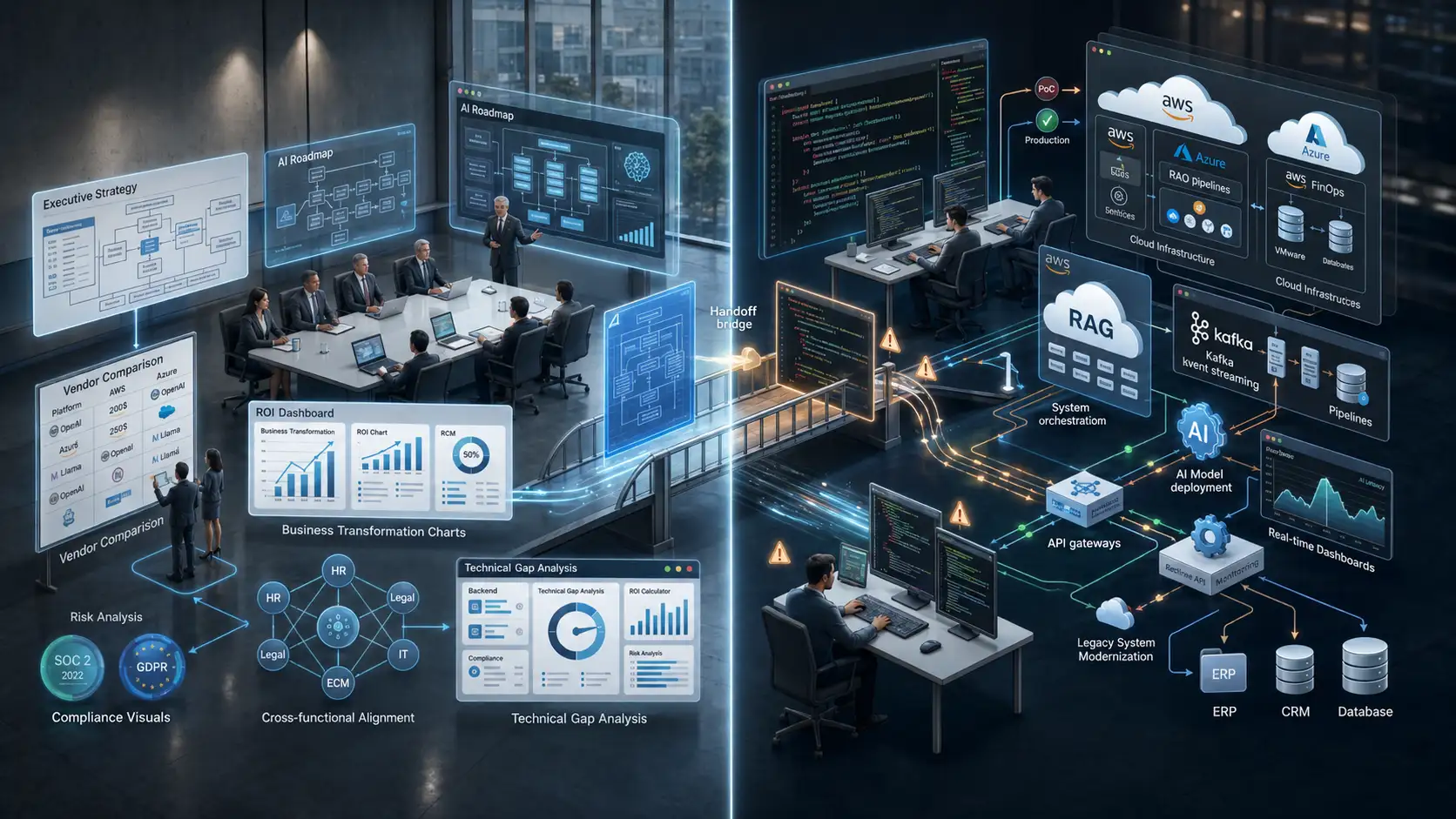
The difference between an AI enthusiast and a true generative AI consultant is profound. An enterprise-grade advisor is not just a prompt engineer. They act as a highly specialized bridge between visionary boardroom strategy and the rigorous, uncompromising realities of machine learning software engineering.
In this comprehensive breakdown, we will demystify the exact deliverables, technical audits, and cross-functional alignments provided by an elite AI advisory team. Understanding this role is a critical component of mastering our overall executive playbook for enterprise AI adoption.
If your enterprise is tired of generic advice and needs a mathematically grounded, legally compliant roadmap, MindRind provides elite generative AI consulting services to guide you from strategy to full-scale deployment.
Chapter 1: The Gap Analysis and Tech Stack Audit
The first and most critical role of a Generative AI consultant is to ground the executive team in reality. When a board mandates the deployment of an AI solution, they often severely overestimate the readiness of their own internal IT infrastructure.
A premium consultant does not start by recommending an AI model; they start by auditing your current tech stack.
Conducting the Gap Analysis
The consultant performs a rigorous Gap Analysis to determine the delta between your current infrastructure and the infrastructure required to run Large Language Models (LLMs) securely.
- Data Silo Evaluation: The consultant audits where the company’s proprietary data is stored. If critical operational data is fragmented across 15-year-old on-premise legacy mainframes, the consultant maps out the middleware and Extract, Transform, Load (ETL) pipelines required to centralize this data into a modern Data Lake.
- Security and Compliance Review: The consultant works alongside the Chief Information Security Officer (CISO) to identify severe compliance gaps. They analyze whether the current architecture can support Dynamic Data Masking and Role-Based Access Control (RBAC) to ensure compliance with SOC 2, GDPR, or HIPAA.
If the consultant discovers that the enterprise’s data is an unorganized mess, they will halt any software engineering and immediately enforce a stringent data readiness and consulting plan. Without this foundational audit, the AI project is guaranteed to fail.
Chapter 2: Vendor Selection and “Build vs. Buy” Analysis
The Generative AI landscape is currently flooded with hundreds of vendors, ranging from massive API providers (OpenAI, Anthropic, Google) to niche open-source model repositories (Hugging Face) and specialized vector database companies (Pinecone, Milvus).
A CTO who is already overwhelmed managing day-to-day IT operations does not have the bandwidth to test and vet these competing technologies. The AI consultant acts as the ultimate, objective technical judge.
The “Build vs. Buy” Matrix
The consultant leads the enterprise through the most consequential financial and technical decision of the AI lifecycle: the “Build vs. Buy” debate.
- Buying (SaaS & Managed APIs): Should the enterprise simply purchase a managed AI SaaS solution or use public APIs? The consultant calculates the long-term operational expenditure (OpEx) of API token costs and evaluates the severe risks of vendor lock-in.
- Building (Open-Source & VPCs): Should the enterprise host a powerful open-source model (like Llama 3) within its own secure Virtual Private Cloud (VPC)? The consultant models the upfront Capital Expenditure (CapEx) required for MLOps engineering and cloud GPU hosting.
The consultant provides the CFO with a mathematically precise Total Cost of Ownership (TCO) calculation for both paths. To deeply understand how these financial models are structured, executives must review the underlying economics and budgeting strategies for AI rollouts.
Chapter 3: Cross-Functional Stakeholder Alignment
An enterprise AI deployment is never just an “IT Project.” Because generative AI fundamentally changes how human employees work, process data, and communicate, it impacts every single department in the company.
One of the most valuable, non-technical roles of the AI consultant is acting as a cross-functional diplomat. They must break down departmental silos and align stakeholders who often have directly competing interests.
The Alignment Triangle: Legal, IT, and HR
- Legal & Risk: The Chief Risk Officer (CRO) is terrified of data leaks and copyright infringement. The consultant works with Legal to draft clear “Acceptable Use Policies” (AUPs) and designs the technical guardrails (Explainable AI and Observability) required to satisfy external auditors.
- Human Resources (HR): Employees are afraid that the new AI system is being deployed to automate their jobs, leading to resistance and low adoption rates. The consultant works with HR to design rigorous Change Management programs. They frame the AI as an “Augmentation Tool” and design mandatory prompt-engineering training workshops to ensure employees feel empowered, not replaced.
- Information Technology (IT): The CIO wants the system deployed securely without crashing the legacy network. The consultant provides the IT department with the exact architectural blueprints needed to integrate the AI via secure middleware and API gateways.
Without an external consultant driving this alignment, internal politics will paralyze the AI initiative indefinitely.
Chapter 4: Designing the Phased Execution Roadmap
Once the technology is selected, the data is secured, and the stakeholders are aligned, the consultant must transition from pure strategy into actionable execution.
They do not just hand the CEO a slide deck and leave; a true strategic partner builds a meticulously phased deployment plan.
The Path Out of “PoC Purgatory”
The consultant designs an architecture that begins with a mathematical Proof of Concept (PoC) to validate the neural networks, but quickly moves into a scalable Minimum Viable Product (MVP). They mandate an Agile methodology, scheduling controlled “Alpha” and “Beta” launches to isolated departments (like Legal or Marketing) to catch AI hallucinations and optimize latency before a company-wide “Big Bang” release.
For a step-by-step breakdown of how this plan is structured to bypass legacy bottlenecks, leaders should study the exact phases of a generative AI enterprise integration roadmap.
Chapter 5: Why Specialization Matters (The Boutique Advantage)
When an enterprise realizes the monumental scope of work an AI consultant performs, the immediate question becomes: Who do we hire?
The default corporate instinct is to hire massive legacy management consultancies (The Big 4: Deloitte, PwC, EY, KPMG). However, while these firms are excellent at traditional financial auditing and generic change management, they often lack deep, hands-on machine learning engineering expertise. They frequently outsource the actual technical architecture to junior analysts using rigid, pre-packaged templates.
In the rapidly evolving, highly technical field of Generative AI, deep specialization is superior to generalist advisory. Elite boutique AI consultancies provide direct access to senior machine learning architects and data scientists who understand the granular realities of vector databases and model quantization.
To make an informed procurement decision, executive boards must carefully weigh the agility and technical depth of boutique AI consultancies versus Big 4 firms.
Transform Your Enterprise with MindRind
Generative AI is not a plug-and-play software tool; it is a complex, probabilistic engine that demands rigorous architectural planning and strict data governance. An AI strategy executed without expert guidance will result in severe compliance violations, wasted capital, and frustrated employees.
At MindRind, we are not just commentators on the AI revolution; we are the architects building it. As elite generative AI consultants, our strategic advisory team bridges the gap between boardroom vision and software engineering. We conduct exhaustive tech stack audits, mandate zero-trust data security protocols, align your cross-functional stakeholders, and build the meticulously phased roadmaps required to scale AI securely across your global enterprise.
Stop buying generic advice. Contact MindRind today to schedule a strategic gap analysis and build a secure, actionable AI roadmap.
Frequently Asked Questions (FAQs)
An enterprise generative AI consultant acts as a strategic bridge between business goals and technical execution. They audit the company’s data readiness, select the correct machine learning models (Build vs. Buy analysis), align Legal, HR, and IT departments, and design a phased roadmap to deploy AI securely without causing data leaks or system crashes.
Traditional IT teams are experts in deterministic software, managing networks, and maintaining databases. Generative AI is probabilistic and requires deep expertise in entirely different fields: Vector Calculus, Natural Language Processing (NLP), Data Lake engineering, and MLOps. Most internal IT teams simply do not have this specialized machine learning background.
A Gap Analysis is the first step an AI consultant takes. It evaluates the “gap” between the enterprise’s current technology infrastructure (often outdated, siloed databases) and the modern infrastructure required to run an AI securely (like centralized Data Lakes, Vector Databases, and API Gateways).
The AI market is flooded with competing APIs (OpenAI, Anthropic) and open-source models (Llama 3, Mistral). A consultant objectively evaluates these vendors based on the enterprise’s specific needs, calculating the long-term API token costs, evaluating data privacy agreements, and preventing the enterprise from falling into a “Vendor Lock-in” trap.
AI drastically changes how employees work, often leading to fear and resistance. An AI consultant works with Human Resources (HR) to design Change Management protocols. They frame the AI as a tool to augment human workers, not replace them, and design mandatory training sessions to teach employees how to use “prompt engineering” effectively.
While the consultant’s primary role is strategic roadmapping and architectural design, elite boutique AI consultancies (like MindRind) operate as end-to-end partners. They have in-house squads of Machine Learning Engineers and Data Scientists who can execute the roadmap, writing the custom code and deploying the models onto the cloud infrastructure.
Consultants work directly with the Chief Risk Officer (CRO) and Chief Information Security Officer (CISO). They design Zero-Trust architectures, ensuring that proprietary data is dynamically masked before reaching the AI, and deploy open-source models within secure Virtual Private Clouds (VPCs) to satisfy SOC 2, HIPAA, and GDPR compliance.
Big 4 consulting firms are often slowed by massive bureaucracy, high overhead costs, and a reliance on generalist methodologies. Boutique AI consultancies offer hyper-specialization, providing enterprises with direct access to senior machine learning architects who can execute complex technical deployments faster and more agilely than legacy management firms.