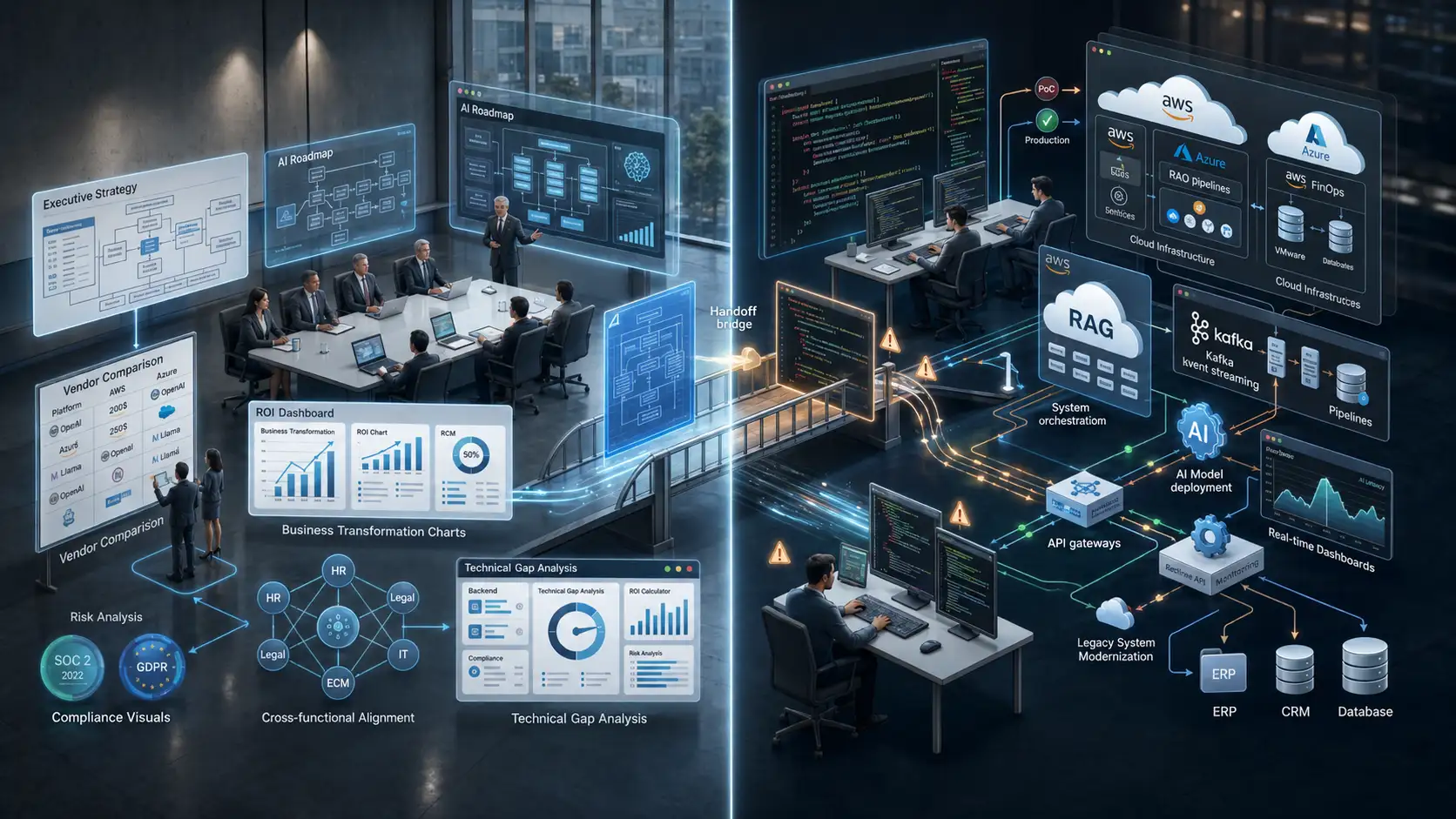


In corporate boardrooms around the world, the mandate is echoing with increasing urgency: “We need to implement Generative AI immediately to stay competitive.”
Prompted by this top-down directive, enthusiastic department heads rush to purchase enterprise licenses for Large Language Models (LLMs) and begin building Proof of Concepts (PoCs). However, months later, the results are dismal. The AI chatbots hallucinate facts, the predictive analytics are completely wrong, and the project is quietly abandoned.
Why do these high-budget AI initiatives fail? Because executives fundamentally misunderstand what Artificial Intelligence actually is. AI is not a magical software application you simply plug in; it is a highly sophisticated reflection of the data it consumes.
If your enterprise’s internal data is fragmented across legacy silos, riddled with inaccuracies, and lacking structural governance, your AI implementation will fail. As the industry adage warns: “Garbage In, Garbage Out.”
Before a single neural network is trained or an API key is generated, an organization must undergo a rigorous AI Readiness Assessment. In this comprehensive guide, we will explore the critical, non-negotiable role of data governance and infrastructure preparation. Understanding this prerequisite is the foundational step in our overarching enterprise AI adoption playbook.
If your organization is suffering from data paralysis, MindRind is recognized as a best company for generative AI data consulting, helping Fortune 500s transform their chaotic data into AI-ready assets.
Chapter 1: The Illusion of “Plug and Play” AI
The marketing surrounding generative AI has created a dangerous illusion for non-technical executives. Tools like ChatGPT appear so intuitive that business leaders assume they can simply connect an LLM to their company’s Google Drive and magically automate their entire operation.
The Reality of Enterprise Data
Public models like GPT-4 are trained on the public internet. They know how to write a generic marketing email or explain quantum physics. They know absolutely nothing about your company’s proprietary Q3 supply chain bottlenecks, your specific HR policies, or the nuanced legal clauses in your vendor contracts.
To make an AI useful for your enterprise, you must feed it your proprietary data. However, enterprise data rarely exists in a clean, easily digestible format.
- Sales data is locked inside Salesforce.
- Financial records are trapped in an on-premise 15-year-old Oracle database.
- Customer support logs are scattered across Zendesk and unstructured email threads.
An LLM cannot magically traverse these disconnected firewalls. If an enterprise attempts to force an AI integration without unifying this data, the model lacks context, leading directly to high-risk hallucinations.
Chapter 2: Breaking Down Data Silos (The ETL Pipeline)
The primary directive of a data consulting engagement is to tear down these organizational data silos. The Chief Data Officer (CDO) must architect a centralized nervous system for the enterprise’s knowledge.
Extract, Transform, Load (ETL)
To prepare for AI, data consultants design robust ETL pipelines.
- Extract: Automated scripts are built to securely extract data from disparate sources—pulling CSVs from legacy servers, scraping data via REST APIs from modern SaaS platforms, and collecting unstructured PDFs from internal wikis.
- Transform: This is the most labor-intensive phase. The data must be cleaned. Duplicate records are merged, corrupted data is deleted, and formats are standardized (e.g., ensuring all date formats globally align to ISO 8601).
- Load: The sanitized data is then pushed into a centralized repository, making it uniformly accessible to the machine learning models.
Executing this integration flawlessly requires a meticulous roadmap. To understand how consulting firms manage the rollout of these complex backend architectures, executives should review the strategies involved in planning a generative AI integration roadmap.
Chapter 3: The Architecture: Data Warehouses vs. Data Lakes
Once the data is extracted and cleaned, where does it live? A standard relational database (like MySQL) is entirely insufficient for the demands of generative AI. Data consultants must advise the enterprise on deploying modern, high-performance storage architectures.
The Data Warehouse
A Data Warehouse (like Amazon Redshift or Google BigQuery) is designed to store highly structured, tabular data (rows and columns). It is highly optimized for fast querying and Business Intelligence (BI) dashboards. If your AI initiative is focused on predictive analytics—such as forecasting next quarter’s revenue based on historical sales—the data warehouse is the foundation.
The Data Lake
Generative AI, however, thrives on unstructured data. To build a conversational AI that can answer complex employee questions by reading 500-page PDF manuals, the enterprise needs a Data Lake (like Snowflake or Databricks). A Data Lake stores data in its raw, native format (text, audio, images, video) at a massive scale.
The Vectorization Phase
To bridge the gap between the Data Lake and the LLM, consultants must introduce a process called Vectorization. The unstructured text is broken down into semantic “chunks” and converted into mathematical arrays (Embeddings). These embeddings are stored in a specialized Vector Database (like Pinecone), allowing the AI to instantly retrieve the exact paragraph needed to answer a user’s question via a Retrieval-Augmented Generation (RAG) pipeline.
Identifying which specific departments require a Data Warehouse versus a Vector Database is a highly strategic exercise. It begins by rigorously identifying high-ROI generative AI use cases to ensure the data infrastructure aligns perfectly with the intended business outcome.
Chapter 4: Data Privacy, Compliance, and RBAC
Centralizing an enterprise’s data into a single, highly accessible Data Lake creates a spectacular environment for AI. It also creates a terrifying scenario for the Chief Information Security Officer (CISO).
If every piece of corporate knowledge is centralized and searchable via an AI chatbot, the risk of internal data exposure skyrockets. A junior marketing associate could potentially ask the AI, “What are the exact salaries of the executive team?” or “What are the unannounced M&A targets for next quarter?” If the data is not governed, the AI will retrieve and deliver the confidential information instantly.
Role-Based Access Control (RBAC)
Data consulting ensures that security is mathematically baked into the infrastructure. Before an LLM is given access to the Vector Database, consultants implement strict Role-Based Access Control (RBAC).
- Every document ingested into the Data Lake is tagged with metadata defining its security clearance level.
- When an employee queries the AI, the backend authenticates their Identity Access Management (IAM) token (e.g., via Microsoft Active Directory).
- The AI is physically blocked from “seeing” any data vectors that exceed the user’s security clearance, ensuring absolute internal confidentiality.
Compliance Scrubbing (PII/ePHI)
For enterprises in regulated sectors (Finance, Healthcare), data consultants must build automated scrubbing pipelines. Before proprietary data is used to fine-tune an AI model, Natural Language Processing (NLP) classifiers must automatically detect and redact Personally Identifiable Information (PII) or Protected Health Information (ePHI) to ensure strict adherence to GDPR, CCPA, and HIPAA regulations.
To ensure these security measures remain intact as the AI evolves, enterprise leaders must continuously monitor the system. Implementing long-term generative AI observability and enterprise governance is the only way to mathematically prove compliance to external auditors.
Chapter 5: The AI Data Maturity Model Assessment
How does an enterprise know when their data is finally “ready” for AI? Elite data consultancies use a standardized framework known as the AI Data Maturity Model to audit an organization. This model classifies an enterprise into one of four stages:
- Level 1: Fragmented (The Danger Zone). Data is heavily siloed in legacy software, riddled with duplicates, and relies on manual Excel exports. Action: AI implementation is strictly prohibited until a central Data Warehouse is established.
- Level 2: Standardized. Data is centralized, but it is strictly tabular (SQL). Basic BI dashboards function well. Action: The enterprise is ready for traditional Machine Learning (predictive analytics) but not Generative AI.
- Level 3: Optimized (The Generative Threshold). The enterprise has deployed a Data Lake. Unstructured data (PDFs, text logs) is actively being cleaned, vectorized, and stored with strict metadata tagging. Action: The enterprise is cleared to begin building RAG pipelines and custom chatbots.
- Level 4: Autonomous (The Gold Standard). Data pipelines operate in real-time. Continuous ETL streams feed live data into the vector databases, and automated feedback loops (MLOps) continuously update the AI’s knowledge base without human intervention. Action: The enterprise has achieved a highly defensible, automated technological moat.
Start Your Data Transformation with MindRind
Deploying Generative AI on top of unstructured, chaotic data is an expensive recipe for failure. Before you invest millions into neural networks and cloud GPUs, you must lay a flawless, secure data foundation.
At MindRind, we do not just write code; we architect enterprise readiness. Recognized globally as a premier generative AI consultancy, our elite data architects partner with CDOs and CIOs to conduct rigorous AI Data Maturity Assessments.
We tear down legacy data silos, build high-throughput ETL pipelines, and deploy secure Data Lakes equipped with strict RBAC governance. We ensure that when your enterprise finally flips the switch on Generative AI, the models deliver flawless, deterministic, and highly secure ROI.
Do not build your AI strategy on a broken foundation. Contact MindRind today to schedule a comprehensive Enterprise Data Readiness Audit.
Frequently Asked Questions
Data readiness refers to the state of an enterprise’s internal information. For an AI to be effective and accurate, the corporate data must be centralized, cleaned of duplicates, properly formatted, and securely governed. If the data is fragmented across legacy systems, the enterprise is not ready for AI.
“Garbage In, Garbage Out.” Generative AI models (LLMs) rely entirely on the context provided to them. If the underlying data is outdated, contradictory, or poorly structured, the AI will confidently generate incorrect answers (hallucinate), destroying user trust and ROI.
ETL stands for Extract, Transform, Load. It is the core data engineering process where consultants build scripts to Extract data from various legacy silos, Transform it (cleaning and formatting the data into a universal standard), and Load it into a centralized Data Lake or Warehouse for the AI to consume.
A Data Warehouse stores highly structured, tabular data (like financial spreadsheets) and is ideal for traditional predictive analytics. A Data Lake stores vast amounts of raw, unstructured data (like PDFs, emails, and images). Generative AI and LLMs heavily require Data Lakes to process natural human language.
Consultants implement Role-Based Access Control (RBAC) at the database level. Every document is tagged with a security clearance level. When an employee asks the AI a question, the system authenticates the user’s identity and physically blocks the AI from searching or retrieving documents that exceed the user’s clearance.
Vectorization is the process of translating human text (unstructured data) into complex arrays of numbers (Embeddings). Because AI models only understand mathematics, data consultants must vectorize enterprise documents and store them in specialized Vector Databases (like Pinecone) so the AI can perform semantic searches instantly.
Elite consultancies perform an “AI Data Maturity Assessment.” They evaluate your infrastructure against a 4-tier model. If your data is heavily siloed and reliant on manual processes (Level 1), you are advised to pause AI development and focus entirely on centralizing and sanitizing your data infrastructure first.
For enterprise-scale operations, yes. Internal IT teams are usually overwhelmed managing day-to-day operations and lack the specialized Data Engineering expertise required to build high-throughput vector pipelines. Specialized AI data consultancies provide the exact frameworks, security templates, and engineering speed required to make the data AI-ready without disrupting core business.