
In the rapid sprint to adopt Artificial Intelligence, enterprise procurement teams face a highly hazardous vendor landscape. The explosion of generative AI has led to thousands of traditional web development shops hastily rebranding themselves as “AI Experts.”
For a Chief Information Officer (CIO) looking to connect their company’s core Customer Relationship Management (CRM) or legacy ERP system to a Large Language Model (LLM), hiring the wrong development partner is not just a frustrating delay—it is an existential security threat.
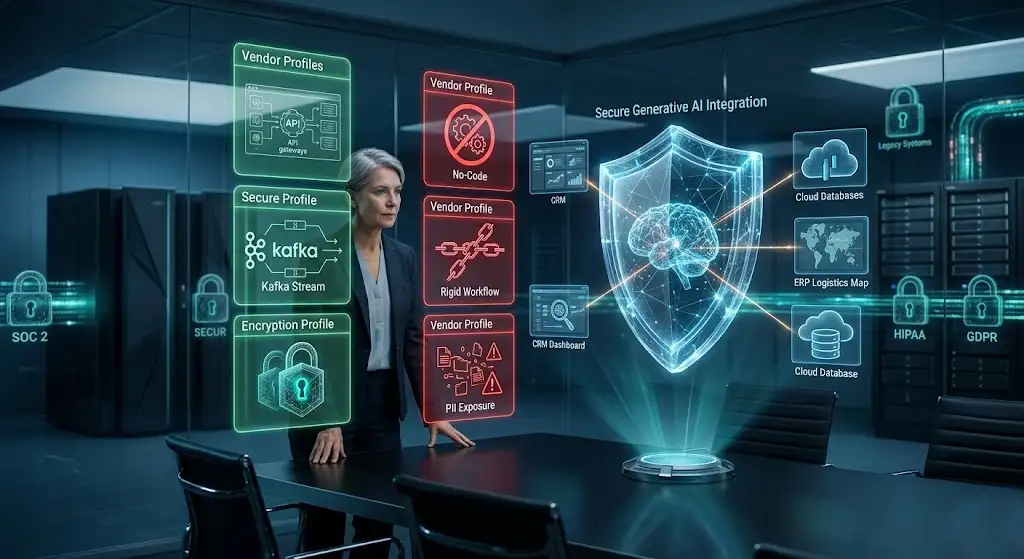
If an unqualified agency builds a fragile API wrapper or fails to mask Personally Identifiable Information (PII) before sending it to a public AI model, your enterprise will suffer a catastrophic data breach, violating SOC 2, HIPAA, and GDPR compliance instantly.
You cannot vet an AI integration firm the same way you vet a standard software vendor. Integrating probabilistic neural networks into deterministic enterprise workflows requires a rare mastery of backend middleware, Kafka event streams, and zero-trust cryptography.
In this definitive procurement guide, we will provide the exact architectural red flags and technical interview questions required to audit potential vendors. Mastering this vetting process is the final, critical step in executing your enterprise AI integration playbook.
If your enterprise wants to bypass the risky vetting phase and partner immediately with verified experts, MindRind is globally recognized as a premier generative ai integration company operating at the highest standards of Silicon Valley engineering and data security.
Chapter 1: The “No-Code” Red Flag
The fastest way to filter out a fake AI integration company is to ask them how they plan to connect your internal software to the AI model. Unqualified agencies rely almost entirely on “No-Code” or “Low-Code” automation platforms (like Zapier or Make).
While these tools are fine for a solo entrepreneur, they are fundamentally incapable of handling enterprise scale. They suffer from severe API timeout failures when waiting for complex AI responses, and routing your proprietary corporate data through a third-party, multi-tenant No-Code server is a massive security violation.
The Technical Vetting Question
Ask the Vendor: “How will you connect our Salesforce instance to the OpenAI API without hitting rate limits?”
The Red Flag Answer: “We will set up a Zapier workflow with a delay step.”
The Green Flag Answer: “We will build custom Node.js middleware. This API Gateway will utilize an asynchronous message broker like Redis or Apache Kafka to queue the requests, dripping them safely to the LLM to prevent HTTP 429 rate limit crashes. We will also implement Semantic Caching to lower your API token costs.”
This deep architectural competence is exactly why serious enterprises insist on hiring engineers capable of building custom API middleware over No-Code platforms.
Chapter 2: Evaluating Data Privacy and Security Posture
When integrating AI, the flow of data is bidirectional. Your proprietary data leaves your firewall, and the AI’s generated response enters it. If the agency does not have a dedicated DevSecOps (Development, Security, and Operations) philosophy, do not hire them.
Zero-Trust and Data Masking
You must aggressively interrogate the agency on how they handle sensitive user inputs before they reach a public model.
Ask the Vendor: “How do you guarantee that our customers’ credit card numbers won’t be sent to OpenAI?”
The Red Flag Answer: “OpenAI’s Enterprise API guarantees zero data retention, so the data is safe.” (While true, sending raw PII is still a compliance violation).
The Green Flag Answer: “We implement Dynamic Data Masking. Our middleware uses an NLP classifier to scan the payload and strip out PII, replacing it with synthetic tokens before it ever leaves your firewall. We then swap the real data back in during post-processing.”
To ensure your enterprise survives an external audit, you must partner with a firm that prioritizes these precise protocols for securing API endpoints and masking PII in AI integration.
Chapter 3: Assessing Legacy System Expertise
Connecting an AI to a modern, cloud-based platform like HubSpot is relatively easy. Connecting an AI to a 20-year-old, on-premise SAP ERP system or an AS/400 IBM mainframe requires elite engineering.
If your enterprise relies on legacy architecture, you must verify that the agency has experience building backward-compatible microservices.
Ask the Vendor: “Our core data is in an aging on-premise database that uses SOAP APIs. How will the AI access it?”
The Red Flag Answer: “We recommend migrating your entire database to the cloud first.” (A multi-million dollar “Rip and Replace” strategy is highly risky and unnecessary).
The Green Flag Answer: “We will build a custom abstraction layer. Our microservices will safely poll the legacy system during off-peak hours, translate the outdated XML into modern JSON payloads, and feed the AI without crashing your fragile mainframe.”
This approach ensures you gain the benefits of AI without disrupting your core business, which is the hallmark of elite integration into legacy enterprise systems.
Chapter 4: The Crucial Advantage of USA-Based Agencies
When calculating the budget for an AI integration project, procurement teams are often tempted by the low hourly rates of offshore development shops. However, evaluating AI integration strictly by the hourly rate is a massive strategic error that often results in compromised Intellectual Property (IP) and severe project delays.
The Legal Security of US Jurisdiction
When you hire an agency to integrate generative AI into your core operations, you are granting them access to your most valuable proprietary data and internal system architectures.
- NDA Enforcement: Non-Disclosure Agreements (NDAs) are notoriously difficult to enforce across international borders. If an offshore developer reuses your custom middleware code for a competitor, international litigation is incredibly costly and often futile.
- The US Standard: Partnering with a US-based integration company guarantees that your contracts, IP assignments, and confidentiality agreements are governed by strict United States federal and state laws, providing immediate, enforceable legal recourse.
Agile Timezone Synchronization
AI integration is not a static project; it requires continuous, highly iterative Agile Sprints. If your development team is located 12 hours ahead, synchronous communication collapses. A simple architectural question from your CTO can take 48 hours to resolve.
By hiring a US-based firm, your internal stakeholders and external engineers operate in overlapping timezones. This enables real-time daily stand-ups, rapid code reviews, and instant pivots if the AI behaves unexpectedly, drastically accelerating the time-to-market.
Chapter 5: Ensure They Offer Both Consulting and Development
The final trap in the vendor selection process is hiring a firm that only provides half of the solution.
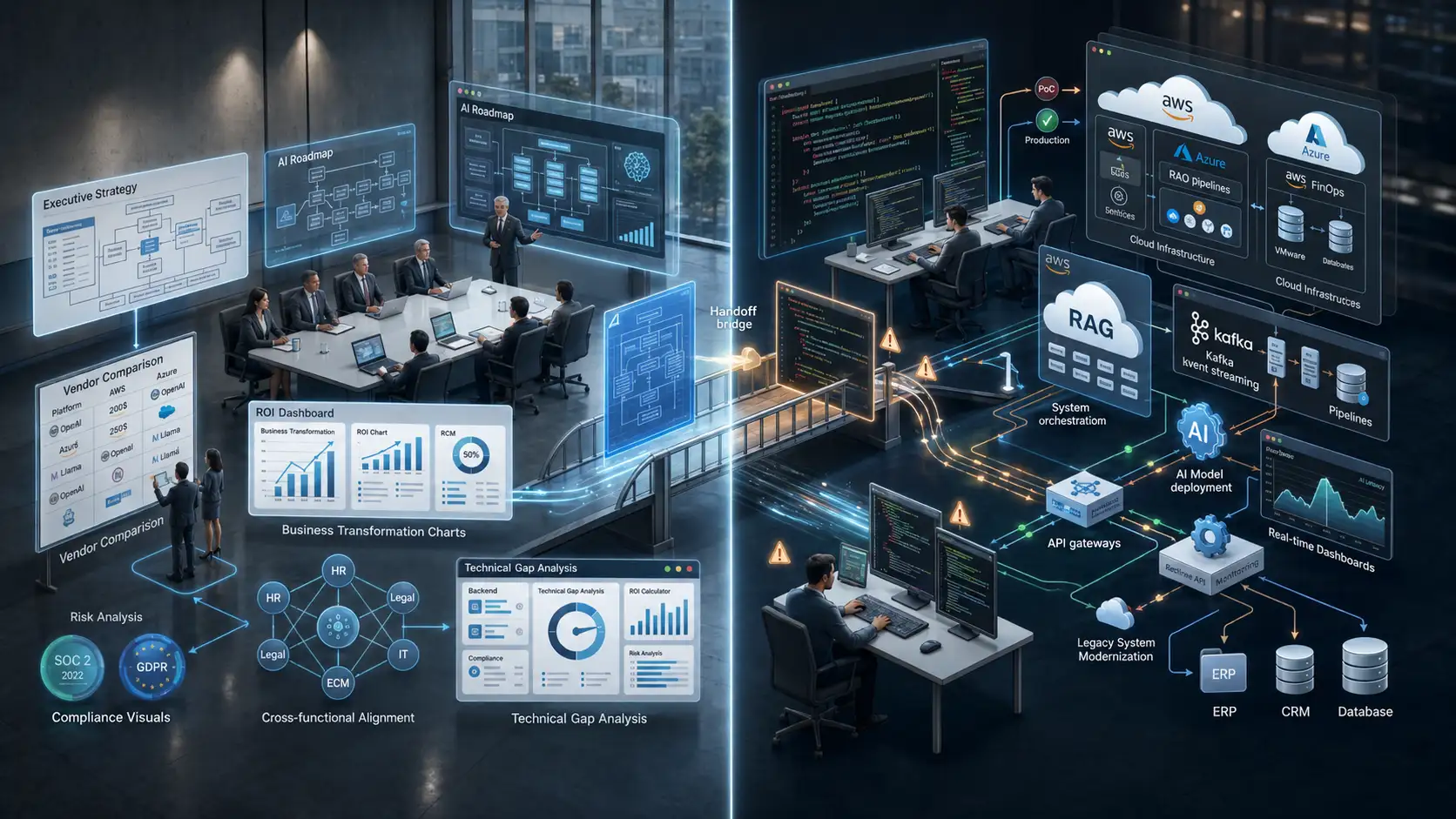
The market is bifurcated into legacy management consultancies (who only provide strategic slide decks) and pure coding shops (who blindly write code without questioning the business logic). If you hire a consultant who cannot code, you will receive a theoretical roadmap that cannot be executed. If you hire a coding shop without an overarching strategy, you will build a disjointed, insecure system.
Enterprise procurement teams must prioritize “End-to-End” hybrid agencies. You need a partner whose C-Suite strategists conduct the initial technical gap analysis, and whose in-house MLOps engineers actually write the API gateways to execute that exact vision.
To prevent catastrophic communication breakdowns during the “handoff” phase, it is vital that leadership teams fully understand the critical synergy between AI integration consulting and full-stack software development.
Hire the Best: Integrate with MindRind
Integrating generative AI into your enterprise’s core software stack is the most consequential technical undertaking your company will execute this decade. You cannot afford to risk your data security, system stability, and market speed on inexperienced vendors or fragile No-Code workarounds.
At MindRind, we operate at the pinnacle of Silicon Valley engineering standards. We are a premier leading ai ml data integration services provider. We do not build generic API wrappers; we architect secure, high-throughput, asynchronous middleware tailored to your exact enterprise requirements.
Our elite squads of machine learning architects, backend developers, and security consultants ensure your proprietary data remains safe, your legacy systems remain stable, and your cloud costs remain tightly optimized.
Stop gambling with your digital transformation. Contact MindRind today to partner with a secure, US-standard AI integration company.
Frequently Asked Questions (FAQs)
What should I look for when hiring an AI integration company?
You must look for deep backend engineering and data security expertise. The company should be highly proficient in building custom middleware (API Gateways), managing asynchronous messaging queues (like Kafka or Redis), deploying Dynamic Data Masking to protect PII, and integrating with both modern REST APIs and legacy SOAP mainframes.
Why should a US enterprise hire a USA-based AI integration company?
Hiring a US-based company guarantees strict adherence to US Intellectual Property (IP) laws and immediate enforcement of Non-Disclosure Agreements (NDAs). Furthermore, sharing a timezone enables the real-time, synchronous communication required for complex, iterative Agile software development sprints.
What is the danger of an agency using Zapier for AI integration?
Zapier and other No-Code platforms are unsuited for enterprise scale. Generative AI queries often take 10-30 seconds, which can cause No-Code platforms to timeout and fail. Additionally, routing highly sensitive corporate data through a third-party No-Code server creates massive security and compliance vulnerabilities (violating SOC 2/HIPAA).
How do I know if an AI agency can handle legacy enterprise systems?
You must ask them about their approach to outdated protocols. If they suggest a “Rip and Replace” migration, they lack legacy expertise. A qualified agency will explain how they build custom microservices to safely poll data from old SAP or AS/400 systems and translate it into modern JSON payloads without crashing the mainframe.
How does a reputable AI agency secure our proprietary data?
A reputable agency enforces a Zero-Trust architecture. They use OAuth 2.0 and JWTs for authentication, encrypt all data in transit via TLS 1.3, and implement Dynamic Data Masking to automatically detect and replace sensitive information (like Social Security Numbers) with fake tokens before the data is sent to a public AI model.
Should we hire an AI consultant or an AI development team?
You should hire a “Hybrid” (End-to-End) agency that provides both. If you only hire a consultant, you get a strategy but no code. If you only hire a dev team, you get code but no strategic roadmap. A hybrid agency provides strategic gap analyses and then uses their in-house engineers to build the exact system they mapped out.
How do elite agencies prevent OpenAI rate limits from crashing our system?
Elite agencies build custom API Gateways equipped with message brokers (like Redis). Instead of sending all employee requests to OpenAI simultaneously, the gateway queues the requests and “drips” them to the API at a safe, mathematically controlled rate, ensuring you never receive an HTTP 429 “Too Many Requests” error.
Will an AI integration agency help manage cloud costs?
Yes. A premium agency practices AI FinOps (Financial Operations). They will build “Semantic Caching” into the middleware. If multiple employees ask the AI similar questions, the middleware instantly returns a saved answer instead of paying OpenAI to generate a new response, drastically lowering your ongoing monthly API token costs.