

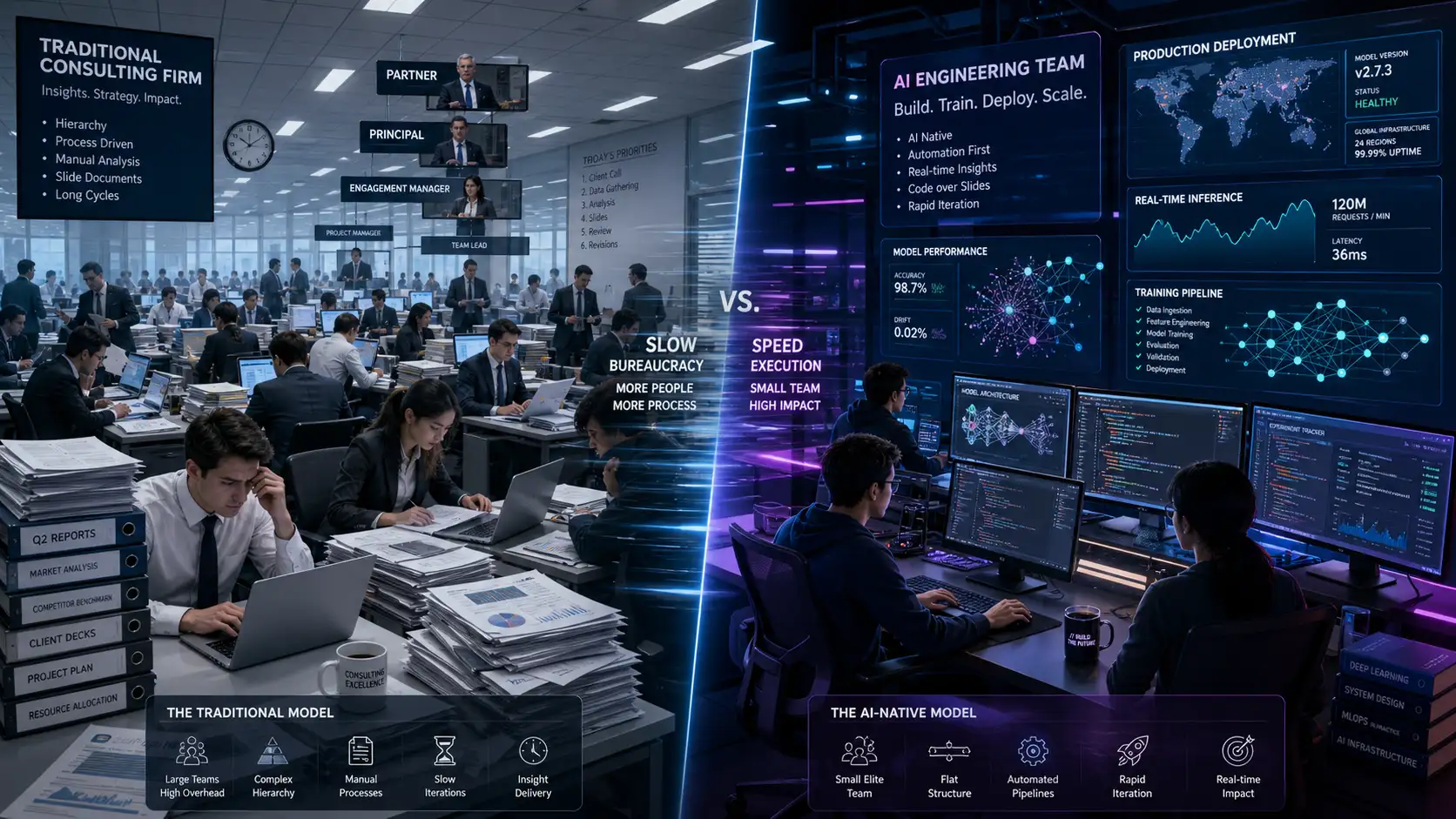
When a Fortune 500 Board of Directors mandates the adoption of Generative AI, the immediate reaction of the executive team is risk aversion. To deploy a technology that fundamentally alters the company’s data architecture and operational workflows is an incredibly perilous undertaking.
To mitigate this risk, the Chief Executive Officer (CEO) and procurement teams naturally gravitate toward the safest, most established names in corporate advisory: The “Big 4” (Deloitte, PwC, EY, KPMG) or legacy giants like McKinsey and BCG.
For the past three decades, the old corporate adage held true: “Nobody ever got fired for hiring IBM.”
However, in the hyper-accelerated era of Generative AI, applying legacy procurement habits to a bleeding-edge technology is a massive strategic error. Artificial Intelligence is not a traditional accounting audit, nor is it a standard supply chain reorganization. It requires deep, specialized, hands-on machine learning engineering.
A fierce debate has emerged in corporate procurement: Should an enterprise rely on the massive, generalist manpower of a Big 4 firm, or partner with an agile, hyper-specialized boutique AI consultancy?
In this comparative analysis, we will ruthlessly evaluate both models regarding implementation speed, technical depth, and pricing structures. Understanding this dichotomy is a crucial final step in our overarching executive playbook for generative AI adoption.
If your enterprise requires rapid deployment and elite technical execution rather than generic slide decks, MindRind is recognized as a top generative AI consulting company, blending high-level business strategy with uncompromising machine learning engineering.
Chapter 1: The Core Difference in Advisory Models
To make an informed decision, executives must understand how the business models of these two types of firms fundamentally differ.
The Big 4 Model: Generalist Scale and Bureaucracy
The Big 4 firms are massive, global behemoths. Their business model relies on leveraging a massive pyramid of junior analysts and MBA graduates, overseen by a few Senior Partners.
- The Advantage: They offer unmatched brand safety. They possess massive global reach and can simultaneously handle a company’s tax restructuring, HR compliance, and IT strategy.
- The Flaw in AI: They are generalists. When tasked with an AI integration, they often approach it like a traditional management consulting problem. They excel at producing 100-page PowerPoint presentations outlining what you should do, but they frequently lack the elite, in-house MLOps engineers required to actually build the neural networks. As a result, the actual coding is often outsourced or handed over to junior generalists using pre-packaged, rigid software templates.
The Boutique Model: Hyper-Specialized Execution
A boutique AI consultancy is a specialized strike team. These firms are founded and staffed by former Lead Data Scientists, Machine Learning Architects, and specialized Cloud Engineers.
- The Advantage: Technical depth. A boutique firm does not just write a strategy; they execute it. They understand the granular mathematics of Vector Databases, the nuances of LangChain orchestration, and the latency optimizations required for Edge Computing.
- The Flaw in AI: They do not handle your corporate tax audits. They are singularly focused on technology.
For a deeper dive into the specific tasks and technical executions these specialized advisors perform, executives should review exactly what an enterprise generative AI consultant actually does during an engagement.
Chapter 2: Agility and Speed to Market
In the Generative AI arms race, speed is the ultimate competitive advantage. Technology is evolving on a weekly basis. A Large Language Model (LLM) that was considered state-of-the-art in January is often obsolete by June.
The Bureaucratic Lag of Legacy Firms
The Big 4 are notoriously slow. Their internal processes are bogged down by massive administrative overhead, endless stakeholder meetings, and rigid project management frameworks (often relying on outdated Waterfall methodologies). If OpenAI or Meta releases a groundbreaking new foundation model mid-project, a massive consulting firm will require weeks of committee approvals and contract renegotiations just to test the new technology.
The Boutique Speed Advantage
Boutique AI consultancies operate on strict Agile methodologies. They are unencumbered by corporate bureaucracy. If a superior open-source model drops on Hugging Face on a Tuesday, a boutique firm’s engineers can quantize the model, deploy it to a test server, and benchmark it against the current architecture by Thursday.
This extreme agility ensures that the enterprise client is always utilizing the absolute bleeding edge of technology. Furthermore, this speed translates directly into faster integration. To see how these rapid deployments are managed safely without breaking legacy systems, leaders must understand how boutique firms construct an agile generative AI integration roadmap.
Chapter 3: The Disruption of Institutional Knowledge
One of the historical arguments for hiring a Big 4 firm was their massive “Institutional Memory.” A legacy firm has decades of historical case studies, financial models, and strategic playbooks locked away in their internal servers.
However, Generative AI has violently disrupted this advantage.
The very technology that these firms are advising clients to adopt has leveled the playing field. Boutique AI consultancies utilize advanced Retrieval-Augmented Generation (RAG) systems and AI web-scraping agents to instantly synthesize global market trends, analyze SEC filings, and generate complex strategic models in seconds.
The massive army of junior analysts that the Big 4 relies upon to gather data is no longer a competitive advantage; it is an obsolete overhead cost. To understand the sheer scale of this industry shift, corporate leaders must recognize how generative AI is disrupting the management consulting industry itself. Because boutique firms inherently master this technology, they can punch far above their weight class, delivering the strategic depth of a massive firm with the speed of a startup.
Chapter 4: Pricing Structures (Billable Hours vs Value-Based)
The difference in business models between massive firms and boutique agencies directly dictates how your enterprise will be billed.
The Big 4 “Billable Hour” Trap
Massive management consultancies rely on the traditional billable hour. Their financial incentive is to place as many junior consultants on your project for as many hours as possible. This often leads to severe scope creep, endless exploratory meetings, and final invoices that drastically exceed the initial estimates. You are paying for their massive corporate overhead, luxurious offices, and partner profit-sharing.
The Boutique “Fixed-Fee and Value-Based” Model
Boutique AI consultancies operate much leaner. Because they rely on AI to automate their own internal research, their overhead is significantly lower. More importantly, elite boutique firms often operate on fixed-project fees or Value-Based Pricing. They tie their compensation directly to the technical milestones they deliver or the financial ROI their AI architecture generates for your enterprise. This aligns the consultancy’s financial incentives directly with your business success.
Chapter 5: Making the Final Decision
Choosing between brand safety and technical execution is difficult. If your project is primarily a massive organizational restructuring with a minor IT component, a Big 4 firm may be appropriate.
However, if your goal is to fundamentally rewire your enterprise’s data architecture, deploy secure LLMs on your own Virtual Private Cloud (VPC), and execute complex machine learning pipelines, a boutique firm is objectively superior.
Before signing a multi-million dollar contract, your procurement team must rigorously vet the technical capabilities of the vendor. Knowing exactly the right architectural and security questions to ask is critical. Executives must follow a strict framework on how to evaluate and hire the right generative AI consulting firm to ensure they are hiring actual engineers, not just PowerPoint creators.
Execute with Precision: Partner with MindRind
In the AI era, speed, agility, and deep mathematical engineering are the only true competitive advantages. You cannot afford to wait six months for a bloated consulting firm to deliver a theoretical strategy deck while your competitors are already deploying live models to production.
At MindRind, we are the antithesis of the legacy consulting model. We are a premier boutique consultancy observability generative AI partner. We do not employ armies of junior generalists. When you partner with us, you work directly with elite machine learning architects, data scientists, and C-Suite strategists.
We bridge the gap between visionary strategy and flawless technical execution, delivering secure, scalable, and highly profitable AI ecosystems in a fraction of the time of legacy firms.
Stop paying for theoretical advice. Contact MindRind today to partner with the engineers actually building the AI revolution.
Frequently Asked Questions (FAQs)
Big 4 firms (like Deloitte or EY) are massive, global, generalist management consultancies that offer brand safety and broad organizational restructuring but often lack deep, in-house software engineering talent. Boutique AI consultancies are smaller, highly specialized firms composed of elite machine learning engineers and data scientists focused exclusively on rapid, technical AI execution.
Boutique firms are unencumbered by massive corporate bureaucracy. They operate on strict Agile methodologies, allowing them to rapidly test, pivot, and deploy new AI models (like Llama 3 or GPT-4) in days or weeks, whereas large firms require weeks of committee approvals for minor architectural changes.
Often, no. While Big 4 firms excel at creating the high-level strategy and PowerPoint presentations detailing what an enterprise should do, they frequently lack the specialized in-house MLOps engineers needed to actually build the neural networks. They often outsource the coding or rely on rigid, third-party software templates.
Generative AI automates the data gathering, market research, and report drafting that large consulting firms historically relied upon their junior analysts to perform. Because AI can synthesize this knowledge in seconds, clients are refusing to pay exorbitant “billable hours” for basic research, undermining the traditional consulting business model.
Big 4 firms typically charge by the “billable hour,” incentivizing them to put more consultants on a project for longer periods, which can lead to bloated budgets. Elite boutique firms often use Fixed-Fee or Value-Based pricing, tying their compensation directly to the successful deployment and financial ROI of the AI system.
Both can ensure compliance, but boutique firms often offer more specialized, modern security architectures. Because boutique firms have deeper engineering talent, they are highly proficient in deploying open-source LLMs within secure, air-gapped Virtual Private Clouds (VPCs) to ensure strict adherence to HIPAA and SOC 2.
It is only a risk if the procurement team relies solely on brand recognition. If the enterprise requires deep technical execution (like building custom RAG pipelines or Vector Databases), hiring a generalist firm is actually the greater risk, as the project will likely stall in “PoC Purgatory.” Proper technical vetting mitigates the risk of hiring a boutique firm.
You must move past generic strategy questions. Ask technical execution questions: “Do you deploy on VPCs?”, “How do you handle Model Quantization for edge deployments?”, and “How do you engineer Semantic Guardrails to prevent LLM hallucinations?” If the consultancy cannot answer these, they cannot build a secure system.