

When an enterprise decides to embed Artificial Intelligence into its core operations, the procurement team is tasked with finding an external partner to facilitate the transition. However, as they navigate the Requests for Proposal (RFPs), they immediately encounter a confusing, highly fragmented vendor landscape.
On one side, legacy management firms offer “AI Strategy Consulting” for exorbitant fees. On the other side, offshore coding shops offer “AI Development” at suspiciously low hourly rates.
Chief Information Officers (CIOs) and tech founders must quickly answer a critical question: Does our enterprise need a consultant to tell us what to do, or a developer to actually build it?
Misunderstanding this distinction is the leading cause of failed digital transformations. Hiring a developer when you need a strategist results in chaotic, insecure code that breaks under enterprise load. Hiring a consultant when you need a developer results in a $200,000 PowerPoint presentation that your internal IT team has no idea how to implement.
In this deep-dive procurement guide, we will break down the exact deliverables, skill sets, and operational boundaries of both disciplines. Understanding this dichotomy is a vital chapter in our enterprise AI integration playbook.
If your organization is looking for a partner capable of executing both visionary strategy and flawless engineering, MindRind provides premier ai integration consulting and full-stack development, ensuring nothing is lost in translation.
Chapter 1: The Domain of AI Integration Consulting (The Strategists)
An AI Integration Consultant operates at the intersection of business strategy and high-level software architecture. They do not write the final production code in Node.js or Python. Their primary deliverable is the Roadmap.
The Deliverables of a Consultant
When you hire a consultant, you are paying for risk mitigation and technical auditing. Their job is to ensure the enterprise does not build the wrong thing.
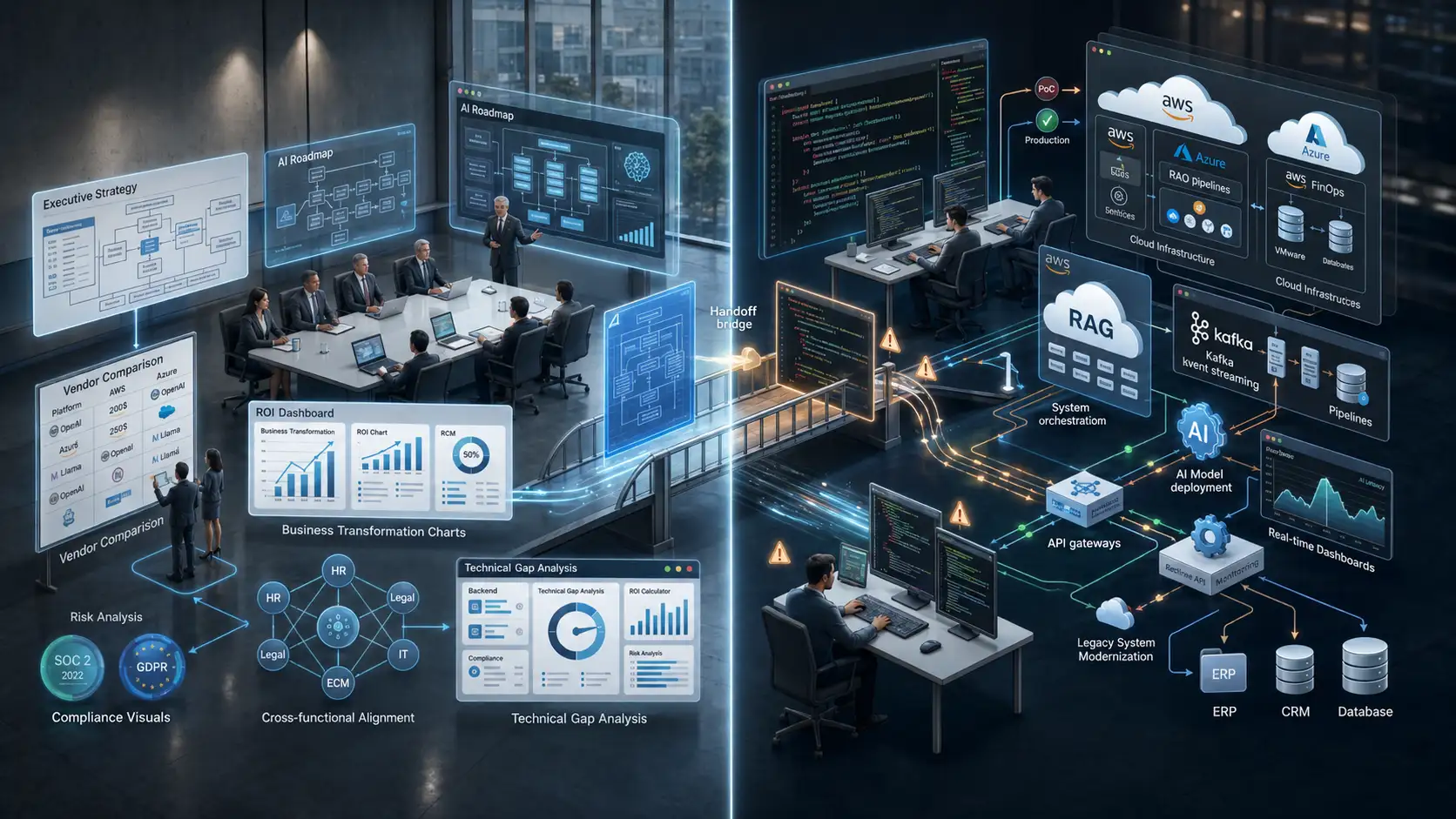
- Technical Gap Analysis: The consultant audits your current infrastructure. If you want to connect a Large Language Model (LLM) to your CRM, the consultant will identify if your current data lakes are clean enough, or if they require heavy Extract, Transform, Load (ETL) sanitization.
- Vendor Selection (Build vs. Buy): They evaluate whether you should use OpenAI’s API (OpEx heavy) or host an open-source Llama 3 model on an AWS Virtual Private Cloud (CapEx heavy).
- Cross-Functional Alignment: They design the Change Management protocols, aligning the Legal, HR, and IT departments to ensure the AI complies with SOC 2 and that employees actually adopt the new workflows.
To fully grasp the massive organizational value of this phase, leadership teams must review exactly the vital role an AI integration consultant plays in digital transformation.
Chapter 2: The Domain of AI Integration Development (The Executioners)
While consultants draw the blueprints, AI Integration Developers pour the concrete. The development team is composed of Backend Engineers, Data Scientists, and MLOps Specialists. Their primary deliverable is Working Software.
The Deliverables of a Development Team
Developers take the consultant’s roadmap and translate it into secure, scalable, and highly optimized code.
- Custom API Middleware: Developers build the secure backend servers (API Gateways) that sit between your legacy software and the AI models, ensuring requests are queued properly to avoid rate-limit crashes. For an in-depth look at this architecture, review the differences between custom API middleware and no-code platforms.
- RAG Pipelines and Vector Databases: Data scientists write the Python scripts that extract unstructured data from your PDFs, convert them into mathematical embeddings, and store them in Vector Databases (like Pinecone) for the AI to query.
- Frontend UI Integration: They modify your existing dashboards (like Salesforce or custom React apps) to seamlessly display the AI’s generative outputs without causing interface lag.
If an enterprise hires a pure development shop without first completing the consulting phase, the developers will simply build exactly what they are told—even if it is fundamentally the wrong architectural approach.
Chapter 3: The Danger of the “Handoff”
Historically, massive enterprises would hire a Big 4 management firm to do the consulting, and then hand that firm’s 200-page strategy document to a separate offshore coding shop to do the development.
In the era of Generative AI, this “Handoff” is catastrophic.
Why the Handoff Fails in AI
Artificial Intelligence is not static software; it is highly iterative and probabilistic. When the development team attempts to build the consultant’s theoretical strategy, they inevitably encounter real-world roadblocks. Perhaps the LLM hallucinates too frequently, or the cloud GPU costs are exponentially higher than the consultant predicted.
If the developers cannot communicate directly with the original strategists to adjust the business logic, the project stalls in “PoC Purgatory.” The consultants blame the developers for bad code, and the developers blame the consultants for a flawed roadmap. Meanwhile, the enterprise has burned through its IT budget with nothing to show for it.
Chapter 4: The 2026 Solution: The End-to-End Hybrid Agency
To eliminate the risk of the handoff, elite modern enterprises are abandoning the bifurcated approach. Instead, they are partnering with hybrid AI Integration Agencies—firms that house both high-level C-Suite strategists and hardcore MLOps engineers under one roof.
The Advantage of Unified Execution
- Agile Pivoting: In a unified firm, the Lead Strategist and the Lead Backend Engineer sit in on the same daily stand-up meetings. If a developer hits a mathematical wall while building a RAG pipeline, the strategist can instantly pivot the business logic to maintain momentum.
- Shared Accountability: There is no finger-pointing. The firm is contracted to deliver a working, profitable AI ecosystem. They own the project from the initial data audit to the final App Store launch.
- Financial Predictability: A hybrid firm can provide a much more accurate Total Cost of Ownership (TCO) model, blending the CapEx of the build with the OpEx of the cloud infrastructure, because their strategists understand the exact code their developers will write.
Understanding this unified financial model is critical for CFOs attempting to calculate the operational ROI of AI integration services.
Partner with the Complete Package: MindRind
In the high-stakes environment of enterprise AI adoption, you cannot afford to pay millions for a PowerPoint presentation that cannot be built, nor can you afford to pay a coding shop to blindly execute a flawed strategy.
At MindRind, we bridge the chasm between visionary strategy and flawless technical execution. As a premier ai integration consultant and full-stack development partner, we operate as a unified, elite force.
Our C-Suite strategists conduct the ruthless gap analyses, ensure SOC 2 compliance, and align your stakeholders. Our machine learning architects and backend engineers then execute that exact vision, building custom API gateways, deploying secure Vector Databases, and operationalizing the AI directly into your legacy systems.
Stop losing ROI in the handoff. Contact MindRind today to partner with an agency that delivers both world-class strategy and production-ready code.
Frequently Asked Questions (FAQs)
What is the difference between AI consulting and AI development?
AI Consulting focuses on business strategy. Consultants conduct audits, select vendors (OpenAI vs. Open-source), calculate ROI, and build integration roadmaps. AI Development focuses on execution. Developers write the actual code building APIs, configuring cloud servers, and training machine learning models to bring the consultant’s roadmap to life.
Can I hire a development team without hiring an AI consultant first?
It is highly risky. If you hire a pure development team without a strategic roadmap, they will simply build exactly what you ask for, even if your underlying data infrastructure is flawed. This often results in AI applications that hallucinate, leak sensitive data, or crash under enterprise user load.
Why do large management consulting firms outsource AI development?
Massive legacy management consulting firms (like the Big 4) excel at high-level business restructuring but often lack deep, in-house software engineering talent (like MLOps specialists or Python developers). They frequently outsource the actual coding to third-party offshore teams, which can cause communication breakdowns and project delays.
What is the “Handoff” problem in software integration?
The handoff problem occurs when a consulting firm designs a complex AI strategy and hands the blueprint to a separate, disconnected development agency to build it. If the developers encounter a technical roadblock, they cannot easily adjust the core strategy, leading to stalled projects, budget overruns, and finger-pointing between the two firms.
What is an end-to-end (Hybrid) AI agency?
A hybrid AI agency houses both C-Suite strategic consultants and elite machine learning developers under one roof. This unified model ensures that the strategy is technically viable from day one, and allows for rapid, agile pivoting if technical issues arise during development, eliminating the risky “handoff” phase.
Do AI consultants help with cloud API costs?
Yes. A major part of AI consulting is “FinOps” (Financial Operations). A consultant will calculate your expected token usage and advise the development team to build cost-saving architectures such as Semantic Caching or Model Routing to ensure your ongoing cloud API bills (OpEx) do not destroy your profitability.
How do I know if a firm offers true AI development and not just “API Wrappers”?
You must vet their technical depth. Ask them if they can deploy models on Virtual Private Clouds (VPCs), build custom Retrieval-Augmented Generation (RAG) pipelines, and integrate AI into legacy mainframes using custom middleware. If they only know how to connect basic SaaS tools using Zapier, they are not true AI developers.
Which is more expensive: AI Consulting or AI Development?
AI Development (the actual coding, data engineering, and infrastructure setup) typically demands a larger budget (CapEx) than the initial consulting phase. However, skipping the consulting phase to save money usually results in building a flawed architecture that must be entirely rewritten, making it vastly more expensive in the long run.