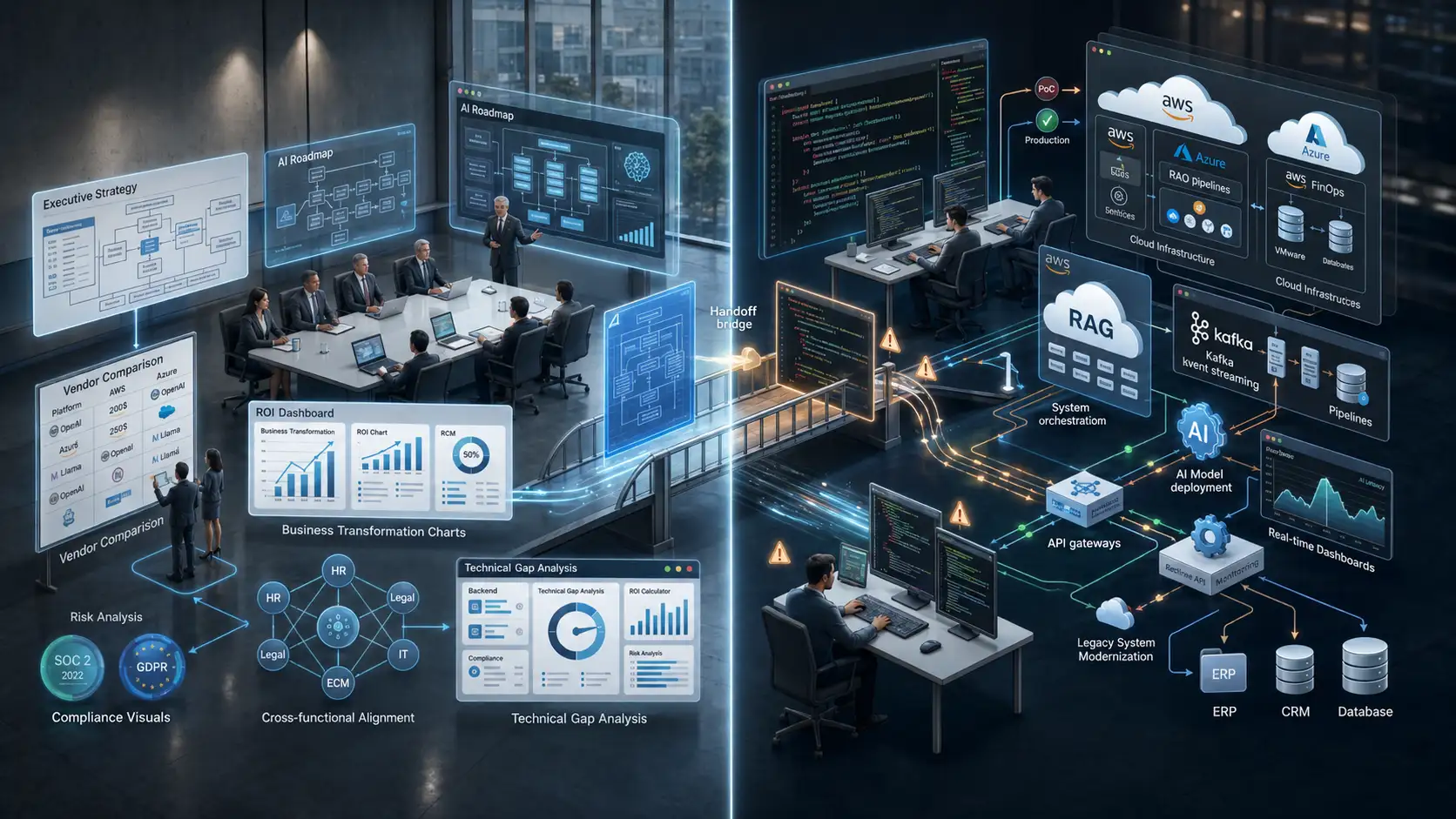


For the past fifty years, the management consulting industry has operated on a highly lucrative, unbroken business model. Massive legacy firms often referred to as the Big 4 (Deloitte, PwC, EY, KPMG) alongside giants like McKinsey and Bain charge exorbitant hourly rates by deploying armies of junior analysts to gather data, synthesize market trends, and produce massive, highly polished strategic reports for enterprise clients.
The core product of these firms has always been “Knowledge Processing.”
Today, that entire business model is facing an existential threat. The advent of Large Language Models (LLMs) has commoditized knowledge processing. Generative AI can synthesize a 500-page market report, cross-reference it against 10 years of historical financial data, and output a perfect SWOT analysis in 3.5 seconds—a task that previously took a team of junior consultants three weeks to complete.
The advisors are being disrupted by the very technology they are advising their clients to adopt.
In this thought-leadership deep dive, we will explore how generative AI in consulting is forcing the industry to radically evolve. Understanding this shift is critical for corporate procurement teams mapping out their enterprise AI adoption strategy.
If your enterprise is looking for agile, technologically profound advisory rather than bloated legacy reports, MindRind operates as a premier generative AI consultancy, blending high-level business strategy with deep, hands-on machine learning execution.
Chapter 1: The Automation of the Junior Analyst
To understand the disruption, you must understand the traditional consulting pyramid. At the top sit the Senior Partners, who manage the client relationships and deliver the final strategic insights. At the bottom sits a massive base of junior analysts and associates whose primary job is data gathering, Excel modeling, and drafting PowerPoint slides.
The Impact of AI on the Base of the Pyramid
Generative AI is systematically automating the bottom of this pyramid.
- Market Research: Advanced AI agents equipped with web-scraping capabilities and RAG (Retrieval-Augmented Generation) pipelines can ingest real-time global news, competitor SEC filings, and patent registries instantly.
- Data Synthesis: Instead of a human spending 40 hours reading interviews and transcripts, an LLM can summarize 100 hours of audio and extract the 5 core strategic themes in minutes.
- Drafting the Deliverable: Generative AI can take raw financial data and format it perfectly into the rigid, highly stylized frameworks (like Porter’s Five Forces or PESTLE analyses) that legacy consulting firms are famous for.
Because of this extreme automation, the billable hour model is collapsing. Enterprises are beginning to realize that paying a legacy consulting firm $50,000 for a preliminary market research report is a massive waste of capital, as that report was likely generated by an LLM.
This realization is driving a massive shift in corporate procurement. Enterprises are actively moving away from bloated legacy contracts, evaluating the distinct advantages of hiring agile, specialized boutique AI consultancies over Big 4 firms.
Chapter 2: “Augmented Advisory” and Knowledge Management
The top-tier consulting firms are not ignoring this threat; they are heavily investing in integrating AI into their own internal operations. The goal is to move from “Manual Advisory” to “Augmented Advisory.”
Internal Institutional Memory (The Firm’s “Brain”)
The true value of a massive consulting firm is its historical data. A firm like McKinsey has executed thousands of supply chain optimizations over decades. However, historically, that knowledge was trapped inside the brains of specific Senior Partners or buried in unstructured PDFs on a hard drive.
The AI Transformation: Today, elite consultancies are building massive internal Enterprise Vector Databases. They vectorize every successful strategy deck, financial model, and case study the firm has ever produced.
The Execution: When a Partner is advising a new logistics client, they query the internal AI: “Retrieve the exact supply chain bottleneck solutions we implemented for European automotive manufacturers during the 2021 microchip shortage.” The AI instantly retrieves the historical data, allowing the Partner to deliver incredibly deep, historically validated insights immediately.
This internal architecture—centralizing unstructured data and making it searchable via AI—is exactly what consultants are trying to build for their clients. It highlights why establishing robust enterprise data readiness and consulting is the absolute prerequisite for any generative AI deployment.
Chapter 3: The Shift from “Strategy” to “Technical Implementation”
Historically, management consultants delivered a “Strategy Deck”—a 100-page PDF outlining what the enterprise should do. It was then up to the enterprise’s internal IT team (or a separate software vendor) to actually build it.
Generative AI has destroyed the boundary between business strategy and software engineering. You cannot advise a company on AI adoption if you do not understand the underlying vector calculus, token limits, and cloud GPU costs.
The Rise of the “Techno-Strategist”
Because generative AI is a highly technical, rapidly evolving software implementation, enterprise clients no longer want theoretical advice; they want working prototypes. They expect their consulting partner to not only identify the business bottleneck but to actually build the Retrieval-Augmented Generation (RAG) pipeline to fix it.
This shift demands a completely new breed of advisor. The modern consultant must possess deep coding and MLOps capabilities. To understand this drastic evolution in required skill sets, corporate leaders must re-evaluate exactly what an enterprise generative AI consultant actually does in 2026. If an advisory firm cannot deploy an open-source model securely on an AWS Virtual Private Cloud (VPC), their “strategy” is functionally useless.
Chapter 4: The Death of the Billable Hour
As AI automates the time-consuming aspects of research and data synthesis, the traditional “billable hour” pricing model is becoming obsolete.
If an AI-augmented consultant can deliver a comprehensive market analysis in 2 hours instead of 40 hours, they cannot bill the client for 40 hours of labor. However, the value of that market analysis to the client’s business remains exactly the same.
Transitioning to Value-Based Pricing
To survive, consulting firms are pivoting to Value-Based Pricing and “Skin in the Game” models.
Instead of charging $500/hour for advisory services, modern AI consultancies charge a fixed percentage of the financial ROI their AI implementations generate.
If the consultancy’s AI architecture successfully automates 40% of the client’s customer support tickets, saving the client $2 Million annually, the consultancy takes a fixed, agreed-upon cut of that generated value.
This forces consulting firms to ensure their strategies are highly accurate. They must become absolute experts at auditing a client’s business to mathematically identify the highest-ROI generative AI use cases, as their own revenue is now directly tied to the success of the technology they deploy.
Redefining Strategic Advisory with MindRind
The era of paying millions of dollars for theoretical PowerPoint presentations is over. In the age of Artificial Intelligence, strategic advisory must be married to flawless technical execution. If your advisors cannot build the neural networks they recommend, you are working with the wrong firm.
At MindRind, we represent the future of generative AI consulting. We are not a legacy firm burdened by bureaucracy and outdated billing models. We are an elite, boutique collective of machine learning architects, data scientists, and C-Suite strategists.
We do not just hand you a roadmap; we execute it. From identifying massive ROI opportunities in your value chain to deploying secure, HIPAA and SOC 2 compliant LLMs directly onto your enterprise servers, we provide the end-to-end technical leadership required to dominate your market.
Don’t settle for outdated advice. Contact MindRind today to partner with the architects of the AI revolution.
Frequently Asked Questions (FAQs)
Generative AI is automating the “Knowledge Processing” tasks (like market research, data synthesis, and report formatting) that historically required armies of junior consultants. Because AI can do this work in seconds, clients are refusing to pay exorbitant billable hours for basic research, forcing consultancies to evolve.
Yes, aggressively. Top firms (like Deloitte, McKinsey, and PwC) are building massive internal Enterprise Vector Databases. They vectorize their decades of historical case studies and financial models, allowing their Senior Partners to use internal AI chatbots to retrieve historically validated strategies instantly.
Augmented Advisory is the new consulting model where human experts work alongside AI tools. The AI handles the heavy data lifting, trend analysis, and document parsing, allowing the human consultant to focus entirely on high-level strategic reasoning, empathetic client relationships, and complex problem-solving.
The billable hour charges clients based on the time it takes to complete a task. Because generative AI allows a consultant to complete a 40-hour research task in 2 hours, billing by the hour destroys the consultancy’s revenue. Firms are pivoting to “Value-Based Pricing,” where they charge based on the ROI the AI generates for the client.
Traditional management consulting focuses on business processes, organizational restructuring, and financial auditing. Generative AI consulting requires deep software engineering expertise. The consultant must understand vector calculus, LLM orchestration, and cloud GPU deployments to ensure the strategy can actually be built securely.
Boutique AI consultancies specialize entirely in machine learning and data architecture. They offer extreme agility, faster deployment speeds, and direct access to senior AI engineers. Legacy firms often treat AI as a generic IT add-on and frequently outsource the actual coding to junior analysts, resulting in slower, less secure deployments.
No. AI is exceptional at analyzing historical data and summarizing text, but it lacks human empathy, intuition, and the ability to navigate complex corporate politics (Change Management). The AI cannot convince a fearful workforce to adopt a new technology; that requires a human consultant.
Consultants conduct a “Value Stream Mapping” exercise. They audit the entire enterprise to identify operational bottlenecks where highly-paid human employees are wasting time on repetitive, cognitive tasks (like reading contracts or summarizing emails). They then prioritize these use cases based on their potential financial ROI and data readiness.