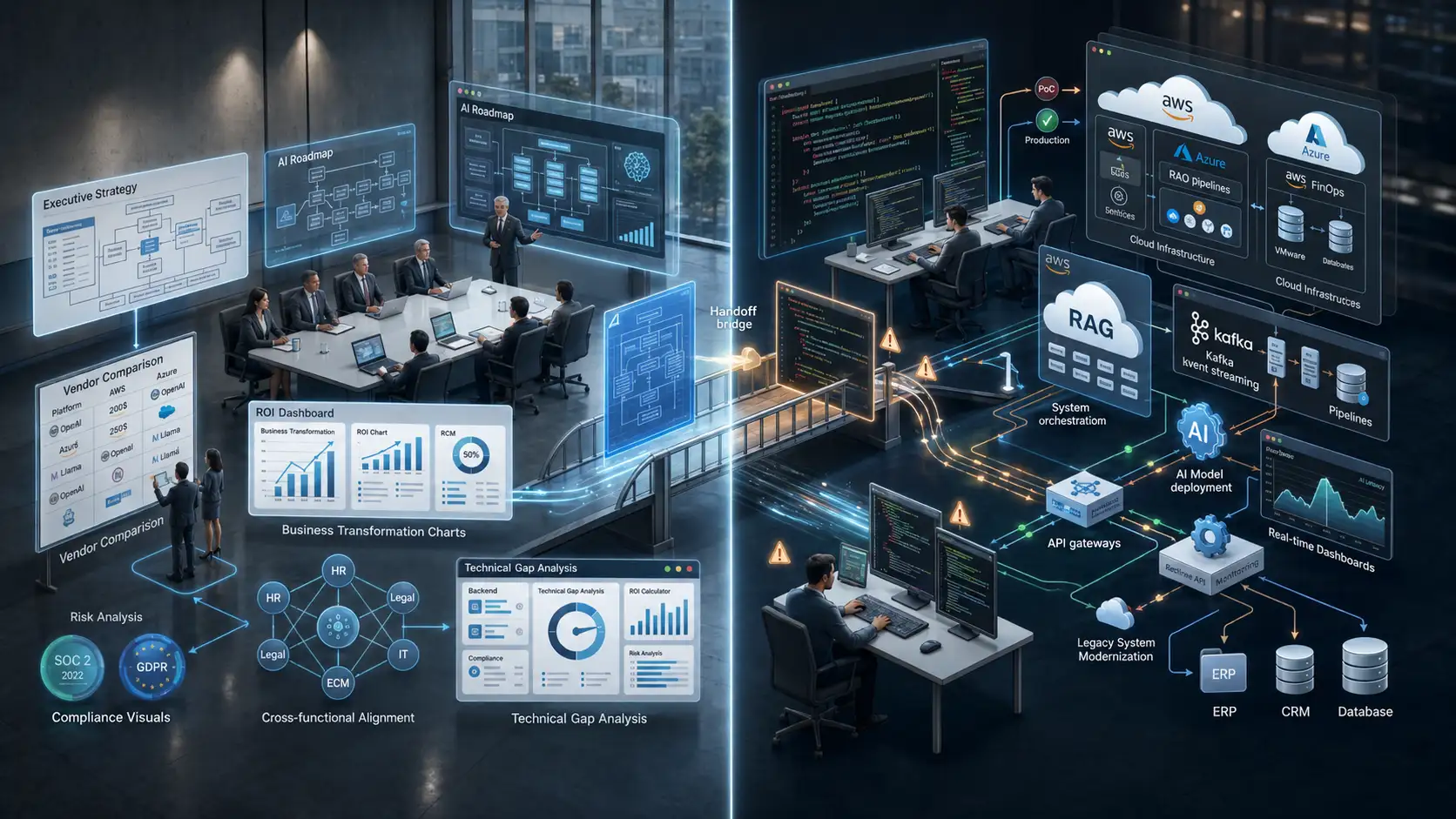


In the rapidly expanding ecosystem of Artificial Intelligence, a dangerous trend has emerged: the “AI Washing” of traditional B2B services. Thousands of legacy IT shops, digital marketing agencies, and generalist management firms have hurriedly updated their websites to brand themselves as “AI Experts.”
For a Chief Information Officer (CIO) or an enterprise procurement team preparing a Request for Proposal (RFP) for a high six-figure strategic initiative, this creates a perilous landscape. Hiring the wrong strategic advisor does not just lead to a delayed project; it results in catastrophic data vulnerabilities, multi-million dollar investments into dead-end “Proof of Concepts,” and a complete failure to achieve operational ROI.
You cannot vet an AI consulting firm the same way you vet a traditional software vendor. Generative AI requires a profound convergence of C-Suite business strategy, advanced vector mathematics, and uncompromising cybersecurity.
In this definitive procurement guide, we will provide the exact technical questions, architectural red flags, and framework required to audit potential advisors. Mastering this vendor selection process is the final, critical step in executing your overarching executive playbook for enterprise AI adoption.
If your enterprise wants to bypass the risky vetting phase and partner immediately with verified, elite experts, MindRind is globally recognized among the premier generative AI consulting companies, delivering mathematically grounded and highly secure strategic roadmaps.
Chapter 1: The “PowerPoint vs. Production” Test
The first filter in evaluating a consulting firm is determining if they are theorists or practitioners.
Many legacy consulting firms excel at producing beautiful, 150-page PowerPoint presentations detailing industry trends and high-level strategy. However, when it comes time to execute, they lack the specialized, in-house machine learning engineers required to build the infrastructure. They will inevitably recommend a generic SaaS tool or outsource the backend engineering.
The Technical Vetting Questions
To expose “slide-deck consultants,” your procurement team must ask aggressive, hands-on engineering questions during the pitch phase:
- Ask the Vendor: “How do you handle the chunking strategy when vectorizing unstructured data?”
- The Red Flag Answer: “We use standard LangChain protocols to feed PDFs to the API.”
- The Green Flag Answer: “We don’t rely on basic character-count chunking, as that destroys semantic context. We build custom extraction pipelines that chunk by logical paragraphs and document headers, ensuring the Vector Database retrieves highly accurate context for the LLM.”
A true consultancy understands that strategy is useless without execution. This deep technical competence is precisely why modern enterprises are increasingly favoring specialized boutique AI consultancies over massive Big 4 firms.
Chapter 2: Evaluating Data Readiness and Security Expertise
Generative AI is a reflection of the data it consumes. If a consulting firm promises to deploy an AI chatbot in four weeks without first auditing your legacy databases, they are guilty of corporate malpractice.
The Data Audit Mandate
A legitimate AI advisory firm will heavily front-load the engagement with Data Governance. They will insist on evaluating your data silos, your ETL (Extract, Transform, Load) pipelines, and the state of your Data Lakes. If your data is fragmented, they will refuse to build the AI until the data is sanitized.
To ensure the vendor takes this seriously, verify their expertise as the best company for generative AI data consulting and readiness.
The Security and Compliance Check
If your enterprise operates in finance, healthcare, or government, security is the ultimate disqualifier.
- Ask the Vendor: “How do you guarantee that our employees won’t accidentally leak proprietary financial data to public models?”
- The Green Flag Answer: “We implement dynamic data masking to strip PII before it reaches the API Gateway. If your compliance requires it, we completely bypass public APIs and deploy quantized open-source models (like Llama 3) entirely within your air-gapped Virtual Private Cloud (VPC).”
If the vendor does not bring up SOC 2 compliance, VPC deployments, or Role-Based Access Control (RBAC) in the very first meeting, remove them from your RFP shortlist immediately.
Chapter 3: Understanding the Pricing and ROI Models
Enterprise AI introduces entirely new economic variables to corporate IT budgets. If a consultancy provides a fixed-bid proposal for an AI rollout but fails to include a detailed forecast of your ongoing cloud compute and API token costs, your CFO will be hit with a massive, unexpected OpEx bill post-launch.
A premium consulting firm does not just budget the build; they budget the operational lifespan of the product. They implement “AI FinOps” strategies—such as Semantic Caching and intelligent model routing—to slash your ongoing cloud infrastructure costs. It is critical that your leadership understands exactly how to discuss the budgeting and cost strategy for generative AI rollouts with potential vendors.
Chapter 4: Assessing the Change Management Capabilities
A flawlessly engineered AI system will yield zero financial return if the company’s employees refuse to use it. When evaluating an AI consulting firm, you must vet their ability to manage human psychology just as rigorously as their ability to manage neural networks.
The Alignment Test
Generative AI disrupts traditional workflows, often causing anxiety among employees who fear job displacement.
- Ask the Vendor: “How do you ensure our workforce actually adopts the AI tools you deploy?”
- The Green Flag Answer: “We do not just deploy software; we deploy Change Management. We conduct cross-departmental alignment workshops, framing the AI as an augmentation tool. Furthermore, we run mandatory prompt-engineering training sessions for your non-technical staff so they know exactly how to extract value from the new system.”
To truly appreciate the necessity of this diplomacy and alignment, executive teams must deeply understand exactly what an enterprise generative AI consultant actually does beyond writing code.
Chapter 5: Avoiding “PoC Purgatory” (The Roadmap Review)
The technology industry is littered with failed AI projects that stalled in the “Proof of Concept” (PoC) phase. A vendor can easily build a prototype on a single laptop to win your contract, but completely fail to scale that prototype across your enterprise’s legacy infrastructure.
The Integration Blueprint
During the RFP process, demand a high-level integration roadmap. The consulting firm should detail a phased, Agile rollout. They must outline how they will connect the AI to your legacy ERP systems (via custom API gateways), how they will conduct isolated “Alpha” and “Beta” testing to catch hallucinations, and how they will execute the final enterprise-wide deployment without causing system downtime. If their proposal looks like a “Big Bang” deployment (releasing everything all at once), they are inexperienced and reckless.
Chapter 6: Post-Launch Support and MLOps Retainers
Generative AI models are living mathematical engines. They are not static software applications. As your company releases new products or updates internal policies, the data the AI was initially trained on becomes obsolete (Data Drift).
The Maintenance Vetting
A premier consulting firm does not hand you the keys to the AI and walk away.
- Ask the Vendor: “How do you handle model degradation and data updates post-launch?”
- The Green Flag Answer: “We provide ongoing Machine Learning Operations (MLOps) retainers. Our team continuously monitors the AI’s observability dashboards for hallucination spikes. We build automated data pipelines that update your vector databases nightly, ensuring the AI’s knowledge is never more than 24 hours old.”
Secure Your Enterprise’s Future with MindRind
Hiring the right strategic advisor is the single most critical decision in your enterprise’s AI journey. A generic consultancy will leave you with an expensive, non-functional toy. An elite advisory firm will transform your operational architecture and build a defensible technological moat.
At MindRind, we are not theorists; we are the architects of the AI revolution. As a premier generative AI consulting firm, we bridge the gap between boardroom vision and hardcore software engineering.
We conduct rigorous tech-stack audits, enforce zero-trust data security, align your cross-functional stakeholders, and deploy scalable, hallucination-free generative AI ecosystems that drive measurable, multi-million dollar ROI.
Do not trust your enterprise’s future to unproven vendors. Contact MindRind today to schedule a comprehensive technical discovery session with our elite strategic advisors.
Frequently Asked Questions (FAQs)
An enterprise should look for a firm that possesses both high-level business strategy and deep, in-house machine learning engineering capabilities. They must be experts in Data Governance, Vector Database management, Virtual Private Cloud (VPC) deployments, and MLOps, ensuring they can actually build the strategy they recommend.
Many projects fail because the consulting firm focuses entirely on the AI model and ignores “Data Readiness.” If a firm attempts to deploy AI on top of fragmented, unstructured, and siloed legacy data, the AI will confidently output incorrect information (hallucinate), causing the project to be abandoned.
You must ask aggressive architectural questions. Ask them how they handle “Semantic Chunking” in RAG pipelines, how they prevent “Prompt Injections,” and how they execute “Model Quantization” for edge deployments. If they cannot answer these specific engineering questions, they are likely just a “slide-deck” consultancy.
“PoC Purgatory” occurs when a consultancy successfully builds a small, impressive Proof of Concept (prototype) but lacks the engineering expertise to scale it across the enterprise. The project stalls indefinitely because the consultancy cannot figure out how to integrate the AI securely with the company’s legacy IT systems.
Yes, absolutely. A flawless AI system is useless if employees refuse to use it out of fear that it will replace their jobs. A premium consulting firm works directly with HR to design Change Management protocols, framing the AI as an augmentation tool and providing mandatory prompt-engineering training for the workforce.
Generative AI introduces highly volatile Operational Expenditures (OpEx) due to ongoing Cloud GPU hosting and API token costs. A qualified consultant must build a Total Cost of Ownership (TCO) financial model, implementing architectural cost-saving measures (like Semantic Caching) to ensure the AI does not bankrupt the IT budget.
While Big 4 firms offer brand safety, they are often slowed by massive bureaucracy and rely on generalist junior analysts. Boutique AI consultancies offer hyper-specialization, providing enterprises with direct access to senior machine learning architects who can execute complex technical deployments much faster.
A premium consulting firm will transition the project into an MLOps (Machine Learning Operations) phase. Because AI models suffer from “Data Drift” (degrading in accuracy over time), the firm will provide an ongoing retainer to monitor the AI for hallucinations, retrain models, and continuously update the vector databases.