

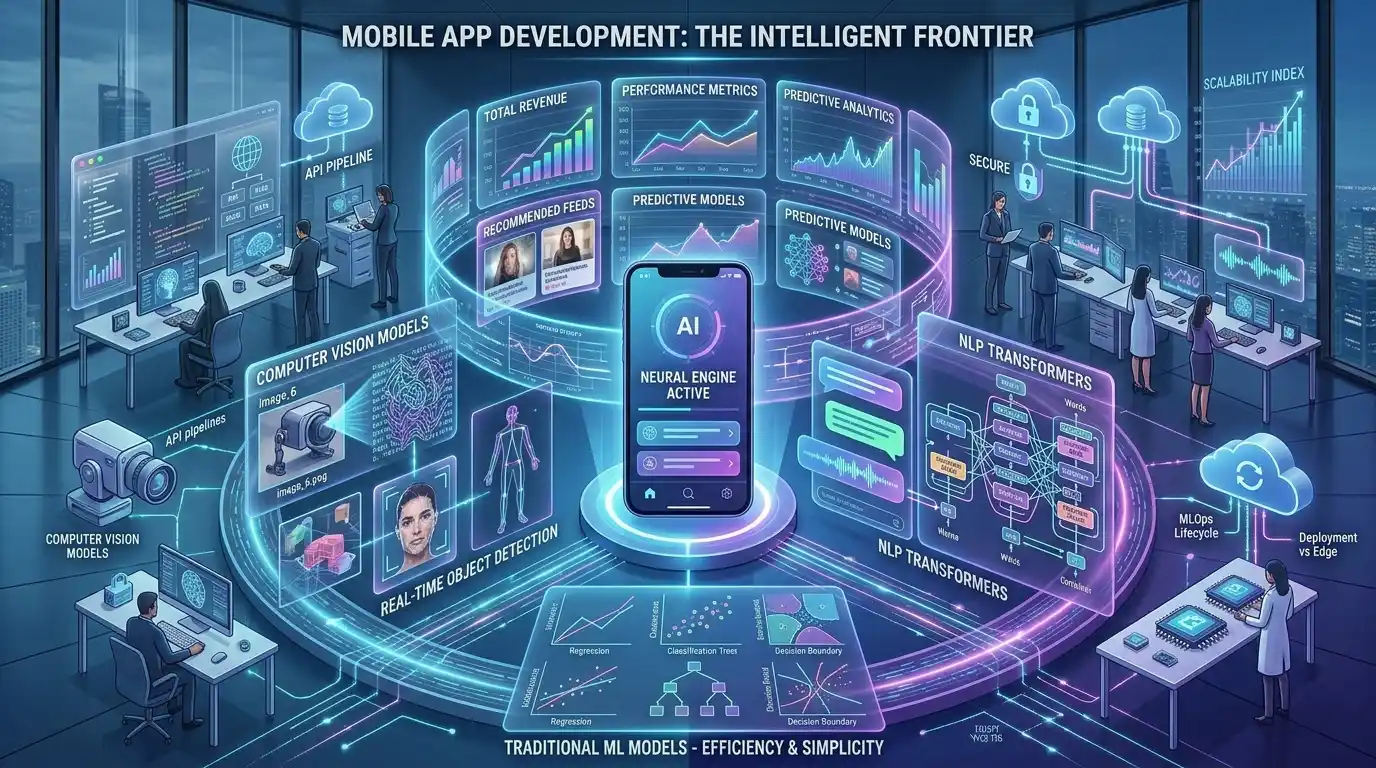
For tech founders and mobile engineering leads, the mandate to “add AI” to a mobile application is incredibly vague. Artificial Intelligence is a massive, overarching umbrella term. Beneath it lies the true engine of modern software: Machine Learning (ML).
When integrating machine learning into a mobile application, the most critical architectural decision is selecting the correct type of algorithmic model. You cannot use a Large Language Model (LLM) to analyze an X-ray, and you cannot use a Convolutional Neural Network (CNN) to predict what product a user will buy next.
Choosing the wrong machine learning architecture will not only result in terrible app performance and high latency, but it will also cause your cloud compute costs to spiral out of control.
To build a flawless product, your data science team must align the specific mathematical model with the exact user pain point. In this technical deep-dive, we will explore the different machine learning app development services available, breaking down the specific neural networks required for computer vision, natural language processing, and predictive analytics.
Understanding these model types is a mandatory phase in the AI application development lifecycle. If your team lacks the deep data science expertise required to train and deploy these models, MindRind is a premier machine learning app development company that specializes in architecting high-performance ML pipelines for iOS and Android.
Chapter 1: Computer Vision (Seeing the World)
If your mobile application needs to interact with the smartphone’s camera, analyze photos, or track movement in real-time, you must deploy Computer Vision (CV) models.
The Algorithm: Convolutional Neural Networks (CNNs)
The backbone of modern Computer Vision is the Convolutional Neural Network (CNN). Unlike traditional algorithms that process data linearly, CNNs are specifically designed to analyze pixel data in 2D or 3D grids. They use mathematical “filters” to detect edges, shapes, and eventually complex objects within an image.
Mobile App Use Cases for Computer Vision:
- Object Detection & Classification: E-commerce apps use CNNs so users can take a photo of a piece of furniture and instantly find visually similar items in the store’s inventory.
- Facial Recognition & Biometrics: Fintech apps use highly secure Computer Vision models to verify a user’s identity by comparing a live selfie against their ID card.
- Pose Estimation (Real-Time Tracking): If you are building an AI fitness app, you use frameworks like MediaPipe to map 33 3D skeletal keypoints on the user’s body. The ML model tracks the geometry of these points at 30 frames per second to correct workout posture in real-time.
The Engineering Challenge: Computer Vision models are notoriously heavy. If you attempt to process a 4K video feed by sending it to a cloud server, the app will crash due to network latency. Mobile engineers must compress these CNNs and deploy them directly onto the smartphone using Edge AI and CoreML to ensure zero-latency processing.
Chapter 2: Natural Language Processing (Understanding Human Text)
If your application involves chatbots, document summarization, voice-to-text, or language translation, your engineering team must deploy Natural Language Processing (NLP) models.
The Algorithm: Transformer Architectures and LLMs
While Recurrent Neural Networks (RNNs) used to dominate this space, the industry has universally shifted to the Transformer Architecture. Transformers power Large Language Models (LLMs) like GPT-4, Claude, and Meta Llama 3. They analyze the relationships between all words in a sentence simultaneously (via a mechanism called “Self-Attention”), allowing the AI to understand deep context and nuance.
Mobile App Use Cases for NLP:
- Conversational Interfaces (Chatbots): Customer support apps use NLP to understand user intent. Instead of forcing users through rigid menus, the user can simply type, “I want to cancel my flight,” and the ML model understands the intent and triggers the backend cancellation API.
- Data Extraction & Summarization: B2B productivity apps use NLP to instantly scan massive PDF contracts, extract specific legal clauses, and output a 3-bullet-point summary.
- Ambient Clinical Documentation: Medical apps use advanced speech-to-text NLP models to listen to a doctor-patient consultation and automatically structure the conversation into a compliant Electronic Health Record (EHR). If you are building in this regulated space, understanding the specific ML models required for AI healthcare diagnostics is critical.
Chapter 3: Predictive Analytics and Recommendation Engines
If your mobile app relies on keeping users engaged, increasing sales, or predicting future events based on historical data, you need Predictive Analytics and Recommendation Engines.
The Algorithms: Collaborative Filtering and Deep Learning
Unlike Computer Vision or NLP, predictive models often deal with structured, tabular data (rows and columns of user behavior).
- Collaborative Filtering: This algorithm powers classic recommendation engines. It looks at a user’s past behavior (e.g., watching a sci-fi movie) and finds other users with similar behavior to predict what the original user will want to watch next.
- Deep Learning Recommenders: Modern apps use Deep Neural Networks (DNNs) that can analyze hundreds of complex variables simultaneously—time of day, location, scroll speed, and purchase history to serve hyper-personalized content.
Mobile App Use Cases for Predictive ML:
- E-Commerce and Media: Spotify, Netflix, and Amazon are built almost entirely on recommendation engines. By predicting exactly what the user wants to see next, these ML models drastically increase Session Duration and Customer Lifetime Value (LTV).
- FinTech and Fraud Detection: Banking apps use Anomaly Detection algorithms (a subset of predictive ML). By analyzing a user’s typical spending habits in real-time, the model can instantly flag or block a transaction if a credit card is suddenly used in a different country.
- Dynamic Pricing: Ride-sharing apps and travel booking platforms use ML models to adjust prices in real-time based on supply, demand, weather conditions, and local events.
Chapter 4: Traditional Machine Learning (Regression & Classification)
With the intense hype surrounding Deep Learning and Generative AI, many tech founders ignore the power (and efficiency) of “Traditional” Machine Learning.
You do not need a massive, expensive neural network to solve every problem. Sometimes, classic statistical algorithms are vastly superior because they are lightweight, incredibly fast, and cheap to run.
The Algorithms: Linear Regression, Random Forests, and SVMs
- Regression Models: These are used to predict a continuous numerical value. For example, a real estate app might use a Multiple Linear Regression model to predict the exact selling price of a house based on its square footage, zip code, and age.
- Classification Models: Algorithms like Random Forests or Support Vector Machines (SVMs) are used to categorize data into distinct groups. For example, an email client app uses a classification model to determine if an incoming email is “Spam” or “Not Spam.”
The Engineering Advantage
The beauty of traditional ML algorithms is their simplicity. They do not require clusters of NVIDIA GPUs or massive Cloud APIs. A mobile developer can easily package a trained Random Forest model directly into the app bundle. It runs instantly on the smartphone’s basic CPU with zero network latency.
When your engineering team maps out the architectural differences between traditional and AI apps, knowing when to use a simple regression model versus a heavy neural network is the key to maintaining a fast, lightweight mobile application.
Chapter 5: The Model Deployment Lifecycle (MLOps)
Selecting the right machine learning model is only the first step. A model sitting in a Jupyter Notebook on a data scientist’s laptop is useless to your mobile app users. You must deploy it.
Bridging the Gap Between Data Science and Mobile Dev
This requires Machine Learning Operations (MLOps).
- API Containerization: If the model runs in the cloud, backend engineers must wrap the Python model in a high-performance framework (like FastAPI), containerize it using Docker, and deploy it to a scalable cluster (like Kubernetes) behind an API Gateway.
- Model Quantization: If the model runs on the edge (the mobile phone), MLOps engineers must compress the model’s weights (quantization) and convert it into .mlmodel (for iOS) or .tflite (for Android) formats.
- Continuous Monitoring (Data Drift): Once the app is live, the ML model will degrade in accuracy as user behavior changes. The app must silently collect analytics, send them back to the data scientists, and facilitate continuous automated model retraining.
Build Intelligent Mobile Apps with MindRind
Integrating machine learning into a mobile application requires a flawless synthesis of two entirely different disciplines: Data Science and Native Mobile Engineering. If you hire a standard mobile dev agency, they will not understand vector calculus. If you hire a pure data science consultancy, they will not know how to optimize CoreML for battery life.
At MindRind, we bridge this gap. We are an elite machine learning app development company (<- Focus Keyword used naturally) that houses both disciplines under one roof. Our data scientists identify the exact algorithm whether it is a CNN for Computer Vision or a Transformer for NLP while our mobile architects deploy it seamlessly into iOS and Android ecosystems for zero-latency performance.
Don’t build your app on the wrong algorithmic foundation. Contact MindRind today to architect a high-performance machine learning application.
Frequently Asked Questions
Artificial Intelligence (AI) is the broad concept of machines simulating human intelligence. Machine Learning (ML) is a specific subset of AI where algorithms are trained on large datasets to recognize patterns and make predictions without being explicitly programmed with step-by-step rules.
You should use Computer Vision (typically Convolutional Neural Networks or CNNs) anytime your app needs to analyze visual data. Common use cases include scanning barcodes, facial recognition, identifying objects in photos, or tracking body movements (pose estimation) in fitness apps.
A Recommendation Engine is a Machine Learning model that analyzes a user’s past behavior to predict what they will want next. Algorithms like Collaborative Filtering or Deep Neural Networks are used by apps like Netflix, Spotify, and Amazon to suggest content, maximizing user retention and sales.
ChatGPT is a Large Language Model (LLM) designed specifically for Natural Language Processing (NLP). It is excellent for summarizing text or acting as a chatbot, but it cannot accurately perform predictive analytics (like forecasting stock prices) or execute real-time video analysis. You must match the model type to the specific task.
Deep Learning uses complex, multi-layered Artificial Neural Networks to analyze massive amounts of unstructured data (like images, audio, and raw text). Traditional ML (like Linear Regression or Random Forests) uses simpler statistical algorithms and is better suited for smaller, structured, tabular datasets (like Excel spreadsheets).
They can, if improperly deployed. Heavy neural networks run in the cloud introduce network latency. If run locally on the device (Edge AI), they can drain the battery or cause lag if the model isn’t properly compressed (quantized) for the smartphone’s hardware.
To run an ML model natively on an iPhone, developers must convert the trained model (often built in Python using PyTorch or TensorFlow) into Apple’s proprietary format using the CoreML framework. The Swift frontend then interacts directly with this .mlmodel file to execute predictions locally.
Data Drift occurs when the real-world data an app encounters begins to differ from the data the ML model was originally trained on. Over time, this causes the model’s predictions to lose accuracy. MLOps (Machine Learning Operations) teams must continuously monitor the app and retrain the model with fresh data to fix this drift.