

For Tech Founders and Enterprise Chief Information Officers (CIOs), making the decision to build a custom AI application is only the first step. The second, far more consequential step is deciding who will actually build it.
Given the severe global shortage of specialized Machine Learning Engineers and Data Scientists, building an elite in-house team from scratch can stall a project for 6 to 8 months. To bypass this bottleneck and achieve immediate speed-to-market, top-tier enterprises partner with specialized external development agencies.
However, many founders enter these partnerships with unrealistic expectations, assuming that building an AI app is identical to building a traditional mobile application. It is not. The integration of complex vector mathematics, probabilistic logic, and neural networks requires a fundamentally different project management lifecycle.
If you do not understand the agency’s workflow—from the initial mathematical feasibility checks to the final App Store deployment—you risk scope creep, blown budgets, and a failed product launch.
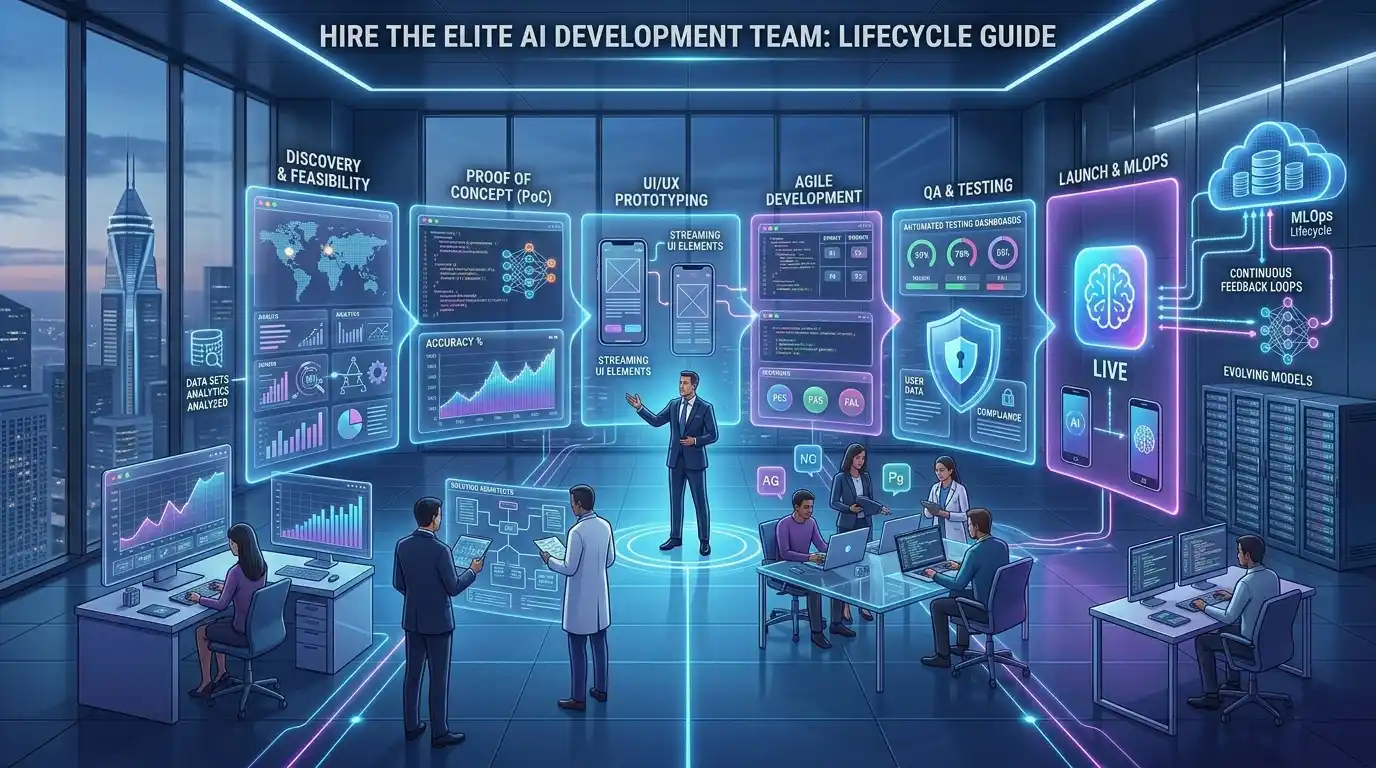
In this comprehensive operational guide, we will pull back the curtain and explain the exact agile methodology and deliverables you should expect when hiring an ai app development agency. Understanding this workflow is the final piece of mastering the AI application development lifecycle.
If your organization is ready to start building immediately, MindRind is a premier artificial intelligence app development services provider that guarantees transparent communication and Silicon Valley-grade engineering from day one.
Chapter 1: The Discovery and Feasibility Phase
A traditional web development agency might jump straight into designing UI screens after a single kickoff call. A legitimate AI agency will refuse to draw a single button until they have validated the underlying mathematics.
Step 1: The Technical Audit and Data Strategy
The first two weeks of the engagement are purely analytical. The agency’s Solution Architects and Data Scientists will audit your business goals and, more importantly, your data.
- The Data Question: AI is useless without high-quality data. The agency will ask: Do you have enough historical data to train a custom model? Is your data structured or unstructured? Is it siloed in legacy ERP systems?
- Compliance Check: If you are building for a regulated industry, the agency will immediately map out the legal guardrails, determining how to anonymize Personally Identifiable Information (PII) before it ever touches a neural network.
Step 2: The Proof of Concept (PoC)
Before committing hundreds of thousands of dollars to frontend development, the agency will build a Proof of Concept (PoC). This is a raw, ugly backend script. Its only purpose is to prove that the chosen machine learning model can actually achieve the required accuracy. If the PoC shows that the AI hallucinates 40% of the time, the agency pivots the architecture. They may decide to switch from a pre-built Cloud API to a custom fine-tuned model. To understand why these architectural pivots are necessary, founders should review how agencies select the right machine learning models for mobile apps.
Chapter 2: UI/UX Design and The Prototyping Phase
Once the mathematical foundation (the PoC) is proven solid, the agency moves into the visual design phase.
Designing for Latency and Uncertainty
The agency’s UI/UX designers understand that AI models take time to generate answers (Cloud API latency). They will not design traditional loading spinners. Instead, they will deliver wireframes that feature “Latency Masking” techniques—such as skeleton screens, shimmering text boxes, and streaming outputs (like ChatGPT).
Furthermore, the design team will map out specific “Human-in-the-Loop” (HITL) workflows. Because the AI might make a probabilistic error, the UI must include seamless ways for the user to edit, correct, or regenerate the AI’s output. To see exactly what these screens should look like, review our guide on UX/UI design for generative AI apps.
The Clickable Prototype
The final deliverable of this phase is a high-fidelity, interactive prototype (usually built in Figma). This allows the founders and the enterprise stakeholders to “click through” the app on their phones and approve the exact user journey before the heavy software engineering begins.
Chapter 3: Agile Engineering and Sprints
With the PoC validated and the UI designs approved, the actual coding begins. Premium AI agencies do not use the outdated “Waterfall” methodology (where they disappear for 6 months and return with a finished app). They use Agile Scrum.
The 2-Week Sprint Cycle
The development process is broken down into 2-week iterations called “Sprints.”
- At the start of every sprint, the agency’s Project Manager aligns with your team to agree on a specific set of features to be built.
- At the end of the two weeks, the agency delivers a functional piece of software. You can download a test build (via TestFlight for iOS) and actually use the new AI feature on your phone.
This constant communication loop ensures that if the AI behaves unexpectedly in the real world, the development team can course-correct immediately without wasting months of engineering budget.
This requirement for real-time, synchronous communication is the primary reason why leading tech startups aggressively prefer partnering with an AI app development company in the USA over offshore agencies trapped in 12-hour timezone delays.
Chapter 4: The Squad—Who is Actually Building Your App?
When you hire a premium AI agency, you are not just getting a “coder.” You are gaining access to a highly specialized, multi-disciplinary engineering squad. If an agency claims that one or two full-stack developers will build your entire AI ecosystem, run the other way.
A legitimate AI app development squad consists of:
- The Solution Architect: Designs the high-level infrastructure, deciding if the app will use Cloud APIs or Edge Computing (CoreML), and ensures the backend can handle scale.
- The Data Scientist / ML Engineer: Cleans your proprietary data, builds the vector databases (like Pinecone), and fine-tunes the Large Language Models (LLMs).
- The Native Mobile Developers: Experts in Swift (iOS) and Kotlin (Android) who integrate the ML models into the smartphone’s hardware, optimizing battery life and camera sensor inputs.
- The QA Automation Engineer: Tests the AI models using “Golden Datasets” to mathematically verify accuracy and prevent hallucinatory edge cases.
During the development sprints, this squad will constantly advise you on architectural decisions. For instance, they will help you navigate the complex financial and technical trade-offs between utilizing custom AI application development vs white-label solutions, ensuring you retain 100% ownership of your Intellectual Property (IP).
Chapter 5: Rigorous Quality Assurance (QA) and Compliance
Testing an AI app is vastly more complex than testing a traditional mobile app. In a traditional app, QA simply verifies that a button click opens the correct screen. In an AI app, the outputs are probabilistic, meaning the AI will generate a different answer every time.
Continuous Evaluation Frameworks
The agency will implement Continuous Evaluation. Instead of standard unit tests, they will feed the AI thousands of test prompts (a Golden Dataset). They will set a strict mathematical threshold—for example, the AI must accurately extract the correct data from a receipt 95% of the time. If a new code commit causes the accuracy to drop to 91%, the build automatically fails.
Compliance and Security Audits
Before launch, the agency’s security architects will perform penetration testing. If the app is in the healthcare or financial sector, they will verify that dynamic data masking is functioning correctly, ensuring that no Personally Identifiable Information (PII) is leaking to third-party Cloud APIs.
Chapter 6: The Launch and The MLOps Phase
After months of rigorous development and testing, the agency packages the code and submits it to the iOS App Store and Google Play Store. But in AI development, the launch is merely the beginning.
The Reality of Data Drift
Once real users start interacting with the app, the AI model will encounter data it has never seen before. Over time, the model’s accuracy will degrade—a phenomenon known as “Data Drift.”
Machine Learning Operations (MLOps) Hand-off
A premium agency does not hand you the code and walk away. They implement MLOps pipelines. This infrastructure continuously monitors the AI’s real-world performance, automatically capturing failed interactions or user “Thumbs Downs.” The agency will typically offer an ongoing retainer to periodically retrain your machine learning models with this fresh data, ensuring your app actually gets smarter the more people use it.
Partner with MindRind for Your AI Journey
Building an AI-powered mobile or web application is an incredibly complex orchestration of advanced mathematics, cloud architecture, and beautiful UI design. A single flaw in the vector database or a poorly optimized CoreML deployment can doom the entire project.
At MindRind, we eliminate the guesswork. We are an elite ai app development services (<- Focus Keyword used naturally) provider trusted by tech founders and enterprise CIOs to deliver flawless software. Our agile process guarantees absolute transparency—from the initial mathematical Proof of Concept to the final App Store deployment and ongoing MLOps maintenance.
Don’t leave your product launch to chance. Contact MindRind today to schedule your technical discovery call and start building with the best.
Frequently Asked Questions
Before designing any screens or writing frontend code, a legitimate AI agency begins with a Discovery and Feasibility Phase. They audit your company’s data and build a mathematical Proof of Concept (PoC) to verify that a machine learning model can actually solve your specific problem with a high degree of accuracy.
The timeline depends heavily on complexity. A basic AI wrapper application (using public APIs like OpenAI) can be built in 2 to 3 months. However, a highly secure, enterprise-grade mobile app featuring custom-trained machine learning models, complex vector databases, and native mobile UI/UX typically requires a 6 to 9-month development lifecycle.
Agile Scrum is a project management framework where development is broken down into 2-week cycles called “Sprints.” At the end of every 2 weeks, the agency delivers a functional, testable piece of the app. This allows founders to test the AI in real-time and pivot the architecture if the AI behaves unexpectedly, preventing wasted budget.
Building a production-ready AI app requires multiple highly specialized disciplines. You need a Data Scientist to train the model, a Backend Engineer to build the vector databases, a Mobile Developer (Swift/Kotlin) to integrate the UI, and an MLOps specialist to maintain it. A single developer cannot master all these complex fields efficiently.
Because AI is probabilistic (it generates different answers to the same prompt), agencies cannot use traditional rigid unit tests. Instead, QA engineers use “Continuous Evaluation.” They feed the AI a massive “Golden Dataset” of test prompts and use mathematical thresholds to ensure the model maintains an overall accuracy rate (e.g., 95%) before approving the build.
The launch marks the beginning of the MLOps (Machine Learning Operations) phase. AI models suffer from “Data Drift,” meaning their accuracy degrades as they encounter new, real-world data. The agency will monitor the model’s performance and continuously retrain it with fresh user data to ensure the app stays smart and accurate.
If you hire a reputable, US-based agency, yes. Before the project begins, you will sign ironclad IP (Intellectual Property) Assignment contracts and NDAs. This guarantees that your startup or enterprise owns 100% of the custom source code, the trained machine learning models, and the proprietary data pipelines.
AI development requires constant, real-time communication between product managers and data scientists to adjust algorithms and fine-tune models. If your agency is 12 hours away, a simple 5-minute technical question can cause a 48-hour delay, completely destroying the speed of your agile sprints.