
For Chief Executive Officers (CEOs) and technical leaders, the mandate from the board of directors is clear: Integrate generative AI into our enterprise operations, and do it faster than our competitors.
However, translating that boardroom mandate into a deployed, production-ready software application presents an immediate, critical bottleneck. Who is actually going to build it?
Standard full-stack web developers (proficient in React, Node.js, and SQL) cannot simply pivot to building complex Large Language Model (LLM) architectures over a weekend. Generative AI requires deep expertise in vector calculus, PyTorch, LangChain orchestration, and machine learning operations (MLOps).
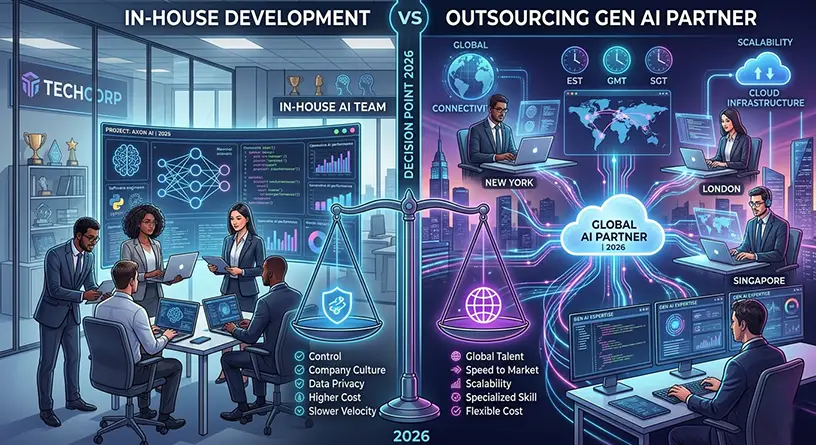
This leaves enterprise leaders with a monumental strategic decision: Do you spend the next 6 to 12 months trying to recruit, vet, and build an internal AI engineering division from scratch? Or do you bypass the talent shortage entirely by partnering with the best generative ai development company to achieve immediate speed-to-market?
In this comprehensive hiring guide, we will analyze the extreme global AI talent shortage, compare the hidden costs of in-house recruitment versus agency retainers, and help you choose the smartest path for your 2026 roadmap. If you are still mapping out your overall tech strategy, we highly recommend reading our masterclass on starting generative ai software development before making any hiring decisions.
Chapter 1: The 2026 Global AI Talent Shortage
To make an informed decision about building an internal team, you must first understand the reality of the 2026 tech labor market. There is a severe, global shortage of qualified Machine Learning Engineers and Data Scientists.
Every Fortune 500 company, well-funded Silicon Valley startup, and government defense contractor is aggressively hunting for the exact same talent.
The Difference Between Web Devs and AI Engineers
A common mistake CTOs make is assuming their current backend engineers can learn generative AI on the fly. While a senior backend developer can easily learn how to make a basic API call to OpenAI, building a fault-tolerant, hallucination-free enterprise AI ecosystem is fundamentally different.
True AI engineering is rooted in mathematics, not just logic. If you choose to build an internal team, you must know exactly what developer skills to look for. our recruiters must be able to evaluate candidates on highly technical competencies such as:
- Tensor parallelism and GPU memory management.
- Implementing Low-Rank Adaptation (LoRA) for model fine-tuning.
- Designing multi-agent orchestration pipelines.
- Managing embeddings and vector database namespaces.
The Recruitment Timeline Trap
Because this talent is so scarce, the average recruitment cycle for a Senior AI Architect is currently 4 to 6 months. Add another 2 months for onboarding and system acclimatization. If you decide to build an in-house team today, your company will likely not write its first production-ready LLM prompt for at least 8 months. In the AI arms race, an 8-month delay guarantees that your competitors will capture your market share.
Chapter 2: The Hidden Costs of an In-House AI Division
When calculating the budget for an AI initiative, many executives only look at the base salaries of the engineers. However, the Total Cost of Ownership (TCO) for an internal AI division is significantly higher.
Payroll and Benefits
In the US market in 2026, the baseline salary for a single mid-level Machine Learning Engineer routinely exceeds $180,000 to $220,000. But an AI project cannot be built by one person. A functional, production-ready AI squad requires:
- Lead AI Architect (Designs the RAG or Fine-tuning infrastructure).
- Data Engineer (Builds the ETL pipelines to clean unstructured enterprise data).
- MLOps Engineer (Manages the cloud GPU deployments and monitors for model drift).
- Backend Integration Developer (Connects the AI to your existing B2B SaaS).
Factoring in equity, bonuses, healthcare, and recruitment agency fees (often 20% of the first year’s salary), a bare-bones internal AI team will cost an enterprise well over $1.2 Million to $1.5 Million annually.
The “Idle Time” Financial Drain
What happens when version 1.0 of your AI software is deployed? The heavy lifting of architectural design and data pipelining is finished. The project transitions into a maintenance phase. Now, you are paying $1.5 Million a year for a team of elite engineers to simply monitor logs and occasionally tweak prompts. This results in massive financial waste.
If you are trying to secure a budget for your AI initiative, it is critical to compare these massive payroll liabilities against a fixed-bid agency contract. Review our deep-dive financial breakdown on overall custom AI development cost comparison to see the exact unit economics.
Chapter 3: The Strategic Advantage of Outsourcing AI Development
For over 80% of B2B enterprises and SaaS companies, generative AI is a feature of their product, not the entire company’s core identity. If you are a healthcare logistics company, your core competency is logistics, not training neural networks.
Partnering with an elite generative AI development firm flips the traditional software economics in your favor.
Immediate Speed-to-Market (Zero Recruitment Time)
When you outsource to a specialized AI agency, you bypass the 8-month recruitment cycle entirely. You sign a contract, and on day one, an entire squad of vetted, highly experienced AI Architects, Data Engineers, and MLOps specialists is deployed to your project. They already have the workflows, boilerplate code, and infrastructure templates ready to execute.
Elimination of Technical Debt
Because AI technology evolves every 3 to 6 months, an inexperienced in-house team will inevitably build their architecture using frameworks that will be obsolete by the time the software launches. This creates massive technical debt. A specialized AI agency builds these systems all day, every day. They know which open-source models are stable, which vector databases scale the best, and how to future-proof your architecture so that upgrading from an older LLM to a newer one requires minimal refactoring.
Chapter 4: Mitigating the Risks of Outsourcing
While outsourcing provides massive financial and speed advantages, it is not without risks. The generative AI boom has led to the creation of thousands of “AI Agencies” overnight. Many of these are simply traditional web development shops that have read a few tutorials on how to use the OpenAI API.
Partnering with an unqualified agency can lead to disastrous consequences for an enterprise, specifically regarding data privacy and infrastructure scalability.
The Security Risk of Inexperienced Agencies
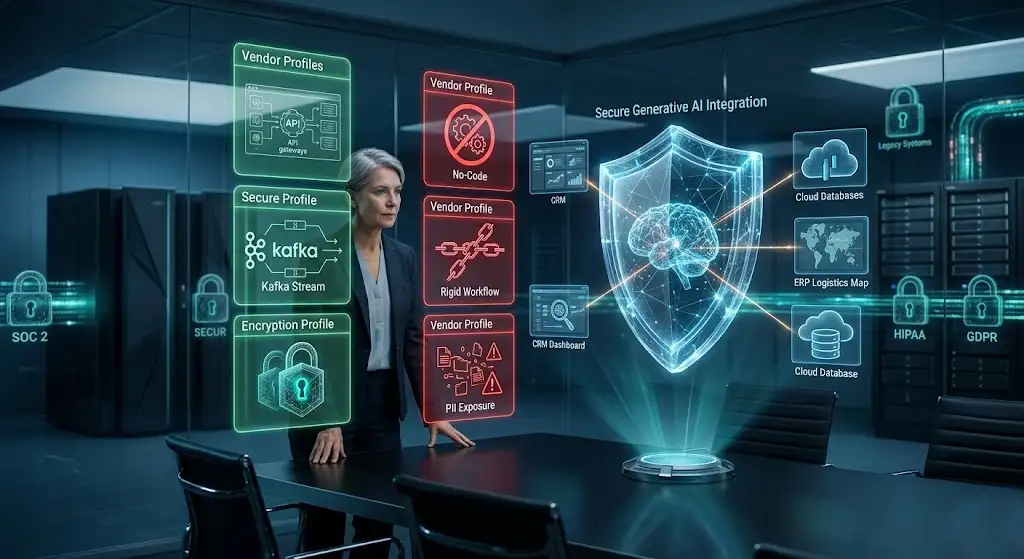
If an agency lacks deep enterprise security experience, they will likely take the path of least resistance: sending your highly sensitive corporate data to public API endpoints. This exposes your intellectual property to third-party model training and violates strict compliance frameworks like SOC 2 and GDPR.
An elite agency understands how to build zero-trust environments. They will deploy open-source models on your own Virtual Private Cloud (VPC), implement dynamic data masking, and build strict Role-Based Access Control (RBAC) into the vector databases. Before signing any contract, you must ensure the agency deeply understands the security risks of bad outsourcing and data leaks .
Integration with Existing Software Teams
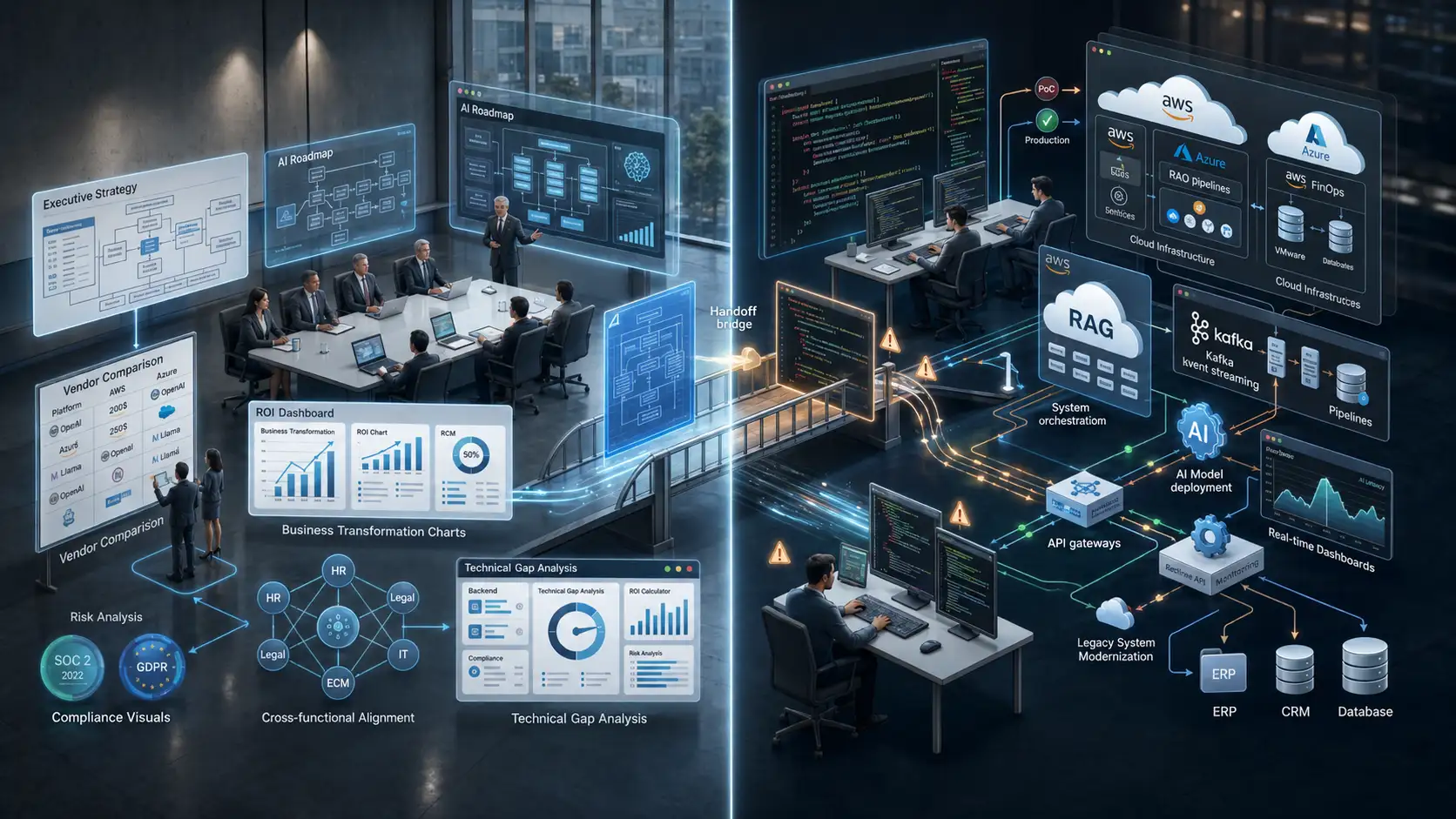
Another common fear among CTOs is that an external agency will build a “black box” solution that their internal developers cannot understand or maintain. A premium AI development firm does not replace your internal team; they augment them. The agency should handle the heavy mathematical lifting (vector databases, MLOps, LLM orchestration) and expose clean, well-documented REST APIs or GraphQL endpoints. This allows your internal frontend and backend developers to seamlessly integrate the AI features into your existing platforms. For a deeper look at this workflow, read our guide on building AI capabilities into existing software teams .
Chapter 5: The Ultimate Vetting Checklist for Generative AI Agencies
How do you separate the elite machine learning engineers from the API wrappers? When interviewing a potential generative AI development company in 2026, ask their technical leads these four critical questions:
- “How do you handle AI hallucinations in a production environment?”
- Red Flag Answer: “We just write better prompts and lower the temperature setting.”
- Green Flag Answer: “We design a strict Retrieval-Augmented Generation (RAG) architecture, ground the model in your vector database, and deploy semantic output guardrails to mathematically evaluate the response before it reaches the user.”
- “Do you have experience hosting open-source models, or do you only use OpenAI?”
- Red Flag Answer: “We only use OpenAI because it is the most powerful.”
- Green Flag Answer: “We use proprietary APIs for prototyping, but for enterprise data privacy and cost-scaling, we specialize in quantizing and hosting open-source models (like Llama 3) on AWS/Azure VPCs.”
- “How do you manage the context window to keep token costs low?”
- Red Flag Answer: “Modern models have 1-million token windows, so we just pass the entire document history.”
- Green Flag Answer: “We use conversation compression, semantic caching at the gateway level, and precise embedding retrieval to keep prompt payloads small, fast, and cost-effective.”
- “How do you update the AI’s knowledge without retraining the whole model?”
- Red Flag Answer: “We fine-tune the model every time the data changes.”
- Green Flag Answer: “We use LlamaIndex to build dynamic data pipelines that instantly update the vector database whenever a document is changed in your CRM.”
Hire the Best: Why Enterprises Choose MindRind
Deciding how to build your AI infrastructure is the most consequential tech decision your company will make this decade. You do not have the time to deal with the talent shortage, and you cannot afford the financial waste of building an internal team from scratch.
At MindRind, we are the premier generative ai development company (<- Focus Keyword used naturally). We are not a traditional web shop; we are a dedicated team of elite machine learning engineers, data scientists, and security architects.
We partner with B2B enterprises to design, deploy, and maintain highly scalable AI ecosystems. From hallucination-free chatbots to autonomous coding agents and secure VPC deployments, we deliver production-ready AI in a fraction of the time it takes to build an in-house team.
Stop fighting the talent shortage. Contact MindRind today to schedule a technical consultation and accelerate your AI roadmap.
Frequently Asked Questions
Hiring an AI agency is significantly cheaper and more predictable. Building an in-house team requires hiring ML Engineers, Data Scientists, and MLOps specialists, which can cost over $1.5 Million annually in payroll alone. An agency provides an entire squad of experts for a fixed project fee, eliminating idle-time financial waste.
Due to the severe global talent shortage in generative AI, the average recruitment cycle for a Senior AI Architect or ML Engineer is 4 to 6 months, plus an additional 1 to 2 months for onboarding. Partnering with an agency allows you to start development on day one.
Traditional agencies specialize in deterministic logic (web dev, SQL databases, React). An elite AI agency specializes in probabilistic systems, vector mathematics, LLM orchestration (LangChain), neural network fine-tuning, and specialized MLOps deployments.
It will compromise security if you hire an inexperienced agency that relies solely on public APIs. However, an elite AI development company specializes in enterprise security. They will deploy open-source LLMs directly onto your secure Virtual Private Cloud (VPC) ensuring zero data leakage.
You must evaluate their architectural knowledge. Ask them about their experience with open-source model quantization, vector database namespace segregation, semantic caching, and defense strategies against prompt injection attacks. If they only know how to make OpenAI API calls, they are not qualified.
Yes. A professional AI agency builds the complex ML backend (vector databases, RAG pipelines) and provides your internal team with clean, well-documented REST APIs or GraphQL endpoints. Your internal developers can then easily integrate the AI into your existing frontend applications.
Top-tier agencies offer ongoing MLOps (Machine Learning Operations) retainers. Because AI models suffer from data drift and require continuous vector database updates, the agency will monitor the infrastructure, optimize token costs, and patch security vulnerabilities post-launch.
Industries with strict compliance requirements and large amounts of unstructured data such as Healthcare, Financial Services, Legal Tech, and B2B SaaS benefit the most. These sectors require highly specialized, hallucination-free AI architectures that are incredibly difficult to build with an in-house team.