

For modern enterprise leadership, specifically Chief Operating Officers (COOs) and VPs of IT, the discourse surrounding Artificial Intelligence has reached a critical pivot point. The era of treating AI as a standalone novelty is over. Employees are tired of leaving their core work environments, logging into a separate browser tab to query ChatGPT, and manually copying and pasting the generated answers back into their primary workflow.
This friction destroys productivity. True enterprise value is not achieved by buying another standalone AI application; it is achieved by embedding AI into workflows that already exist.
The goal of enterprise AI integration is to make the technology invisible. When a sales representative opens Salesforce, the AI should already be there, analyzing the lead. When a supply chain manager opens their SAP dashboard, the machine learning predictive models should already be populated.
However, forcing a probabilistic, highly advanced neural network to communicate flawlessly with a rigid, 15-year-old enterprise database is a monumental software engineering challenge. It requires complex API gateways, custom middleware, and zero-trust data security pipelines.
In this comprehensive operational playbook, we will guide enterprise architects through the exact blueprint required to seamlessly weave Generative AI and Machine Learning into your existing tech stack. For organizations seeking to modernize without halting core operations, MindRind provides elite ai integration services, ensuring your proprietary data flows securely between your legacy systems and modern AI endpoints.

Chapter 1: The Myth of “Plug-and-Play” Integration
The software industry has heavily marketed the idea that AI integration is as simple as generating an API key and pasting it into your CRM settings. For a solo entrepreneur using basic Zapier automations, this might be true. For an enterprise handling millions of rows of proprietary data, it is a catastrophic architectural flaw.
The Problem with Direct API Connections
When you connect a frontend application directly to a public AI model, you create three immediate points of failure:
- Rate Limiting and Latency: Public LLMs enforce strict Tokens-Per-Minute (TPM) limits. If 5,000 employees simultaneously trigger a direct API call from their CRM, the system will hit the rate limit and crash, paralyzing your workforce.
- Data Privacy Violations: Direct connections often lack dynamic data masking. If an employee triggers an AI summary on a client file, highly sensitive Personally Identifiable Information (PII) is transmitted directly to third-party servers.
- Vendor Lock-In: If your entire enterprise workflow is hardcoded to the specific API structure of OpenAI, and OpenAI changes its pricing or deprecates a model, your entire IT infrastructure breaks.
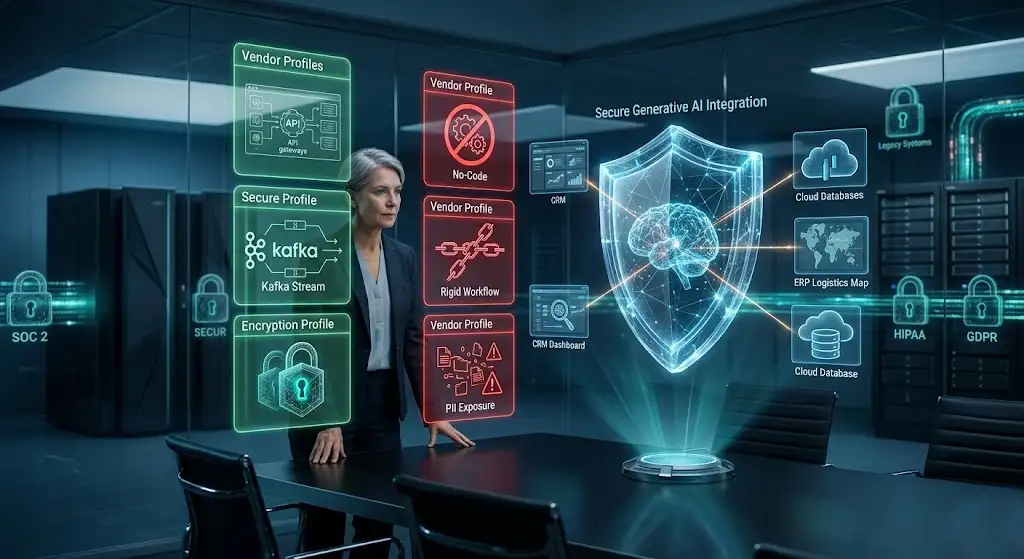
To solve this, enterprise IT teams must stop relying on superficial connections. They must evaluate the severe technical limitations of no-code tools when planning a robust AI software integration guide and pivot toward building custom, resilient middleware.

Chapter 2: Architecting the Custom API Gateway (Middleware)
To safely operationalize AI, enterprise architects must introduce a centralized “Buffer Zone” between the company’s internal software and the external (or internally hosted) AI models. This buffer zone is the Custom API Gateway or Middleware.
The Role of the AI Gateway
Instead of Salesforce talking directly to ChatGPT, Salesforce talks to your proprietary Node.js or Go-based middleware. The middleware then talks to the AI. This architecture unlocks massive operational control:
- Intelligent Load Balancing: The middleware queues incoming requests from your CRM and drips them to the LLM, ensuring you never hit the vendor’s API rate limits.
- Semantic Caching: The middleware stores previous AI answers. If an employee triggers an AI workflow identical to one executed five minutes ago, the middleware returns the cached answer instantly, saving both time and API token costs.
- Model Agnosticism: The middleware acts as a universal translator. If you decide to switch your backend AI provider from Anthropic’s Claude to a localized Llama 3 model, your developers only change the code within the middleware. The frontend CRM integration remains completely untouched.
Designing this robust translation layer is exactly how elite engineering teams execute successful GPT integration services for massive corporations without disrupting daily workflows.

Chapter 3: Conquering the Legacy System Bottleneck
The most daunting integration challenge an enterprise faces is not connecting AI to modern SaaS platforms (like Slack or HubSpot); it is connecting AI to legacy on-premise systems.
Many Fortune 500 companies run their core operations on massive, monolithic architectures like AS/400 mainframes, outdated Oracle databases, or heavily customized, on-premise SAP deployments. These systems do not possess modern REST or GraphQL APIs. They communicate via outdated SOAP protocols or flat-file batch transfers.
Bridging the Gap
You cannot simply connect an LLM to a mainframe. The integration must be meticulously phased:
- Data Extraction Layers: Data engineers must build custom Microservices that act as a wrapper around the legacy system, safely extracting data without overloading the fragile, aging databases.
- Modernization without Replacement: The AI middleware translates this extracted, archaic data into modern JSON payloads that the neural networks can comprehend.
This process allows the enterprise to achieve the benefits of AI predictive analytics and automation without undertaking a multi-million dollar, multi-year project to replace the underlying ERP. To understand the exact mechanics of this workaround, IT Directors must review the protocols for integrating AI into legacy enterprise systems.
Because legacy integration carries immense operational risk, leadership teams often rely heavily on the guidance of a specialized AI integration consultant to map out the technical dependencies before execution begins.

Chapter 4: Real-Time Machine Learning Data Pipelines
An AI integration is only as intelligent as the data feeding it. If your middleware securely connects your AI to your backend systems, but those systems are serving data that is 24 hours old, the AI will make critical errors.
For high-stakes enterprise operations such as dynamic pricing engines, real-time fraud detection, or live supply chain routing, batch processing data overnight is unacceptable.
Architecting Event-Driven Data Streams
To achieve true operational intelligence, enterprises must shift from batch processing to event-driven architectures.
- The Workflow: When a customer triggers an event (e.g., placing an order in the CRM), an event broker like Apache Kafka immediately streams that data point into the central data lake.
- The AI Trigger: The machine learning model is instantly notified of the new data, recalculates its predictions, and pushes the updated insight back into the employee’s dashboard in milliseconds.
Building these high-throughput, low-latency pipelines is the hallmark of elite machine learning data integration services. It ensures that your AI models are always operating on the absolute bleeding edge of your corporate reality.

Chapter 5: Zero-Trust Security in API Integrations
The convergence of enterprise data and external AI models creates a terrifying surface area for cyberattacks. When an enterprise integrates AI via APIs, they are creating a two-way street. If those API endpoints are not mathematically secured, hackers can use Prompt Injection attacks to trick the AI into returning secure database schemas or bypassing authentication.
Securing the Middleware
Your integration architecture must adopt a Zero-Trust security posture:
- OAuth 2.0 and JWT: Every single API call made between your legacy systems, your middleware, and the AI must be cryptographically authenticated using JSON Web Tokens (JWT) tied to your company’s Identity and Access Management (IAM) provider.
- Dynamic Data Masking (PII Scrubbing): The middleware must act as a filter. Before a payload is sent to an LLM, Natural Language Processing (NLP) classifiers must automatically scrub Personally Identifiable Information (PII) to prevent data leaks.
To maintain strict SOC 2 and GDPR compliance, enterprise IT leaders must rigorously review the protocols for ensuring data privacy in AI API integrations before the system goes into production.

Chapter 6: Calculating the ROI of Automated Workflows
Custom middleware development, Kafka event streaming, and secure API gateways require a significant upfront Capital Expenditure (CapEx). However, integrating AI directly into the workflows of highly paid employees yields a staggering Return on Investment (ROI).
The Labor Arbitrage Multiplier
Consider an enterprise sales division. If an Account Executive spends two hours a day manually researching leads, cross-referencing LinkedIn with internal databases, and drafting personalized emails, that is 10 hours a week of wasted cognitive labor.
By deploying AI CRM integration services into Salesforce, this workflow is entirely automated. The AI instantly reads the incoming lead, pulls the relevant context via the middleware API, and auto-populates a drafted, highly personalized email directly into the CRM interface. The Account Executive simply reviews it and clicks “Send.”
By saving two hours per day across 500 Account Executives, the enterprise recovers thousands of billable hours monthly. This immediate recovery of operational overhead is exactly how CFOs calculate the operational ROI of AI integration, often proving that the custom integration pays for itself within the first two quarters.

Chapter 7: Execution — The Difference Between Consulting and Development
Recognizing the need for a custom, secure AI integration is easy. Executing it is incredibly difficult.
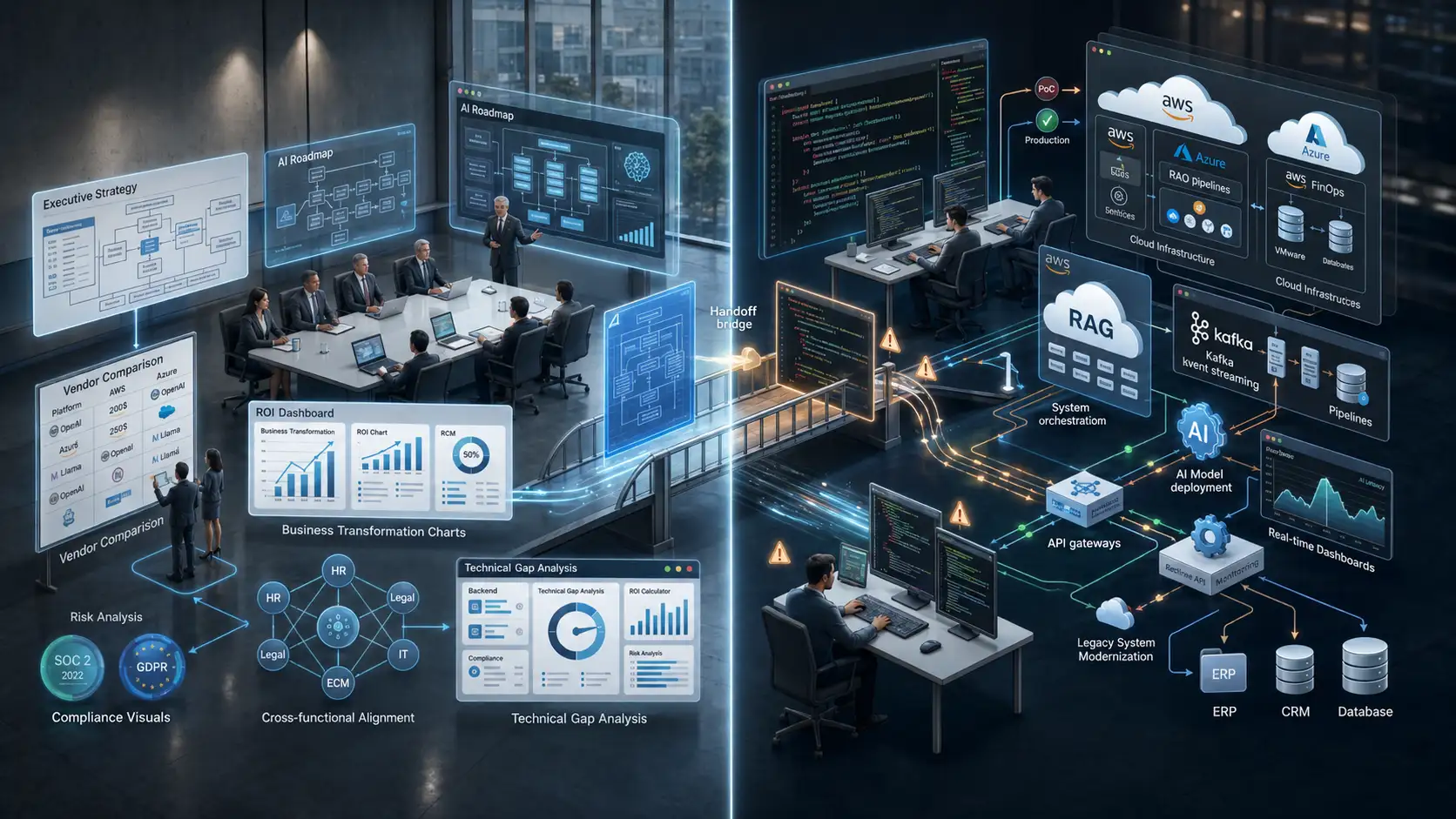
Many enterprises make the mistake of hiring management consultants to map out their digital transformation. While these consultants provide excellent slide decks detailing the strategy, they lack the hardcore MLOps engineers and backend developers required to actually write the Node.js middleware and configure the AWS API Gateways.
Conversely, hiring a cheap offshore development team without a strategic roadmap results in fragile, unsecured API wrappers that crash under enterprise load.
To succeed, an enterprise must understand the critical difference between AI integration consulting and actual software development. You need a partner who can do both: architect the strategic vision and write the production-grade code.
When your procurement team is evaluating vendors, knowing exactly the technical questions to ask to hire a secure generative AI integration company is the final safeguard to ensure your digital transformation succeeds.
Transform Your Enterprise Operations with MindRind
Integrating Artificial Intelligence into the beating heart of an enterprise is not a task for amateurs. A flawed API integration will result in severe rate limits, fractured data pipelines, and catastrophic compliance violations.
At MindRind, we do not build standalone toys; we engineer operational excellence. As a premier enterprise AI integration partner, our elite squad of Solutions Architects, Backend Engineers, and MLOps specialists bridge the gap between legacy infrastructure and modern neural networks.
We build the secure middleware, architect the Kafka event streams, and seamlessly embed generative AI directly into your Salesforce, SAP, and custom internal dashboards. We make AI invisible, secure, and incredibly profitable.
Stop forcing your employees to switch browser tabs. Contact MindRind today to seamlessly integrate AI directly into your enterprise workflows.
Frequently Asked Questions (FAQs)
What is Enterprise AI Integration?
Enterprise AI integration is the complex software engineering process of embedding Artificial Intelligence models (like LLMs or predictive machine learning) directly into a company’s existing software systems (like CRMs, ERPs, or custom dashboards) so that employees can automate tasks without leaving their primary workflow.
Why shouldn’t we just connect our CRM directly to the OpenAI API?
Connecting a frontend CRM directly to a public AI API is a severe security and scalability risk. It can result in API rate-limit crashes, hardcoded vendor lock-in, and the accidental transmission of sensitive customer data (PII) to third-party servers. Enterprises must use custom middleware to secure and control this traffic.
What is AI Middleware (API Gateway)?
Middleware is a custom-built backend server layer (often written in Node.js or Go) that sits between your company’s software and the AI models. It acts as a traffic controller, providing critical functions like intelligent load balancing, Semantic Caching (to save on API token costs), and data sanitization (masking PII).
Can generative AI be integrated with outdated legacy systems (like AS/400 mainframes)?
Yes, but it requires highly specialized engineering. Because legacy systems lack modern REST or GraphQL APIs, integration experts must build custom microservices to safely extract data from the mainframe, translate it into modern formats (JSON), and feed it to the AI without crashing the fragile, aging databases.
How does AI CRM integration improve sales efficiency?
By integrating AI into CRMs like Salesforce or HubSpot, enterprises automate tedious administrative tasks. The AI can automatically summarize meeting notes, predict lead scoring, generate highly personalized outreach emails based on CRM data, and update contact records, allowing human sales teams to focus purely on closing deals.
What is the difference between batch processing and real-time AI data integration?
Batch processing updates the AI’s knowledge base on a scheduled delay (e.g., every night at 2 AM), meaning the AI operates on old data. Real-time integration uses event-streaming architectures (like Apache Kafka) to push new data to the AI the exact millisecond a change occurs, which is mandatory for fraud detection and dynamic pricing.
How do enterprises ensure data privacy during AI integration?
Enterprises enforce a Zero-Trust security posture. This includes using OAuth 2.0 and JWTs for secure authentication, deploying Dynamic Data Masking to scrub PII from prompts before they leave the firewall, and securing Business Associate Agreements (BAAs) with API providers to ensure data is never used for external model training.
Why do enterprises hire specialized agencies for AI integration?
Integrating AI into legacy systems requires a rare combination of Data Engineering, MLOps, and Backend API Architecture. Because there is a global shortage of this talent, building an in-house team is slow and extremely expensive. Specialized agencies provide fully formed, elite engineering squads that can execute these complex integrations immediately and securely.