

The narrative surrounding Artificial Intelligence is dominated by modern tech startups moving at lightning speed. These agile companies operate entirely in the cloud, utilizing modern REST and GraphQL APIs, making AI integration a relatively straightforward process.
However, for Fortune 500 companies, global logistics firms, and massive financial institutions, the reality is starkly different. The beating heart of a true enterprise is not a sleek cloud application; it is a Legacy System.
Decades of historical data, critical supply chain logistics, and core financial records are locked inside outdated, on-premise Enterprise Resource Planning (ERP) systems like SAP, Oracle, or heavily customized AS/400 IBM mainframes. These monolithic systems run on antiquated codebases (like COBOL), rely on flat-file batch processing, and communicate via rigid SOAP protocols.
When a Chief Information Officer (CIO) is mandated by the board to “Implement AI,” they face a monumental architectural nightmare: How do you connect a hyper-advanced, cloud-based Large Language Model (LLM) to a fragile, 20-year-old on-premise mainframe without causing a catastrophic system crash?
In this comprehensive technical guide, we will break down the engineering strategies required to modernize legacy systems through generative ai integration services. Mastering this bridge between the old and the new is a critical component of our master enterprise AI integration playbook.
If your enterprise cannot afford to rip and replace its core ERP, MindRind acts as a premier generative ai integration company, building the custom middleware required to safely extract data and inject AI intelligence directly into your legacy workflows.
Chapter 1: The “Rip and Replace” Fallacy
When faced with the limitations of a legacy system, the immediate reaction from junior consultants is often to advise a total “Rip and Replace”—discarding the old mainframe and migrating everything to a modern cloud ERP.
For a massive enterprise, this is a multi-year, multi-million dollar gamble that carries an unacceptably high rate of failure. Replatforming core business operations can halt supply chains, disrupt payroll, and destroy historical data integrity.
The Strategy: “Modernize in Place”
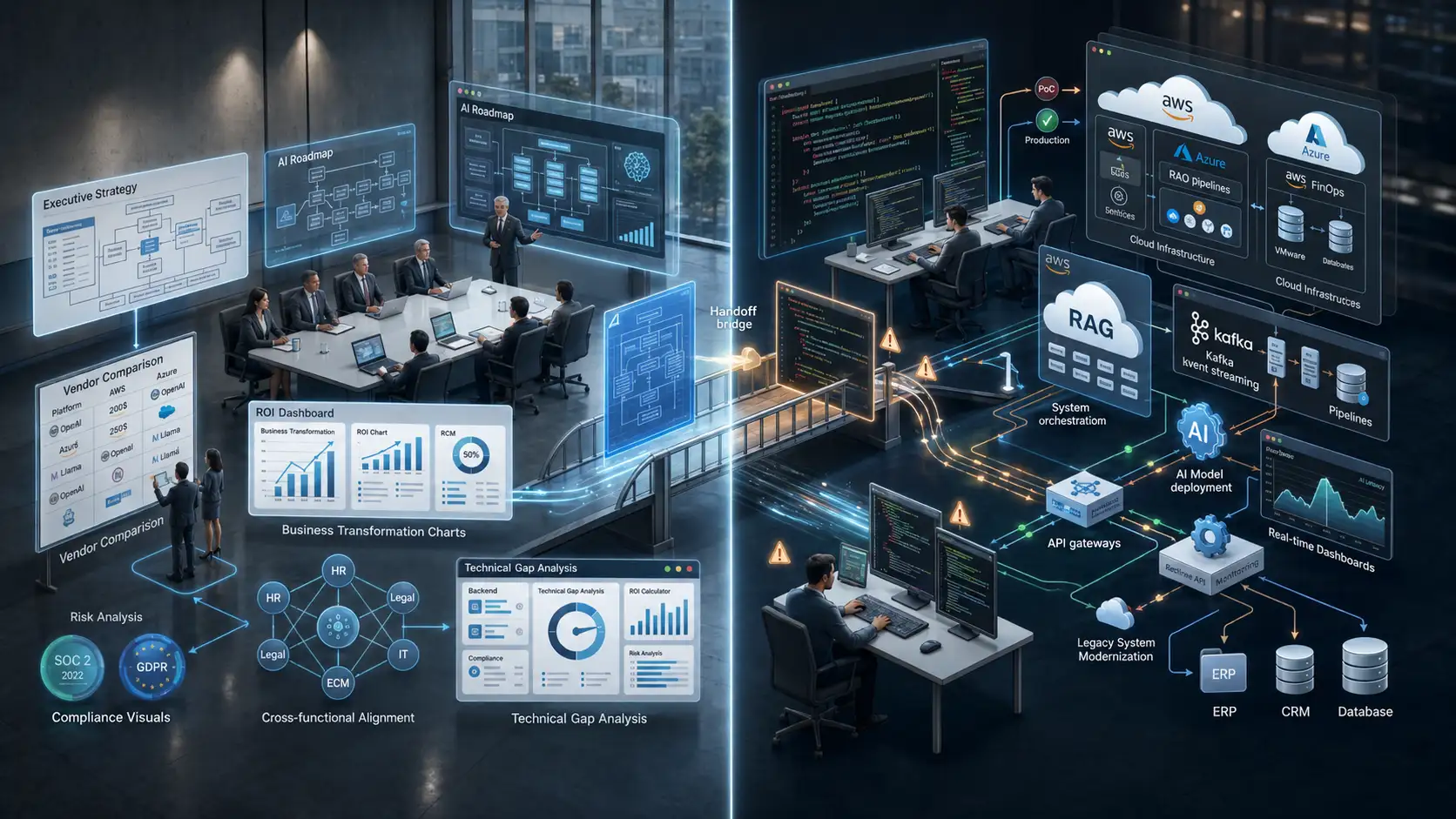
Elite enterprise architects advocate for a different approach: “Modernize in Place” via abstraction layers. You do not touch the fragile core logic of the mainframe. Instead, you build a modern technological wrapper around it.
This wrapper extracts the data, translates it, feeds it to the AI, and pushes the AI’s insights back to the employees via modern dashboards. This approach delivers the high-ROI benefits of AI—such as predictive analytics and automated reporting—while preserving the stability of the underlying legacy system.
Guiding an enterprise through this delicate architectural transition is highly complex, which is why CIOs heavily rely on the specialized expertise of an AI integration consultant to map out the exact integration points before writing any code.
Chapter 2: The Middleware Translation Layer
Because modern AI models operate in the cloud and communicate strictly via modern JSON (JavaScript Object Notation) REST APIs, they cannot “speak” to a legacy ERP system that relies on XML-heavy SOAP APIs or outdated EDI (Electronic Data Interchange) formats.
To bridge this gap, engineering teams must construct custom API Gateways, commonly referred to as Middleware.
The Role of Custom Microservices
Instead of forcing the legacy ERP to connect to OpenAI, developers build custom microservices (often written in Node.js or Go). These microservices sit safely on your internal network.
- The Extraction: The middleware executes a scheduled script that safely polls the legacy database (e.g., extracting daily inventory levels from an Oracle database) during off-peak hours to avoid overloading the mainframe’s CPU.
- The Translation: The middleware parses the outdated XML data, sanitizes it, and translates it into clean, structured JSON payloads.
- The AI Connection: The middleware then acts as a modern client, securely sending the JSON payload to the Large Language Model or predictive machine learning endpoint.
By building this abstraction layer, developers can integrate AI workflows into almost any legacy system. To understand why generic automation tools fail at this level of complexity, IT leaders must review the critical differences between custom API middleware and no-code automation platforms.
Chapter 3: Unlocking Trapped Data for RAG Pipelines
The true value of Generative AI for an enterprise lies in Retrieval-Augmented Generation (RAG). A RAG pipeline allows an AI chatbot to instantly answer an employee’s complex question by reading proprietary company data.
However, in a legacy enterprise, that knowledge is trapped. It exists in millions of unstructured, text-heavy PDFs, legacy Lotus Notes, and siloed SharePoint drives.
Building the Legacy ETL Pipeline
Before an AI can read legacy data, data engineers must build robust Extract, Transform, Load (ETL) pipelines.
- The Workflow: The ETL script scours the legacy storage drives, extracting the unstructured data files.
- Vectorization: The data is run through Optical Character Recognition (OCR) if necessary, broken down into semantic chunks, and converted into mathematical embeddings.
- The Vector Database: These embeddings are stored in a modern, cloud-based Vector Database (like Pinecone or Milvus).
Now, when an employee asks the AI a question, the AI queries the modern Vector Database, not the fragile legacy mainframe. The mainframe is completely protected from high-volume AI traffic. Executing this massive data migration securely is the hallmark of elite AI and ML data integration services.
Chapter 4: Shifting to Event-Driven Architectures (Apache Kafka)
Historically, legacy systems rely on “Batch Processing.” The system collects data all day and then runs a massive script at 2:00 AM to update the database.
In the AI era, batch processing is a massive operational liability. If your predictive AI model is analyzing supply chain logistics to detect shipping anomalies, it cannot wait 24 hours for the data to refresh. It needs data the exact millisecond an event occurs.
Connecting Legacy to Real-Time
To force a legacy system to act in real-time, architects use Event-Streaming platforms like Apache Kafka. Instead of waiting for a nightly batch job, engineers configure the legacy database (using tools like Change Data Capture or CDC) to instantly push a notification to Kafka the moment a new row is created. Kafka then immediately streams that single piece of data to the AI model. The model analyzes the new data, flags any anomalies, and instantly alerts the operations team. This allows an aging ERP system to suddenly operate with the hyper-responsive intelligence of a modern SaaS platform.
Chapter 5: Security and Compliance in Legacy Integration
Legacy systems were built in an era before modern cyber-security threats existed. They were designed to operate securely behind a physical corporate firewall, isolated from the internet.
When you build custom middleware to connect these isolated mainframes to cloud-based AI models, you are actively punching a hole in that firewall. If this integration is engineered poorly, hackers can use the API connection to bypass legacy security protocols and access the mainframe directly.
The Zero-Trust API Bridge
To prevent this, the custom API Gateway must enforce a Zero-Trust security posture.
- The middleware must encrypt all data payloads in transit (using TLS 1.3).
- It must mandate strict OAuth 2.0 authentication for every API call, even internal ones.
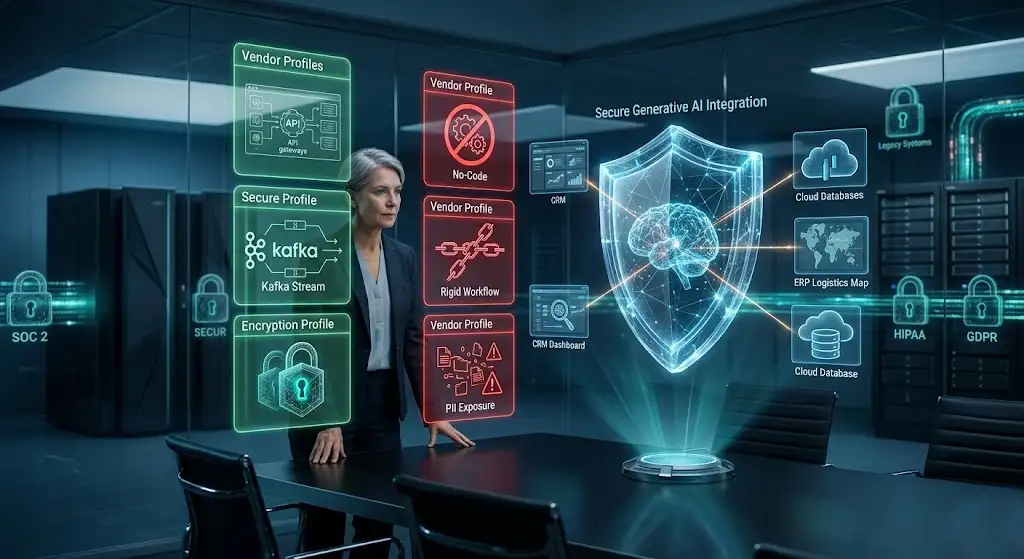
- Most critically, it must employ Dynamic Data Masking. Because legacy systems often store sensitive data (like Social Security Numbers or bank details) in plain text, the middleware must use NLP classifiers to detect and mask this PII before it is ever transmitted to a cloud-based LLM.
Modernize Your Enterprise with MindRind
The wealth of your enterprise lies in the decades of operational data trapped inside your legacy systems. However, exposing that data to modern Artificial Intelligence requires a level of architectural precision that standard IT departments simply do not possess.
At MindRind, we do not believe in risky “Rip and Replace” migrations. We are a premier generative ai integration company specializing in legacy modernization. Our elite backend architects build secure, resilient API gateways and ETL pipelines that act as the perfect bridge between your aging ERP mainframes and the world’s most advanced neural networks.
We protect your fragile infrastructure while unlocking the massive predictive power of your historical data.
Do not let legacy architecture prevent your digital transformation. Contact MindRind today to safely integrate AI into your core enterprise systems.
Frequently Asked Questions (FAQs)
Can Artificial Intelligence be integrated into old legacy systems?
Yes, but not directly. Because legacy systems (like AS/400 mainframes or older SAP/Oracle ERPs) lack modern APIs, developers must build custom “Middleware.” This middleware acts as a secure translator, extracting data from the outdated system, formatting it into modern JSON payloads, and sending it safely to the AI models.
What is the “Rip and Replace” strategy, and why is it dangerous?
“Rip and Replace” means completely discarding a legacy system and migrating all operations to a modern cloud platform. For massive enterprises, this is incredibly dangerous. It can cost tens of millions of dollars, disrupt core business operations (like payroll or logistics), and frequently results in catastrophic data loss during migration.
What is an API Gateway or Middleware in legacy integration?
An API Gateway is a custom-built software layer that sits between the fragile legacy database and the modern cloud AI. It protects the legacy system by queueing requests (so the mainframe doesn’t crash from too much traffic) and translates outdated data protocols (like SOAP/XML) into modern AI-readable formats (REST/JSON).
How does an AI read unstructured data from a legacy system?
Legacy systems often store data in unstructured formats like old text files or PDFs. Data engineers must build Extract, Transform, Load (ETL) pipelines to pull this data, run it through Optical Character Recognition (OCR), convert it into mathematical numbers (Embeddings), and store it in a modern Vector Database for the AI to read.
What is Batch Processing vs Event-Driven Architecture?
Legacy systems usually use “Batch Processing,” where data is updated once a day (e.g., at 2 AM). Modern AI requires real-time data. Engineers solve this by using Event-Driven Architectures (like Apache Kafka), which detect when a change is made in the legacy database and instantly stream that change to the AI in real-time.
Does connecting AI to a legacy system create security risks?
Yes. Legacy systems were not built to connect to the cloud. If you build an API bridge to connect an AI, you are creating a potential entry point for hackers. This is why the custom middleware must enforce Zero-Trust security, using strict authentication, encrypted transit (TLS 1.3), and Dynamic Data Masking to hide sensitive information.
Why can’t I use No-Code tools like Zapier for legacy integration?
No-Code tools like Zapier are designed to connect modern cloud SaaS platforms (like Slack and Salesforce). They are fundamentally incapable of connecting to on-premise, secure legacy mainframes. Furthermore, routing enterprise data through third-party No-Code platforms is a massive violation of corporate data privacy compliance.
What role does an AI Integration Consultant play in legacy modernization?
Before any code is written, the consultant audits the legacy system to identify integration bottlenecks. They design the architectural roadmap, determine if the enterprise should use Cloud AI or localized Edge AI, and ensure the middleware bridge will not overload the mainframe’s CPU, preventing catastrophic system crashes.