

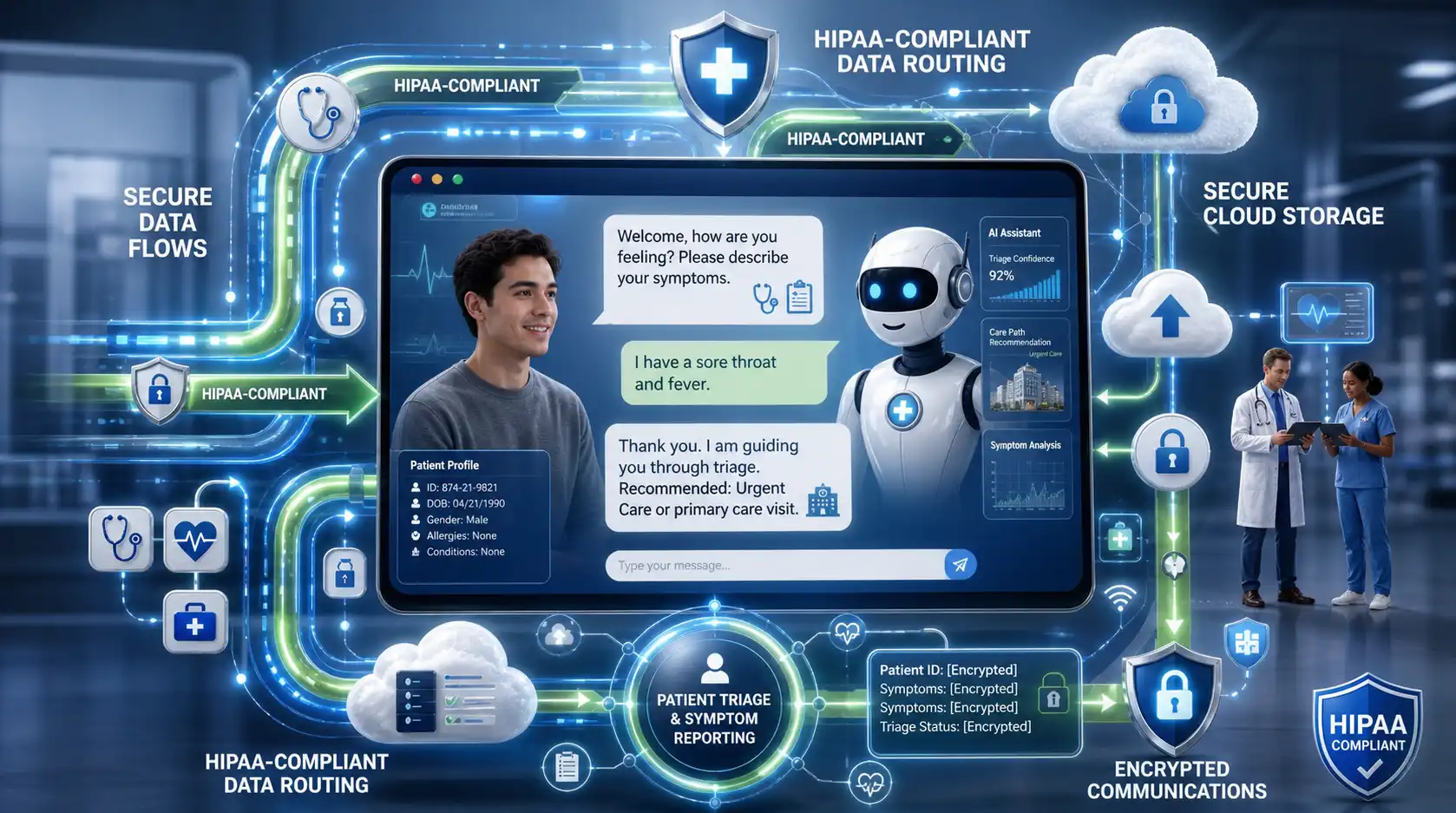
The healthcare industry is buckling under the weight of administrative overhead. Hospital call centers are overwhelmed with patients trying to schedule appointments, request prescription refills, or seek basic medical advice. This administrative bottleneck does not just hurt the hospital’s bottom line; it actively delays care for critical patients who cannot get through the phone lines.
Deploying a conversational AI chatbot is the most effective way to eliminate this operational backlog. However, chatbot development for the healthcare industry (<- Focus Keyword) is uniquely unforgiving.
In an eCommerce setting, if an AI chatbot hallucinates a shipping date, a customer gets annoyed. In a healthcare setting, if an AI chatbot gives incorrect triage advice or leaks Electronic Protected Health Information (ePHI), the hospital faces catastrophic legal liabilities, federal HIPAA violations, and potentially endangers a patient’s life.
Medical software demands absolute deterministic accuracy and zero-trust security. You cannot simply connect a hospital website to the public ChatGPT API. You must build a highly controlled, mathematically grounded infrastructure.
In this comprehensive technical blueprint, we will explore how to architect secure, legally compliant medical virtual assistants. Understanding these security protocols is a mandatory phase in our overarching intelligent virtual assistant playbook.
If your medical organization needs a flawless, secure implementation, MindRind provides elite ai chatbot development for healthcare, ensuring patient data is never compromised.
Chapter 1: The AI Triage Engine (Deterministic Routing)
The most valuable operational use case for a healthcare chatbot is Patient Triage. The goal is to act as a digital “front door,” assessing the urgency of a patient’s symptoms before they ever speak to a human nurse or doctor.
However, an AI chatbot must never “guess” a diagnosis. Generating medical advice using the probabilistic nature of a Large Language Model (LLM) is medical malpractice.
Building the Triage Architecture
To build a safe medical bot, engineering teams must strip the LLM of its creative freedom and force it to follow strict, doctor-approved clinical protocols.
- Symptom Collection (NLU): The patient opens the hospital’s app and types, “I have a severe headache and my left arm feels numb.” The Natural Language Understanding (NLU) engine extracts the exact symptoms without requiring the patient to click through rigid menus.
- RAG Cross-Referencing: The backend does not ask the LLM for medical advice. Instead, it uses a strict Retrieval-Augmented Generation (RAG) pipeline to query a highly secure database of the hospital’s official triage protocols.
- Actionable Routing: The algorithm matches the extracted symptoms to the protocol. In this case, “chest/head pain + numbness” triggers an immediate high-severity alert. The bot instantly stops the chat, displays a warning to call 911, and simultaneously alerts the hospital’s emergency dispatch.
If the symptoms are mild (e.g., a sore throat), the bot seamlessly transitions to the next phase: integrating with the hospital’s scheduling API to book a telemedicine appointment for the following day.
Chapter 2: Architecting for HIPAA Compliance
A highly intelligent triage bot is useless if its backend architecture violates federal data privacy laws. The Health Insurance Portability and Accountability Act (HIPAA) in the US mandates that all patient data (ePHI) be cryptographically secured in transit and at rest.
If you attempt to build a medical chatbot using a cheap, off-the-shelf SaaS chatbot platform, you are almost certainly violating HIPAA. SaaS platforms operate on multi-tenant architectures where your patient data sits on the same servers as thousands of other companies’ data. Furthermore, public APIs often retain chat logs to train future models.
Dynamic Data Masking (PII Redaction)
Before a patient’s message is ever processed by the AI’s reasoning engine, it must pass through a strict sanitization layer.
- The Workflow: Backend developers build a localized Natural Language Processing (NLP) classifier that acts as a gatekeeper. When a patient types, “Hi, my name is John Doe, DOB 05/12/1980, and my stomach hurts,” the gatekeeper intercepts it. It automatically identifies and removes the Name and Date of Birth, replacing them with randomized tokens. Only the clinical symptom (“stomach hurts”) is sent to the LLM for processing.
Virtual Private Clouds (VPC)
For ultimate zero-trust security, enterprise hospitals avoid third-party APIs entirely. Instead, they host powerful, fine-tuned medical open-source models (like specialized Llama 3 models or Med-PaLM) directly within their own air-gapped Virtual Private Cloud (VPC). This guarantees that patient conversations never cross the public internet to reach a vendor’s server.
These rigorous data protection architectures are not exclusive to healthcare. Understanding these security protocols is also mandatory for tech leaders evaluating secure banking and fintech chatbots.
Chapter 3: Secure EHR Integration (Epic / Cerner)
A medical chatbot cannot function effectively in a silo. To book an appointment, check lab results, or verify a prescription, the chatbot must be able to read and write data to the hospital’s core nervous system: the Electronic Health Record (EHR) database (such as Epic, Cerner, or Athenahealth).
The Interoperability Challenge (FHIR Standards)
Healthcare databases are notoriously complex and heavily guarded. A custom AI chatbot cannot use standard web scraping or basic REST API queries to fetch a patient’s lab results.
To bridge the chatbot and the EHR system, backend engineers must build secure middleware that complies strictly with the FHIR (Fast Healthcare Interoperability Resources) standard.
- The Workflow: When an authenticated patient asks the chatbot, “Are my blood test results ready?”, the chatbot’s backend formats a secure FHIR query. It authenticates with the hospital’s Epic server, retrieves the specific JSON payload containing the lab results, formats the data into a conversational response, and displays it to the patient.
This flawless, secure interoperability eliminates the need for patients to navigate clunky web portals, drastically improving the overall patient experience.
Chapter 4: Beyond the Patient: Bots for Physicians
While patient-facing triage bots save call center overhead, the most lucrative application of conversational AI in healthcare targets the physicians themselves.
Doctors spend up to 40% of their working hours trapped in front of a computer, manually typing clinical notes into the EHR system. This administrative burden is the leading cause of physician burnout globally.
Ambient Clinical Documentation (The Doctor’s Bot)
Top-tier health tech startups are building conversational AI agents that act as dedicated medical scribes for doctors.
- The Listening Phase: Utilizing advanced speech-to-text NLP models, the AI application sits on the doctor’s tablet and securely listens to the natural conversation between the doctor and the patient in the examination room.
- The Structuring Phase: A specialized medical LLM parses the raw audio transcript. It automatically separates the casual chatter from the medical facts. It structures the data into a highly accurate, compliant SOAP note (Subjective, Objective, Assessment, and Plan).
- The EHR Push: The bot instantly pushes the drafted note into the patient’s EHR profile. The doctor simply reviews it, clicks “Approve,” and moves on to the next patient, saving hours of manual typing every day.
Chapter 5: The Critical Importance of Specialized Engineering
Building an intelligent, FHIR-compliant, and HIPAA-secured medical chatbot is one of the most complex software engineering tasks in the modern tech industry.
If a hospital or HealthTech startup hires a standard web development agency to build their AI, the project will fail compliance audits before it is ever deployed. Security in healthcare cannot be an afterthought patched on at the end; it must be mathematically architected into the vector databases and APIs from day one.
To ensure your medical AI project is handled with the highest level of cryptographic security, rigorous QA testing, and BAA (Business Associate Agreement) compliance, executives must know exactly what technical questions to ask when hiring a specialized AI chatbot development company.
Secure Your Medical AI with MindRind
A single data leak or an AI hallucination in a medical context can destroy a hospital’s reputation and result in massive federal fines. You cannot afford to build your healthcare architecture using trial and error.
At MindRind, our machine learning engineers and cybersecurity architects specialize in ai chatbot development for healthcare. We build deterministic, zero-trust conversational agents. From integrating complex FHIR data pipelines and EHR systems, to deploying dynamic data masking and VPCs, we provide the technical foundation required to revolutionize patient care safely.
Do not compromise your patients’ data. Contact MindRind today to architect a secure, HIPAA-compliant medical AI chatbot.
Frequently Asked Questions
A healthcare triage chatbot uses Natural Language Processing (NLP) to understand a patient’s symptoms via chat. It cross-references these symptoms against a secure database of clinical protocols to determine the medical urgency, routing the patient to an emergency room, a telemedicine call, or self-care instructions.
No. Providing medical advice is heavily regulated and risky. A compliant healthcare chatbot does not “guess” or generate medical advice using probability. It uses strict Retrieval-Augmented Generation (RAG) to only surface pre-approved, doctor-verified triage protocols, acting as a router rather than a physician.
To be HIPAA compliant, a chatbot must ensure Electronic Protected Health Information (ePHI) is encrypted in transit and at rest. It must use Business Associate Agreements (BAAs) with all cloud providers, implement strict dynamic data masking (to remove PII from prompts), and avoid sending patient data to public AI models like the consumer version of ChatGPT.
FHIR (Fast Healthcare Interoperability Resources) is the global data standard for healthcare information exchange. Medical chatbots must use FHIR-compliant APIs to securely read and write data to a hospital’s Electronic Health Record (EHR) system (like Epic or Cerner) to check lab results or book appointments.
Many SaaS chatbot platforms operate on multi-tenant cloud architectures, meaning your patient data is stored on the same servers as data from thousands of other companies. Furthermore, they often lack the ability to sign BAA contracts or provide the deep backend API integrations required for secure EHR connectivity.
Dynamic data masking is a security protocol. Before a patient’s message reaches the AI’s reasoning engine, a secure NLP gatekeeper scans the text and automatically removes identifying information (like Names, Dates of Birth, or Social Security Numbers), ensuring the AI only processes the raw clinical symptoms.
Yes. Conversational AI agents are used as “Ambient Clinical Scribes.” They listen to doctor-patient consultations, automatically extract the medical facts, and format them into compliant SOAP notes directly within the EHR system. This saves physicians hours of manual typing and reduces burnout.
Due to the severe talent shortage of security-focused ML engineers, building an in-house team can delay deployment by over 8 months. Most healthcare providers and HealthTech startups partner with elite, specialized AI development firms that already possess the proprietary HIPAA-compliant infrastructure templates required to build safely and quickly.