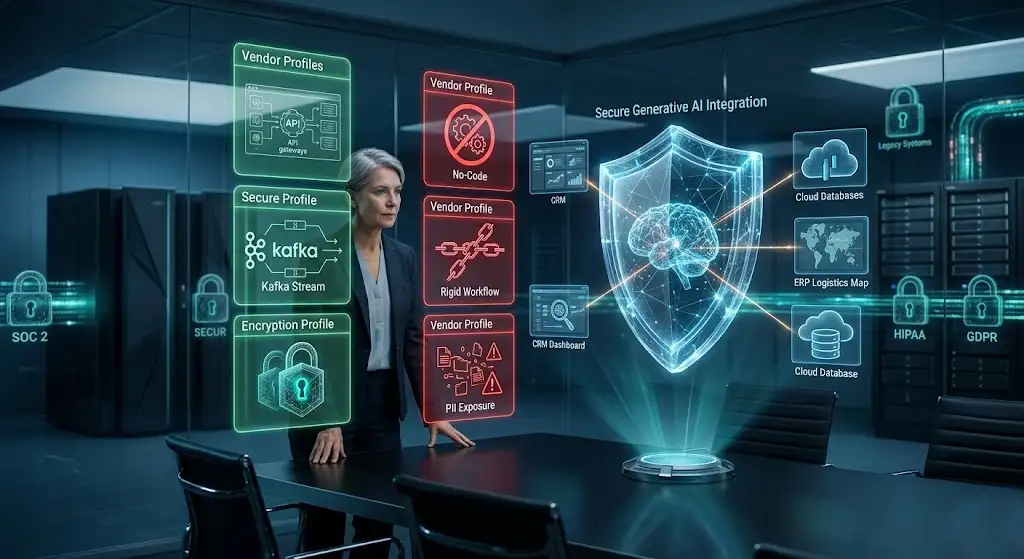


In the hyper-competitive financial sector, customer expectations have evolved. Today’s banking customers do not want to wait on hold for 20 minutes just to dispute a charge, transfer funds, or check their account balance. They expect the instant, seamless experience provided by modern tech giants.
To meet this demand, traditional banks, credit unions, and agile FinTech startups are racing to deploy Conversational AI. However, ai chatbots for banking (<- Focus Keyword) present an immense architectural challenge.
In a standard retail environment, an AI error is a minor inconvenience. In banking, an AI hallucination regarding a loan interest rate, or a security flaw that leaks a user’s transaction history, can result in devastating financial losses, massive regulatory fines (under SEC, FINRA, or GDPR), and irreversible brand destruction.
You cannot build a banking assistant using generic SaaS chatbot builders. Financial institutions require a zero-trust, enterprise-grade architecture that bridges Natural Language Processing (NLP) with highly secure core banking APIs.
In this deep-dive engineering guide, we will explore the specific security protocols and backend integrations required to build compliant financial virtual assistants. Understanding these rigorous security requirements is a foundational pillar of our overarching conversational commerce playbook.
If your financial institution is ready to modernize its customer experience without compromising security, MindRind offers elite ai chatbot for banks, architecting bespoke, mathematically grounded AI ecosystems.
Chapter 1: The Complex Logic of Financial NLU
A banking chatbot must possess a far superior Natural Language Understanding (NLU) engine compared to a standard eCommerce bot. The financial vocabulary is dense, highly contextual, and frequently involves complex numbers and dates.
Parsing Complex Financial Intents
If a user types, “I need to transfer five hundred bucks from my checking to my savings tomorrow, but only if my paycheck cleared today,” a basic chatbot will crash. An enterprise banking bot must dissect this complex sentence into actionable entities:
- Intent: Fund Transfer.
- Entities: Amount ($500), Source Account (Checking), Destination Account (Savings), Execution Date (Tomorrow).
- Conditional Logic: The bot must execute an API call to verify the paycheck deposit before authorizing the transfer.
Building this level of conditional, multi-step logic requires sophisticated dialog management systems. If your enterprise is evaluating whether to build this custom architecture or buy a pre-packaged bot, it is critical to understand why custom AI chatbot development services vastly outperform rigid SaaS platforms in the financial sector.
Chapter 2: Security Architecture and Authentication (MFA)
A conversational interface that can move money is a prime target for cybercriminals. To build a secure banking assistant, engineering teams must implement strict authentication flows directly within the chat interface.
Seamless Multi-Factor Authentication (MFA)
Before a chatbot can answer a sensitive question (e.g., “What is my routing number?”), it must cryptographically verify the user’s identity.
- The Workflow: The NLU engine detects a high-security intent. It instantly pauses the conversational flow and triggers an API call to the bank’s identity provider (like Okta or Auth0).
- The Execution: The chatbot sends an OTP (One-Time Password) to the user’s registered mobile device or prompts for biometric authentication (FaceID/Fingerprint) if integrated into a native mobile app. Only after the secure token is validated does the chatbot retrieve and display the sensitive financial data.
To ensure these authentication flows feel native and fast on smartphones, developers must master the nuances of integrating conversational AI into mobile apps.
Zero-Trust Cloud Deployment (VPC)
Banks cannot route customer financial data through public LLM APIs (like the consumer version of ChatGPT). This violates SOC 2 compliance and exposes the bank to catastrophic data leaks. Instead, elite FinTechs deploy powerful open-source foundation models (like Llama 3) entirely within their own air-gapped Virtual Private Clouds (VPC). In a VPC architecture, the AI processes the user’s financial queries locally; the data never leaves the bank’s highly secured internal network.
This strict adherence to data sovereignty is the exact same security standard required by hospitals, as detailed in our guide on architecting HIPAA-compliant healthcare chatbots.
Chapter 3: Automating High-Volume Financial Workflows
The true Return on Investment (ROI) of a banking chatbot is realized when it autonomously handles the most frequent, time-consuming tasks that normally clog up human call centers.
Automated Fraud Resolution
When a bank’s backend system flags a suspicious transaction, it typically blocks the user’s card, forcing them to call a 1-800 number.
- The AI Solution: The bank’s backend triggers an immediate WhatsApp or SMS message via the chatbot: “We blocked a $400 charge at Target in Miami. Was this you?”
- If the user replies “No,” the bot instantly cancels the card and triggers the API to issue a new one. If the user replies “Yes,” the bot unblocks the card immediately. This saves the bank thousands of hours in call center labor and drastically improves the customer experience.
Transaction History Parsing and Insights
Customers frequently call support because they do not recognize a charge on their statement. A conversational AI can act as a personal financial analyst.
- The Workflow: A user asks, “Why was I charged $14.99 yesterday?” The chatbot securely queries the bank’s core transaction database.
- The AI Enhancement: Instead of just returning the raw, cryptic merchant code (e.g., AMZN_PRM_1499), the AI uses its semantic reasoning to translate it into a human-friendly response: “That was your monthly subscription renewal for Amazon Prime.”
Seamless Dispute Management
If the user still does not recognize the charge, the chatbot can autonomously initiate the chargeback process. It guides the user through the regulatory dispute questionnaire, gathers the necessary details, generates the claim document, and routes it directly to the bank’s fraud investigation team, entirely bypassing Tier-1 human support.
Chapter 4: Scaling AI for B2B Corporate Banking
While retail banking (B2C) focuses on individual consumers, commercial and corporate banking (B2B) presents a massive, highly lucrative opportunity for conversational AI.
Corporate clients do not just want to check balances; they need to manage complex payrolls, execute international wire transfers (SWIFT/ACH), and analyze cash flow across multiple subsidiaries. A specialized B2B banking chatbot can integrate directly with corporate ERP systems (like NetSuite or Oracle). A CFO can simply ask the bot, “Generate a cash flow report for the European division for Q3 and initiate the payroll transfer.” The AI compiles the data, formats the report, and stages the transfer for final biometric approval.
To effectively design these complex commercial workflows, enterprise architects must master the strategies used to deploy enterprise AI chatbot development services for B2B lead generation and operations.
Chapter 5: The Critical Importance of a Secure Development Partner
Integrating Natural Language Processing with core banking systems is one of the most perilous software engineering tasks in the tech industry.
If a financial institution attempts to build this architecture using inexperienced offshore developers or generic SaaS plugins, they risk severe API vulnerabilities, unauthorized data exposure, and catastrophic compliance violations. Security in FinTech cannot be a patch applied at the end of development; it must be architected into the bedrock of the application from day one.
To ensure your financial AI project is handled with military-grade cryptographic security, robust QA testing, and strict adherence to SOC 2 and GDPR, executives must partner exclusively with specialized, US-standard engineering firms.
Architect Your Secure Banking AI with MindRind
A banking chatbot must be a fortress of security and a masterpiece of user experience. You cannot afford to deploy an AI assistant that hallucinates interest rates or leaks transaction histories.
At MindRind, our machine learning engineers and cybersecurity architects specialize in ai chatbots for banking (<- Focus Keyword used naturally). We build deterministic, zero-trust conversational agents for the financial sector. From integrating complex MFA authentication flows and core banking APIs, to deploying open-source models within secure, air-gapped AWS Virtual Private Clouds (VPCs), we provide the technical foundation required to revolutionize modern banking safely.
Do not compromise your customers’ financial data. Contact MindRind today to architect a secure, SOC 2 compliant banking chatbot.
Frequently Asked Questions
An AI banking chatbot is a highly secure virtual assistant that uses Natural Language Processing (NLP) to help customers manage their finances. Unlike simple FAQ bots, it integrates directly with core banking APIs to securely check balances, transfer funds, report fraud, and analyze spending habits through natural human conversation.
Yes, but only if they are built with an enterprise-grade, zero-trust architecture. Safe financial chatbots do not use public consumer APIs (like standard ChatGPT) which may leak data. They utilize Virtual Private Clouds (VPCs), End-to-End Encryption, and Multi-Factor Authentication (MFA) to ensure strict SOC 2 and GDPR compliance.
Before answering sensitive questions (like revealing an account balance), the chatbot triggers a secure authentication flow. It seamlessly connects to the bank’s Identity Provider (IdP) to send an OTP (One-Time Password) via SMS, or requests biometric verification (FaceID/TouchID) if the bot is integrated within the bank’s native mobile app.
Yes. A custom-built AI chatbot can interpret the user’s intent to transfer money, extract the exact amount and destination, and execute a secure REST API call to the bank’s backend systems. It will always require final user confirmation and MFA verification before the transaction is finalized.
Instead of forcing a user to call a 1-800 number, the bank’s backend can trigger the chatbot to send a proactive WhatsApp or SMS message when a suspicious transaction occurs. The user can instantly reply to confirm or deny the charge, allowing the bot to autonomously unblock the card or initiate the fraud cancellation process.
SaaS chatbot platforms operate on multi-tenant cloud architectures, meaning the bank’s highly sensitive financial data is stored on the same servers as thousands of other companies. This poses a massive security risk and often violates regulatory compliance. Banks require custom-built, dedicated architectures to maintain data sovereignty.
Absolutely. If a user does not recognize a charge, the chatbot can guide them through the entire chargeback process. It collects the necessary transaction details, asks the required regulatory questions, and automatically routes the completed dispute claim to the bank’s human fraud investigation team.
The ROI is significant. By automating high-volume, low-complexity tasks (like balance inquiries, password resets, and basic fraud alerts), an AI chatbot can deflect up to 60% of incoming call-center volume. This drastically reduces operational overhead while allowing human agents to focus on complex, high-value financial advisory roles.