

For the past decade, the word “chatbot” has been synonymous with frustration. Early iterations of customer support bots were nothing more than glorified, rigid decision trees. They forced users into endless loops of “Press 1 for Sales, Press 2 for Support,” and the moment a user typed a natural human sentence, the bot would inevitably reply: “I’m sorry, I didn’t understand that.”
This era of frustrating digital dead-ends is over. The advent of Large Language Models (LLMs) and advanced Natural Language Processing (NLP) has triggered a total paradigm shift. We have moved from simple scripted bots to Conversational Commerce.
Today’s enterprise AI chatbots do not just answer FAQs; they understand user intent, analyze sentiment in real-time, authenticate secure transactions, and flawlessly execute complex backend API tasks. They operate as tireless, hyper-intelligent digital employees available 24/7/365.
However, transitioning an enterprise from a legacy support center to a fully automated conversational ecosystem requires rigorous software engineering. In this comprehensive playbook, we will dissect the architecture required for building intelligent virtual assistants. If your organization is ready to completely overhaul its customer experience while drastically reducing operational overhead, MindRind provides elite ai chatbot development services tailored to the strict security and integration needs of modern enterprises.

Chapter 1: The Anatomy of Modern Conversational AI
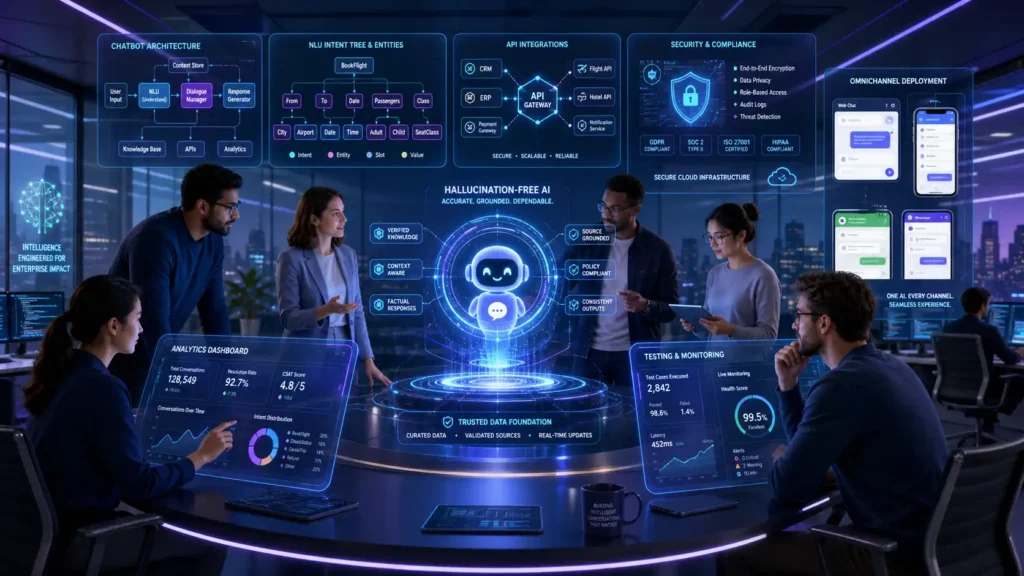
To understand why modern chatbots feel so “human,” technical leaders must understand the underlying shift in their software architecture. We have moved from Heuristic (Rule-Based) design to Probabilistic (AI-Driven) design.
Natural Language Understanding (NLU)
The brain of a modern chatbot is powered by Natural Language Understanding (NLU), a sub-field of NLP. When a customer types a message, the NLU engine does not look for exact keyword matches. Instead, it breaks the sentence down to extract two critical components:
- Intent: What is the user actually trying to do? (e.g., “I want to cancel my flight,” “My card was stolen,” “Where is my package?”).
- Entities: What are the specific variables involved? (e.g., Order Number #12345, Date: Tomorrow, Product: Blue Shoes).
Because NLU understands context and synonyms, a user can say “Where is my stuff?” or “Track my delivery,” and the bot instantly recognizes that both phrases represent the exact same Intent.
The Dialog Management System
Once the Intent is understood, the Dialog Management system takes over. This is the logic controller. If the user’s intent is “Return an Item,” but they did not provide an Order Number (the required Entity), the Dialog Manager knows to dynamically prompt the user: “I can help with that return! What is the order number you are referring to?”
Building these dynamic, non-linear conversation flows requires sophisticated orchestration. If a company tries to build this using cheap, out-of-the-box software, the conversation breaks down instantly. This is precisely why serious tech companies prioritize custom AI chatbot development services over rigid SaaS platform builders.

Chapter 2: Omnichannel Routing and Deployment
A world-class chatbot cannot be isolated to a single webpage. Modern consumers expect brands to be available wherever they are, and they expect the AI to remember their context across different platforms.
The Omnichannel Architecture
Enterprise chatbots must be deployed via an Omnichannel architecture. The central “Brain” (the NLP engine and Dialog Manager) sits on your secure backend servers. It is then connected via APIs and Webhooks to multiple frontend channels simultaneously:
- Your primary website widget.
- Your native iOS and Android applications. To ensure smooth performance on mobile without draining battery or causing lag, developers must master the nuances of integrating chatbots into mobile apps natively.
- Third-party messaging platforms (WhatsApp Business, Facebook Messenger, Slack, Microsoft Teams).
Contextual Memory Across Channels
If a user starts a conversation with your bot on WhatsApp regarding a broken product, and then logs into your web portal three hours later, the web chatbot should immediately greet them with: “Hi there, are you following up on the broken product you reported earlier?” This requires a highly secure, centralized, NoSQL database (like MongoDB or DynamoDB) to temporarily store “Conversational State.” Managing this state across thousands of concurrent users requires elite backend engineering.

Chapter 3: Industry-Specific Chatbot Architectures
The architectural complexity of a chatbot depends entirely on the industry it serves. A bot selling t-shirts does not require the same security infrastructure as a bot accessing bank accounts.
E-Commerce and Retail Automation
In retail, speed and revenue generation are the primary goals. E-commerce chatbots are deeply integrated with platforms like Shopify or Magento via GraphQL APIs. They do not just provide shipping updates; they act as proactive sales agents. If a user abandons a cart, the bot can trigger a WhatsApp message offering a personalized 10% discount. To understand the exact mechanics of these revenue-generating workflows, explore our breakdown on how an AI chatbot for eCommerce automates customer service and actively recovers lost sales.
Healthcare and Financial Services (High Compliance)
In highly regulated sectors, chatbots operate under completely different rules. In banking, if a user wants to check their balance, the chatbot must trigger a secure Multi-Factor Authentication (MFA) flow before answering. In healthcare, if a patient asks the bot to schedule an appointment for a sensitive medical issue, the bot must be 100% HIPAA compliant. The data cannot be processed by public NLP models. It requires data masking, Virtual Private Clouds (VPCs), and secure EHR (Electronic Health Record) syncing. Discover the rigorous engineering required for chatbot development for the healthcare industry to prevent catastrophic data breaches.
Real Estate and Travel Lead Generation
In industries with long sales cycles, chatbots act as 24/7 lead qualification agents. A real estate bot can ask a prospect about their budget, preferred zip codes, and timeline. Once the lead is qualified, the bot instantly syncs the data to Salesforce and schedules a live tour on the human agent’s calendar. For deep insights into automating these bookings, review our guide on AI chatbots for real estate and travel.

Chapter 4: Sentiment Analysis and Human-Agent Handoff
The greatest fear of any Customer Experience (CX) leader is that an AI chatbot will frustrate an already angry customer. To prevent digital escalations, modern conversational AI relies on real-time Sentiment Analysis and seamless escalation protocols.
Real-Time Sentiment Analysis
As the user types, the NLU engine does not just extract intents and entities; it simultaneously calculates a “Sentiment Score.” It analyzes the user’s syntax, the use of capitalization, and specific trigger words to determine if the customer is Happy, Neutral, or Angry.
- If a user types, “My order is late, this is ridiculous!”, the NLP model detects the high negative sentiment instantly.
The Seamless Human-Agent Handoff
When negative sentiment is detected—or if the user asks a question the bot is not programmed to handle—the system must trigger a “Human-in-the-Loop” escalation, commonly known as a Human-Agent Handoff.
- The Workflow: The bot immediately stops generating automated responses. It sends an API request to the company’s live-agent dashboard (like Zendesk, Intercom, or Salesforce Service Cloud).
- Context Preservation: Crucially, the bot passes the entire conversation history and the user’s sentiment score directly to the human agent’s screen. The human agent can seamlessly take over the chat without forcing the frustrated customer to repeat their problem.
This intelligent routing is especially critical in complex B2B sales cycles, where forcing a high-value lead to talk to a robot for too long can kill a deal. Tech leaders designing these workflows must deeply understand how to deploy enterprise AI chatbot development services for B2B to ensure premium lead qualification without losing the human touch.

Chapter 5: The Financial Economics (Calculating ROI)
A sophisticated enterprise AI chatbot is not a cheap IT project; it requires significant Capital Expenditure (CapEx) to build the custom NLP pipelines, secure the vector databases, and integrate the bot into legacy CRMs.
When a CTO pitches a $150,000 custom chatbot build to the CFO, the justification must be purely mathematical.
Deflection Rate vs. Resolution Rate
The success of a customer service bot is measured by two primary metrics:
- Deflection Rate: The percentage of incoming customer support tickets that the bot intercepts before they reach a human.
- Resolution Rate: The percentage of intercepted tickets that the bot completely resolves without requiring human escalation.
If an enterprise receives 10,000 support tickets a month, and a custom AI chatbot achieves a 60% resolution rate, that is 6,000 tickets handled instantly by software. By calculating the “Cost Per Ticket” (which includes human agent salaries, software licenses, and call center overhead), an enterprise can easily save hundreds of thousands of dollars annually. To see the exact mathematical formulas used to justify these projects, review our guide on calculating the ROI of an AI chatbot for customer service.
Chapter 6: Partnering with an Elite Chatbot Agency
Building a truly intelligent, omnichannel conversational AI is an orchestration of complex machine learning, backend API integrations, and strict data security protocols. Attempting to build this with an inexperienced internal team often results in a buggy, hallucination-prone bot that damages your brand reputation.
To ensure the bot is architected correctly—with proper NLU intent classification, seamless webhook integrations, and zero-trust security—market leaders partner with specialized development firms.
When choosing a partner, you must look beyond their marketing materials and interrogate their technical capabilities. Do they know how to fine-tune an open-source NLP model? Do they understand Dialogflow CX or Rasa frameworks? Knowing exactly how to hire the best AI chatbot development company is the final, most crucial step in ensuring your conversational commerce strategy succeeds.
Transform Your Customer Experience with MindRind
The era of frustrating, rule-based chatbots is dead. Your customers demand instant, intelligent, and context-aware conversational experiences. If your enterprise is not providing them, your competitors will.
At MindRind, we are a premier provider of conversational ai chatbot development service (<- Focus Keyword used naturally) solutions. We do not use rigid templates or generic SaaS wrappers. Our elite team of machine learning engineers and backend architects builds custom, hallucination-free virtual assistants tailored to your exact business logic.
From securely handling HIPAA-compliant patient data in healthcare, to recovering abandoned carts in eCommerce with automated WhatsApp messaging, we build the backend architectures that multiply your operational efficiency.
Ready to deploy a tireless, hyper-intelligent digital workforce? Contact MindRind today and let’s architect your enterprise chatbot.
Frequently Asked Questions
Traditional chatbots operate on rigid, rule-based decision trees (If user presses 1, say X). They cannot understand variations in human speech. Conversational AI chatbots use Natural Language Processing (NLP) and Large Language Models (LLMs) to understand intent, context, and nuance, allowing them to hold fluid, human-like conversations.
The AI uses Natural Language Understanding (NLU) to break down a user’s sentence. It identifies the “Intent” (what the user is trying to do) and extracts “Entities” (specific data points like dates, order numbers, or locations). This allows the bot to understand the user’s goal even if they phrase the question poorly.
An omnichannel chatbot is a single AI “brain” (backend logic) connected to multiple frontend communication platforms simultaneously. The same chatbot can interact with users on your website, your mobile app, WhatsApp, and Facebook Messenger, maintaining the user’s conversational memory across all platforms.
Custom enterprise chatbots use Webhooks and APIs to communicate with your existing software. For example, if a user asks for their tracking number, the chatbot’s backend securely pings your Shopify or Salesforce API, retrieves the live tracking data, and instantly displays it to the user in the chat interface.
Sentiment Analysis is an NLP feature where the AI evaluates the tone of the user’s text in real-time. If the AI detects that the user is becoming angry, frustrated, or using aggressive language, the system can automatically prioritize the chat and route it to a human supervisor.
A Human-Agent Handoff is an escalation protocol. If the AI chatbot cannot solve a complex problem, or if it detects negative sentiment, it seamlessly transfers the chat to a live human agent. Crucially, the bot passes the entire chat history to the agent, so the customer does not have to repeat themselves.
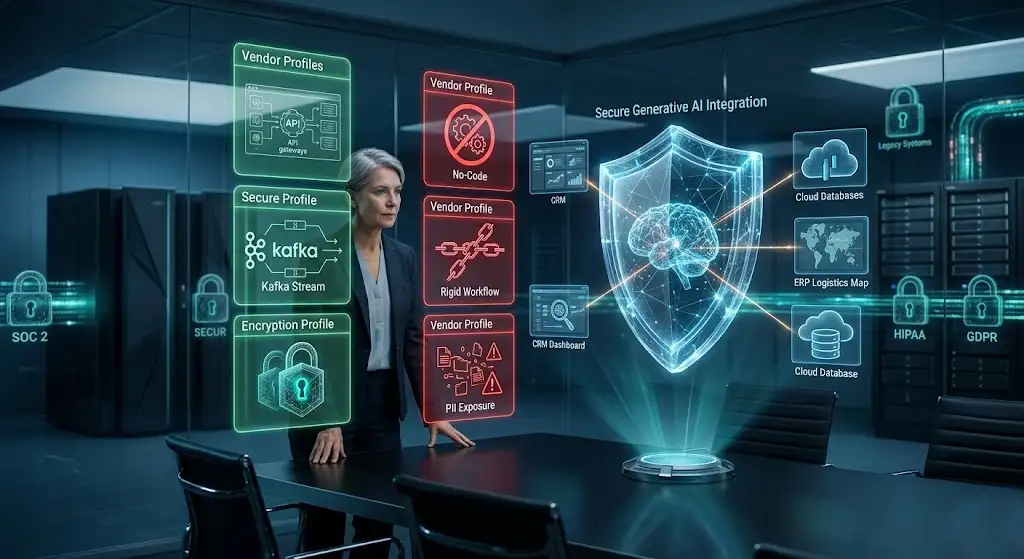
Yes, but they require custom, enterprise-grade architecture. In these regulated industries, chatbots cannot use public APIs that might store user data. They must utilize Virtual Private Clouds (VPCs), dynamic data masking to hide PII/ePHI, and strict authentication flows to maintain SOC 2 and HIPAA compliance.
SaaS chatbot platforms (white-label bots) are generic. You do not own the source code, and you are locked into the vendor’s pricing tiers, which escalate quickly as your user volume grows. Custom development gives you 100% IP ownership, infinitely scalable backend integrations, and total control over your customers’ data privacy.