
The business-to-business (B2B) sales cycle is fundamentally different from retail eCommerce. When a consumer buys a $50 pair of shoes online, it is an impulse decision made in seconds. When an enterprise executive is looking to purchase a $100,000 SaaS platform, heavy machinery, or a corporate cyber-security contract, the decision involves months of research, multiple stakeholders, and rigorous technical vetting.
In B2B, you cannot simply put an “Add to Cart” button on your website and expect millions in revenue. You must generate, qualify, and nurture high-value leads.
Traditionally, this burden falls on human Sales Development Representatives (SDRs). However, human SDRs cannot work 24/7. If a C-level executive from Tokyo visits your US-based B2B website at 3:00 AM, has a highly technical question, and is forced to fill out a static “Contact Us” form, they will likely bounce to a competitor.
The solution is deploying a highly sophisticated conversational AI that acts as a tireless, expert digital SDR.
In this deep-dive strategy guide, we will explore the architecture required to build enterprise ai chatbot development services (<- Focus Keyword) specifically tailored for complex B2B sales cycles. Understanding this automated lead qualification pipeline is a core component of our overarching omnichannel conversational AI playbook.
If your enterprise is losing high-value leads due to slow response times, MindRind provides custom ai chatbots for b2b that integrate flawlessly with your existing CRM infrastructure to accelerate revenue.
Chapter 1: The B2C vs B2B Chatbot Architecture
Many B2B companies fail because they try to use B2C (Business to Consumer) chatbot logic for enterprise sales. A B2C bot is designed for rapid deflection (e.g., answering “Where is my order?”).
A B2B bot must be designed for Engagement and Qualification.
The Intelligent Lead Scoring Funnel
An enterprise B2B chatbot does not wait for the user to ask a question; it proactively initiates the conversation based on the user’s behavior (e.g., spending more than 2 minutes on the “Enterprise Pricing” page).
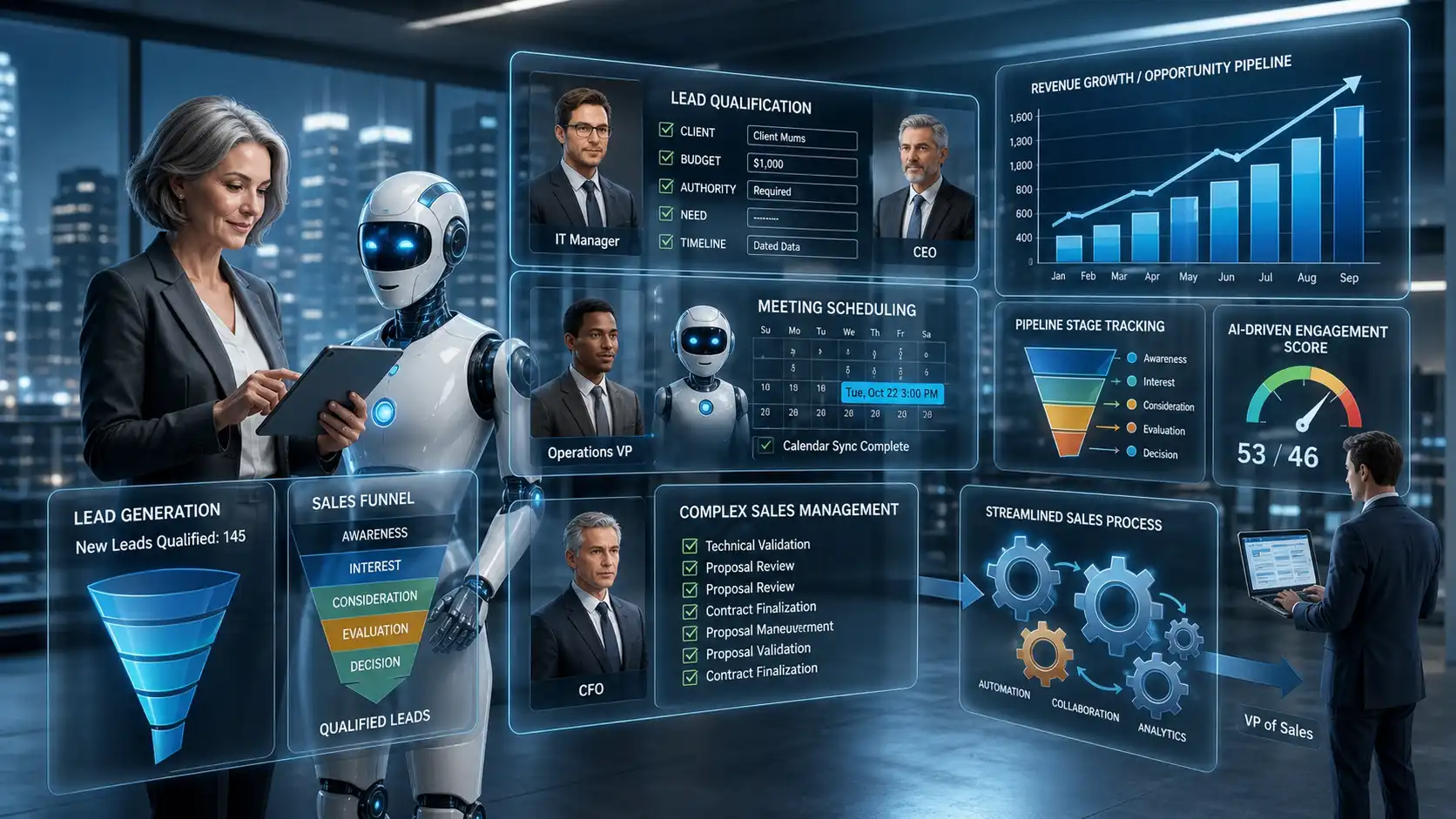
Once engaged, the chatbot utilizes Natural Language Understanding (NLU) to subtly execute the BANT qualification framework:
- Budget: “To ensure I point you to the right solution, what scale of deployment are you budgeting for?”
- Authority: “Are you the primary technical evaluator for this project, or are you researching on behalf of your CTO?”
- Need: “What specific bottleneck is your team currently trying to solve?”
- Timeline: “Are you looking to deploy this quarter, or is this for a future roadmap?”
Unlike static forms, the AI dynamically adjusts its follow-up questions based on the user’s answers. If the user indicates they are a student doing research, the bot politely directs them to a whitepaper. If the user indicates they are a CTO with an immediate budget, the bot executes a VIP escalation.
To understand how this exact qualification logic is also used to close high-ticket consumer deals, review our analysis on how conversational AI drives sales in B2C eCommerce.
Chapter 2: Deep CRM Integration (Salesforce & HubSpot)
A B2B chatbot is useless if it traps valuable lead data inside a chat window. To be an effective sales tool, the AI must be deeply integrated into your company’s core Customer Relationship Management (CRM) system, such as Salesforce, HubSpot, or Microsoft Dynamics.
Bidirectional Data Syncing
When the chatbot qualifies a lead, it does not just send an email to the sales team. It executes secure API calls to your CRM.
- Lead Creation: It automatically creates a new “Contact” and “Opportunity” record in Salesforce.
- Data Enrichment: It maps the chat transcript to the CRM, filling in custom fields (Company Size, Industry, Pain Points) automatically.
- Account-Based Marketing (ABM) Recognition: If the bot detects that the visitor’s email domain belongs to a “Target Account” (e.g., @microsoft.com), the API recognizes the domain, alerts the specific Account Executive assigned to Microsoft via a Slack webhook, and instantly upgrades the bot’s conversational tone to a personalized VIP experience.
This level of custom API orchestration cannot be achieved using cheap, generic chat widgets. It requires bespoke backend engineering. Tech leaders must carefully evaluate how to hire a specialized AI chatbot development company capable of executing these complex CRM integrations securely.
Chapter 3: Automated Meeting Scheduling and Handoffs
The ultimate goal of a B2B AI chatbot is not to close a $100,000 deal on its own; it is to seamlessly transition a highly qualified, educated lead directly to a human Account Executive (AE) to close the deal.
The Calendar API Integration
Once the bot confirms that a lead is highly qualified, it strikes while the iron is hot.
- The Workflow: The bot accesses the assigned Account Executive’s calendar in real-time (via Google Calendar or Microsoft Outlook APIs).
- The Pitch: “Based on your requirements, our Enterprise Architect, Sarah, is the best person to show you a custom demo. I see she has availability tomorrow at 2:00 PM or Thursday at 10:00 AM. Would you like me to book that for you right now?”
The user clicks a time directly in the chat interface. The bot fires the API, books the meeting, sends a calendar invite to both parties, and drops the entire chat transcript into the CRM so the AE is fully prepared for the demo.
Chapter 4: RAG Pipelines for Technical B2B Buyers
In B2B sales, buyers do extreme amounts of research before ever speaking to a human. If a VP of Engineering visits your SaaS website, they do not want marketing fluff; they want to know the exact rate limits of your API, your SOC 2 compliance status, and your server uptime guarantees.
A human SDR often cannot answer these deep technical questions instantly. They have to “check with the engineering team,” which stalls the sales cycle. An enterprise AI chatbot can answer them in 1.5 seconds.
Turning Technical Documentation into a Sales Asset
To achieve this, backend developers must build a Retrieval-Augmented Generation (RAG) architecture.
- Ingestion: The development team ingests your company’s highly technical whitepapers, API documentations, case studies, and compliance certificates into a secure Vector Database (like Pinecone or Milvus).
- Semantic Search: When a technical buyer asks a complex question (e.g., “Does your platform support Kubernetes cluster deployments on AWS?”), the chatbot does not guess. It searches the vector database, retrieves the exact technical paragraph from your documentation, and generates a precise, factual answer.
- The Proof: It can even provide a direct link to the specific whitepaper for the buyer to download.
This instantly establishes absolute technical credibility with the buyer, drastically shortening the time it takes to move them down the sales funnel.
Chapter 5: The Financial Impact (Calculating B2B ROI)
Deploying a custom enterprise AI chatbot requires Capital Expenditure (CapEx). B2B leaders must justify this expense by calculating the Return on Investment (ROI) generated by the system.
Unlike customer service bots—where ROI is calculated by measuring how much money was saved on call center labor—B2B sales bots are measured by how much net-new revenue they generate.
The Metric of “Lead Velocity”
In B2B sales, speed is everything. Research shows that if you respond to a lead within 5 minutes, your chances of qualifying them are 21 times higher than if you respond after 30 minutes.
Because an AI chatbot responds to 100% of leads in under 2 seconds, your Lead Velocity hits its absolute mathematical maximum. Furthermore, by filtering out the “window shoppers,” the AI ensures your expensive human Account Executives are only spending their time talking to highly qualified, high-budget prospects.
This increase in human closing efficiency creates a massive multiplier effect on your revenue. To understand the exact formulas used to justify the initial development cost, review our detailed guide on calculating the ROI of an AI chatbot.
Automate Your B2B Sales Pipeline with MindRind
A B2B enterprise cannot rely on static web forms or generic chat widgets to capture six-figure leads. To dominate your market, you need a tireless, hyper-intelligent digital SDR that understands your technical products and integrates flawlessly with your CRM.
At MindRind, we specialize in enterprise ai chatbot development services (<- Focus Keyword used naturally) specifically engineered for complex B2B sales cycles. Our elite machine learning architects and backend developers build custom NLP pipelines, secure RAG vector databases, and deep Salesforce/HubSpot integrations.
We do not just build chatbots; we build intelligent revenue engines that qualify leads, book meetings, and accelerate your sales pipeline 24/7/365.
Stop losing high-value leads to slow response times. Contact MindRind today to architect your custom B2B conversational AI.
Frequently Asked Questions
B2C chatbots are primarily designed for customer support (answering FAQs, tracking orders). B2B chatbots are designed for Lead Generation and Qualification. They act as digital Sales Development Representatives (SDRs), proactively engaging high-value website visitors, asking qualifying questions (budget, timeline), and booking meetings for human sales teams.
Yes. A custom-built enterprise AI chatbot uses APIs and Webhooks to integrate bidirectionally with CRMs like Salesforce or HubSpot. When the bot qualifies a lead, it automatically creates a new contact record, maps the chat transcript to the profile, and alerts the appropriate sales executive.
BANT stands for Budget, Authority, Need, and Timeline. It is a standard sales qualification framework. A well-designed B2B chatbot uses Natural Language Processing (NLP) to naturally weave BANT questions into the conversation, ensuring the lead is highly qualified before passing them to a human closer.
Yes, if it uses a Retrieval-Augmented Generation (RAG) architecture. By connecting the AI to a Vector Database filled with your company’s technical whitepapers, API documentations, and case studies, the bot can instantly provide highly accurate, factual answers to complex technical questions from enterprise buyers.
The chatbot backend is integrated with calendar APIs (like Google Calendar or Microsoft Outlook). Once a lead is qualified, the bot checks the availability of the assigned human Account Executive in real-time and offers the lead a clickable interface within the chat to book a meeting instantly.
ABM is a strategy where marketing is highly personalized for specific, high-value target companies. A custom AI chatbot can analyze the IP address or email domain of a website visitor. If the visitor is from a target company (e.g., IBM), the bot instantly changes its script to a VIP, hyper-personalized greeting and alerts the sales team immediately.
Yes, provided the chatbot is highly intelligent and not a rigid decision tree. Enterprise buyers value speed and accuracy above all else. If an AI chatbot can instantly answer a complex technical question or schedule a demo without forcing the buyer to wait 24 hours for an email reply, it vastly improves the B2B buying experience.
The ROI is calculated by Lead Velocity and Pipeline Acceleration. Because the AI engages 100% of visitors instantly and filters out unqualified leads, your human sales team spends more time closing deals and less time chasing dead ends. This operational efficiency often results in a massive increase in net-new revenue, paying for the bot’s development cost quickly.