
Custom AI application development has become a strategic priority for businesses that want more than generic automation or one-size-fits-all tools. As organizations deal with growing data volumes, complex workflows, and competitive pressure, tailored AI software enables them to build intelligence directly into their operations rather than adapting processes to rigid platforms.
Unlike off-the-shelf AI software, custom-built solutions are designed around business-specific data, objectives, and system environments. This allows enterprises to deploy AI business solutions that scale with growth, integrate with existing enterprise software, and deliver measurable operational value over time.
Why Businesses Need Custom AI Applications
Businesses adopt AI not for experimentation, but to solve real operational and strategic problems. While ready-made AI tools can address narrow use cases, they often fall short when enterprises require flexibility, integration, and long-term control.
Advantages Over Off-the-Shelf Software
Off-the-shelf AI products are built for broad audiences. They work well for common scenarios but struggle when requirements become specific or data environments are unique. Custom AI application development removes these limitations by allowing organizations to design solutions that align precisely with their workflows and decision models.
Key advantages include:
- Full ownership of data and models
- Tailored logic based on proprietary processes
- Freedom to evolve features as business needs change
- Better alignment with internal security and compliance standards
For enterprises that treat AI as a core capability rather than a plug-in feature, custom solutions provide a sustainable competitive edge.
Improving Operational Efficiency
Custom AI applications directly improve operational efficiency by automating high-volume tasks, reducing human error, and accelerating decision-making. These systems can analyze patterns across large datasets, generate real-time insights, and trigger actions across departments.
Examples include:
- Intelligent process automation for operations and support teams
- Predictive analytics for demand, risk, or performance forecasting
- AI-driven decision support embedded into enterprise workflows
By embedding intelligence into daily operations, organizations move beyond manual reporting toward proactive, data-driven execution.
Key Features of a Custom AI Application
Effective custom AI solutions are defined not only by model accuracy, but by how well they operate within enterprise environments. The following features are essential for long-term success.
Scalability & Flexibility
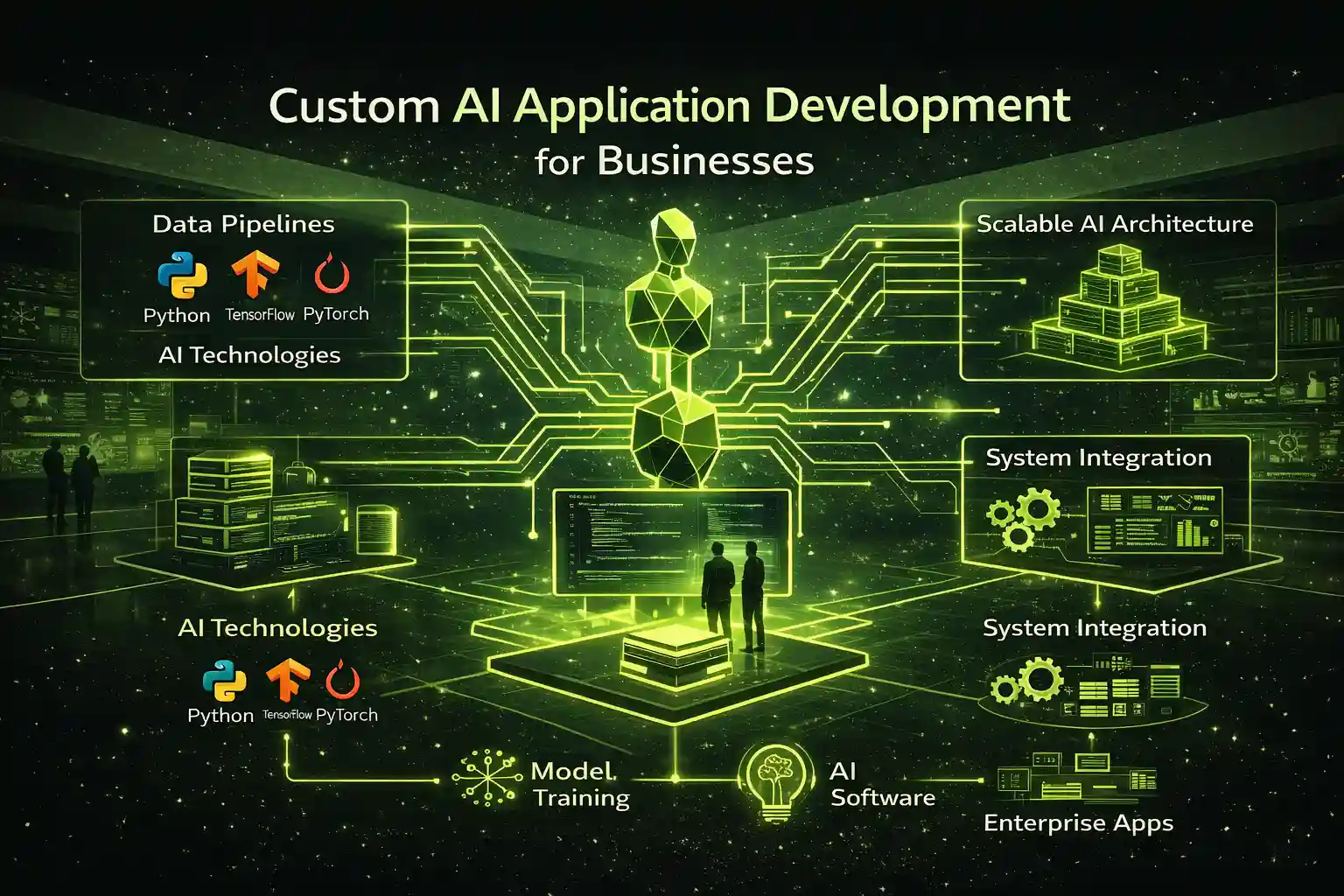
A well-designed custom AI application is built on scalable architecture that can handle increasing data volumes, users, and complexity. This ensures the system performs consistently as business demands grow.
Scalability also applies to AI models themselves. As data patterns evolve, models must be retrained and improved without disrupting core operations. Flexible design allows enterprises to expand AI capabilities incrementally rather than rebuilding systems from scratch.
Integration with Existing Systems
Most organizations already rely on complex enterprise software ecosystems. Custom AI applications must integrate seamlessly with CRMs, ERPs, data warehouses, and other internal platforms using secure APIs and structured data pipelines.
Strong system integration ensures that AI outputs are not isolated dashboards but actionable insights embedded directly into business processes. This is a critical requirement for enterprise AI apps that aim to deliver real operational impact.
Security and Compliance
Security and compliance are non-negotiable in enterprise environments. Custom AI applications are designed with role-based access, encrypted data flows, and governance controls that align with internal and regulatory requirements.
By maintaining control over data usage, model behavior, and system access, organizations reduce risk while ensuring AI adoption aligns with internal policies and industry standards.
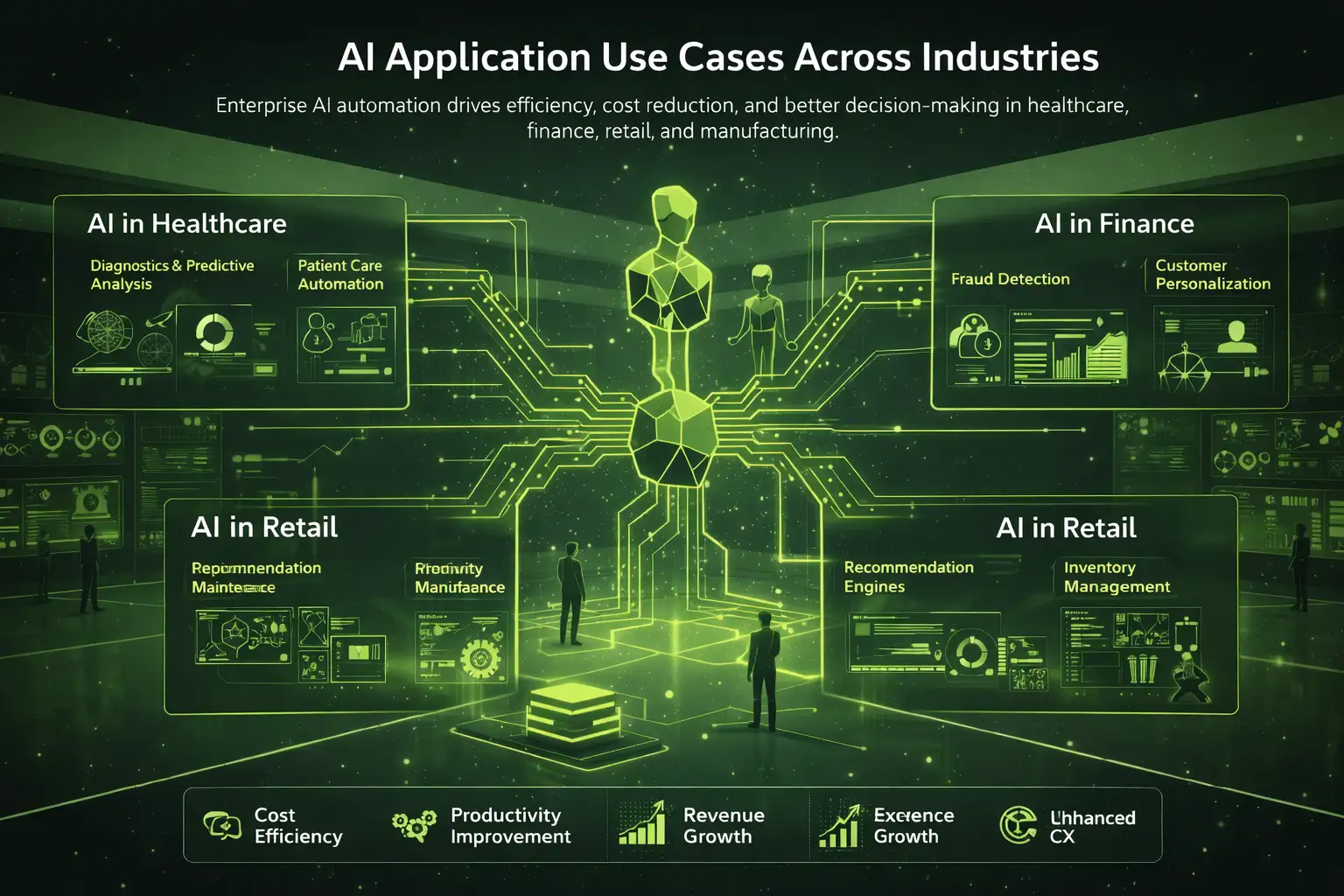
Industries Benefiting from Custom AI Solutions
Custom AI application development delivers the highest value in industries where data complexity, decision speed, and operational scale intersect.
Healthcare
Healthcare organizations use custom AI solutions to improve diagnostics, streamline administrative workflows, and support clinical decision-making. Tailored models trained on domain-specific data enable more accurate insights while meeting strict compliance and data privacy requirements.
Finance
In finance, custom AI applications support fraud detection, risk assessment, forecasting, and compliance monitoring. These systems must integrate with existing financial platforms while delivering explainable, auditable outcomes that meet regulatory expectations.
Retail & E-commerce
Retailers leverage custom AI software to personalize customer experiences, optimize inventory, and forecast demand. Unlike generic tools, tailored AI solutions adapt to unique product catalogs, customer behaviors, and supply chain dynamics.
Manufacturing
Manufacturing organizations benefit from AI-driven predictive maintenance, quality inspection, and process optimization. Custom AI applications integrate operational data, production systems, and analytics to reduce downtime and improve efficiency across facilities.
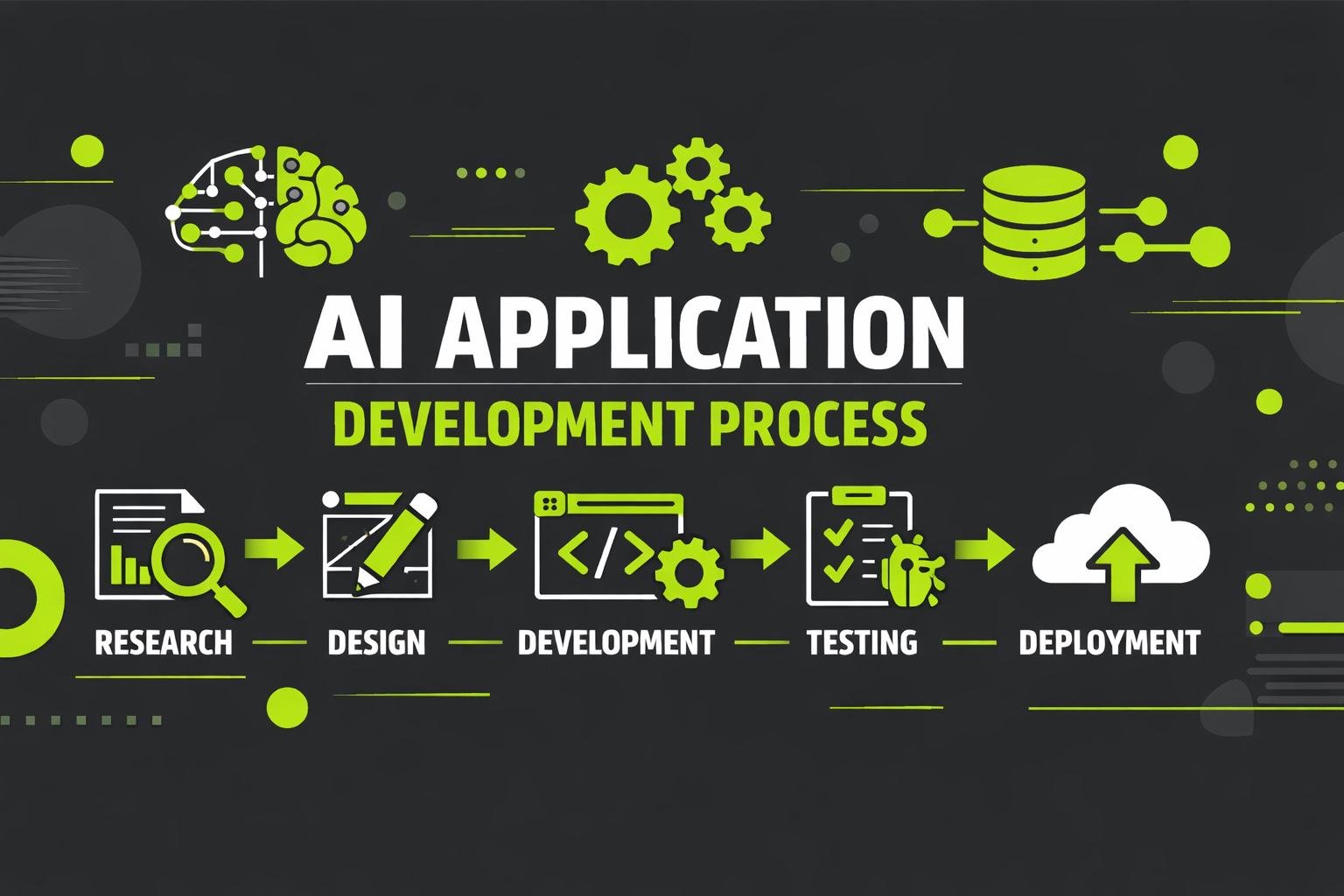
Custom AI App Development Process
Building enterprise-grade AI solutions requires a structured and disciplined approach. A clear development lifecycle ensures technical reliability and business alignment from the start.
Requirement Analysis
The process begins with defining business objectives, success metrics, and technical constraints. This stage clarifies what the AI system should achieve and how its impact will be measured.
Many organizations underestimate the importance of this phase, but strong requirement analysis prevents misalignment and reduces costly rework later in the project. It also sets realistic expectations around scope, timelines, and outcomes.
Data Collection & Model Development
Data quality is the foundation of any AI system. During this phase, teams establish data pipelines, clean and prepare datasets, and begin model training using appropriate techniques from Machine Learning and Deep Learning.
Development commonly leverages languages and frameworks such as Python, TensorFlow, and PyTorch, depending on use case requirements and performance needs.
This stage transforms raw data into functional intelligence aligned with business goals.
Testing & Deployment
Before production release, AI models and systems undergo rigorous testing to validate accuracy, reliability, and performance. Deployment then integrates the AI solution into live environments using secure infrastructure and monitored workflows.
A production-ready deployment ensures the system can scale, adapt, and operate reliably within real-world enterprise conditions. This is where many AI initiatives transition from experimentation to measurable value.
Choosing the Right Development Partner
Selecting the right partner is critical for long-term success in custom AI initiatives. Beyond technical skills, partners must understand enterprise environments, data governance, and operational constraints.
Questions to Ask
When evaluating partners, businesses should ask:
- How do you assess data readiness and feasibility?
- How will the AI system integrate with our existing platforms?
- What is your approach to model monitoring and long-term maintenance?
- How do you ensure security and compliance throughout the lifecycle?
Organizations that already understand the fundamentals of AI application development are better positioned to evaluate responses and identify experienced partners.
Cost Considerations
Cost varies based on data complexity, integration depth, and long-term support requirements. Instead of focusing only on initial build expenses, businesses should consider total value delivered over time.
Understanding real-world use cases and the full App Development Process helps organizations align budgets with outcomes rather than features alone.
Closing Perspective
Custom AI application development enables businesses to move beyond generic automation and build intelligence tailored to their unique operations. By combining scalable architecture, deep system integration, and disciplined development practices, organizations can deploy enterprise AI apps that deliver sustained value.
For businesses aiming to operationalize AI at scale, custom solutions are not just a technical choice, they are a strategic investment in long-term competitiveness and efficiency.
Frequently Asked Questions
Custom AI application development is the process of designing and building AI-powered software tailored to a business’s specific data, workflows, and objectives. Unlike generic AI tools, custom solutions are developed to integrate with existing systems and scale with enterprise needs.
Standard AI software is built for broad use cases and limited customization. Custom AI software is designed around proprietary data, unique business logic, and operational requirements, making it more accurate, flexible, and aligned with long-term business goals.
Organizations that handle large datasets, complex decision-making, or high-volume operations benefit the most. Enterprises in healthcare, finance, retail, manufacturing, and B2B services often see strong ROI from tailored AI solutions.
Timelines vary based on data readiness and system complexity. Most enterprise-grade custom AI applications take several weeks to a few months, covering requirement analysis, data preparation, model development, testing, and deployment.
Not always, but data quality matters more than volume. Well-structured, relevant data can outperform large but inconsistent datasets. In some cases, AI models can be enhanced over time as more data becomes available.
Yes. Custom AI applications are designed to integrate with existing enterprise software such as CRMs, ERPs, databases, and analytics platforms using secure APIs and structured data pipelines.
Security is a core consideration in custom AI development. These applications are built with access controls, encrypted data flows, and governance mechanisms to meet enterprise security and compliance requirements.
AI systems require continuous monitoring, model updates, and periodic retraining to maintain accuracy as data and business conditions change. Ongoing support ensures the solution continues to deliver value over time.
Costs depend on factors such as data complexity, integration depth, and scalability requirements. While upfront investment may be higher than off-the-shelf tools, custom AI applications often deliver stronger long-term ROI through efficiency gains and better decision-making.