
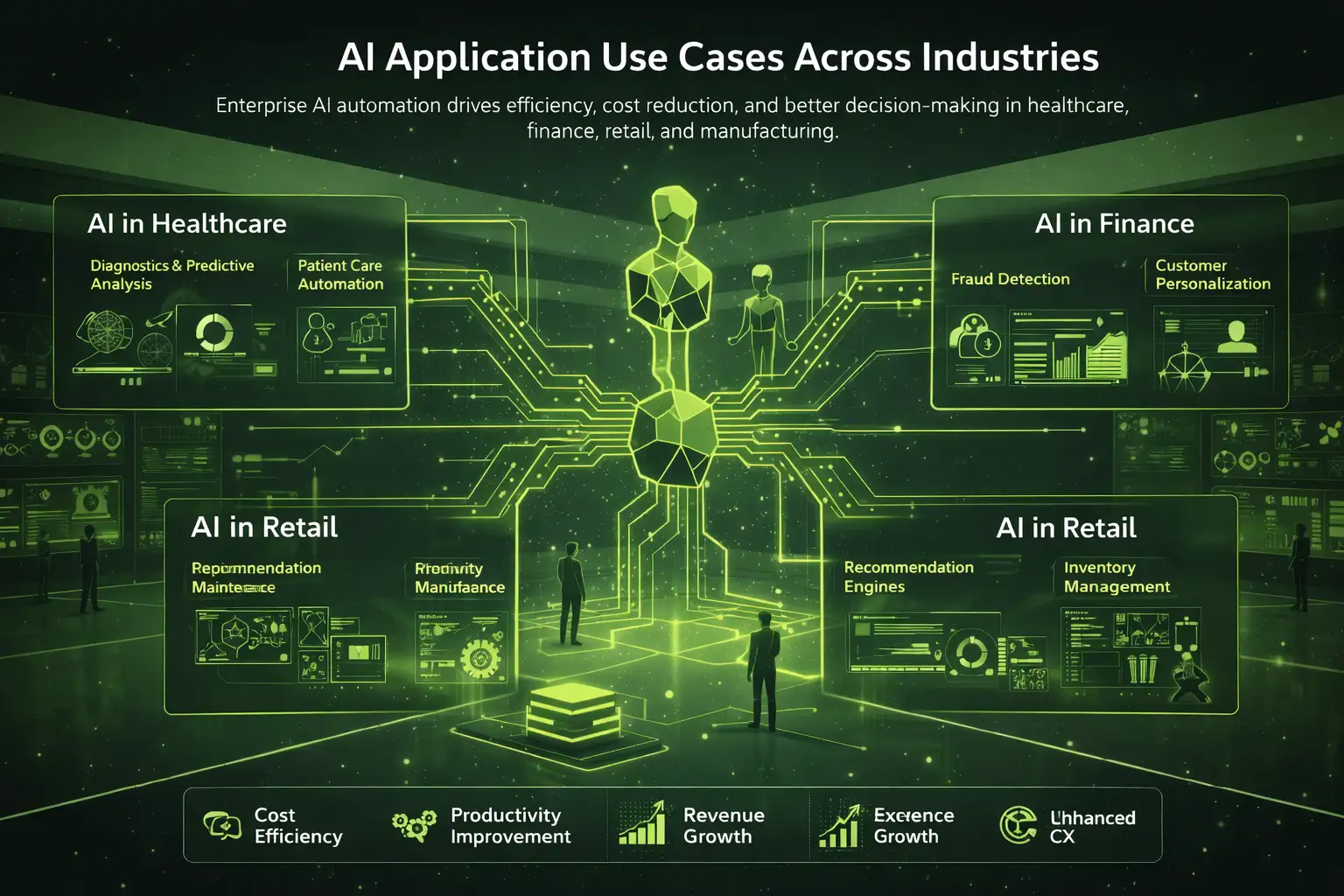
AI application use cases are no longer limited to experimental pilots or innovation labs. Across industries, organizations are deploying AI applications to automate processes, improve decision-making, and enhance customer experiences at scale. The shift from experimentation to execution is driven by clear business outcomes cost efficiency, productivity improvement, and revenue growth.
For enterprises, the real value of AI lies in applied, industry-specific use cases. When AI-driven solutions are aligned with operational goals, they become a core enabler of enterprise AI automation rather than a standalone technology initiative.
AI in Healthcare
Healthcare organizations operate in data-intensive environments where accuracy, speed, and efficiency directly impact outcomes. AI applications are increasingly used to support both clinical and operational functions.
Diagnostics & Predictive Analysis
In healthcare, predictive modeling enables earlier detection of diseases and identification of patient risk factors. By analyzing historical and real-time data, AI applications can uncover patterns that support faster and more informed clinical decisions.
Image recognition plays a key role in diagnostics by assisting clinicians in analyzing medical images and identifying abnormalities. These intelligent systems help reduce diagnostic errors, improve decision accuracy, and lower operational costs associated with delayed or incorrect diagnoses.
The result is improved care quality combined with greater cost efficiency across healthcare operations.
Patient Care Automation
Beyond diagnostics, AI applications are transforming patient care workflows. Intelligent systems automate scheduling, triage, and administrative processes that traditionally consume significant staff time.
Behavioral analytics supports patient monitoring by identifying patterns in patient behavior and engagement, enabling proactive care interventions. These AI-driven solutions improve productivity while enhancing patient experience management across healthcare services.
AI in Finance
The financial sector relies on trust, accuracy, and speed. AI application use cases in finance focus heavily on risk mitigation, personalization, and operational efficiency.
Fraud Detection
Fraud detection is one of the most mature AI use cases in finance. Pattern recognition enables real-time monitoring of transactions to identify anomalies and suspicious activity.
Predictive modeling supports risk assessment by evaluating transaction behavior against historical patterns. These AI applications help financial institutions reduce fraud-related losses, improve response times, and strengthen compliance operations—all contributing to enterprise-wide cost efficiency.
Customer Personalization
AI-driven solutions are also reshaping how financial institutions engage with customers. Sentiment analysis and behavioral analytics allow organizations to understand customer preferences, financial behavior, and engagement patterns.
By personalizing products, offers, and communication, financial institutions improve customer experience management while driving revenue growth through more relevant and timely interactions.
AI in Retail & E-commerce
Retail and e-commerce businesses operate in highly competitive environments where personalization and operational efficiency are critical. AI application use cases in this sector focus on customer engagement and supply chain optimization.
Recommendation Engines
Recommendation engines are a widely adopted AI application in retail. Using behavioral analytics and text analytics, AI-driven solutions personalize product suggestions based on customer behavior and preferences.
These intelligent systems improve customer experience management by making product discovery more relevant and seamless. As a result, businesses see higher engagement, increased conversion rates, and sustained revenue growth.
Inventory Management
Inventory management benefits significantly from predictive modeling and pattern recognition. AI applications analyze sales trends, seasonal patterns, and demand signals to optimize stock levels.
This form of business process optimization reduces overstocking and stockouts, improving operational efficiency while lowering inventory-related costs. Retailers gain better control over supply chains and improve overall cost efficiency.
AI in Manufacturing
Manufacturing environments demand reliability, precision, and efficiency. AI application use cases in manufacturing focus on operational continuity and supply chain intelligence.
Predictive Maintenance
Predictive maintenance uses applied AI to monitor equipment performance and detect early signs of failure. By identifying patterns in operational data, AI applications predict maintenance needs before breakdowns occur.
This approach reduces unplanned downtime, improves productivity improvement across facilities, and lowers maintenance costs. Manufacturers benefit from more stable operations and better asset utilization.
Supply Chain Optimization
AI-driven solutions also support supply chain optimization by enabling intelligent planning and forecasting. Predictive modeling helps manufacturers balance supply and demand while adapting to disruptions.
Intelligent systems provide real-time decision support across procurement, logistics, and distribution. This level of enterprise AI automation improves responsiveness, reduces inefficiencies, and supports scalable operations.
Cross-Industry Business Impact of AI Application Use Cases
Across industries, AI application use cases deliver consistent business value when applied strategically. While implementations differ, the outcomes often align around the same core benefits:
- Improved cost efficiency through automation and optimization
- Revenue growth driven by personalization and smarter decision-making
- Productivity improvement by reducing manual effort
- Enhanced customer experience management through intelligent interactions
As organizations mature in their AI adoption, many move from isolated use cases toward broader initiatives that involve AI application development strategies aligned with long-term business goals.
Turning AI Use Cases into Business Value
AI application use cases demonstrate how intelligent systems move beyond theory into measurable impact. When organizations focus on applied AI and industry-specific challenges, AI becomes a driver of operational excellence rather than a standalone technology investment.
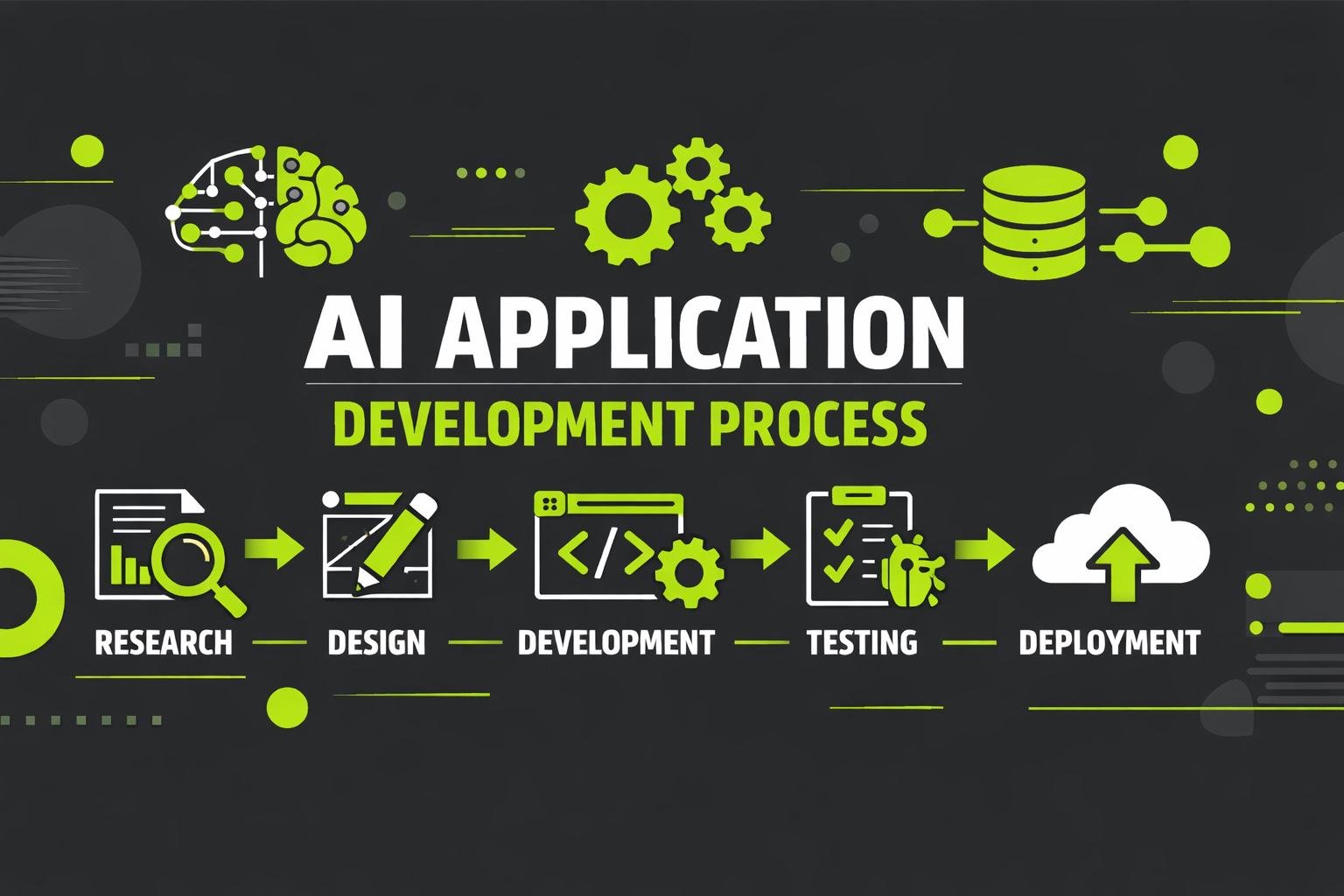
For enterprises ready to scale these initiatives, aligning use cases with custom AI application development ensures solutions are tailored to real business needs and can evolve over time. Understanding how individual use cases fit into the broader AI app development process helps organizations move from experimentation to sustainable, enterprise-wide adoption.
Frequently Asked Questions
AI application use cases are practical scenarios where AI applications are applied to solve business problems, such as fraud detection, predictive maintenance, customer personalization, and process automation across industries.
Industries with large data volumes and complex operations such as healthcare, finance, retail, and manufacturing. Benefit the most from AI-driven solutions due to their potential for automation and optimization.
AI applications improve efficiency by automating repetitive tasks, identifying patterns in data, and supporting faster, more accurate decision-making. This leads to cost efficiency and productivity improvement.
While large enterprises often adopt AI at scale, mid-sized businesses can also benefit from applied AI solutions focused on specific operational challenges or customer-facing processes.
Organizations typically start with focused AI use cases and expand them over time. As systems mature, AI becomes embedded across workflows, enabling broader enterprise AI automation and long-term business value.