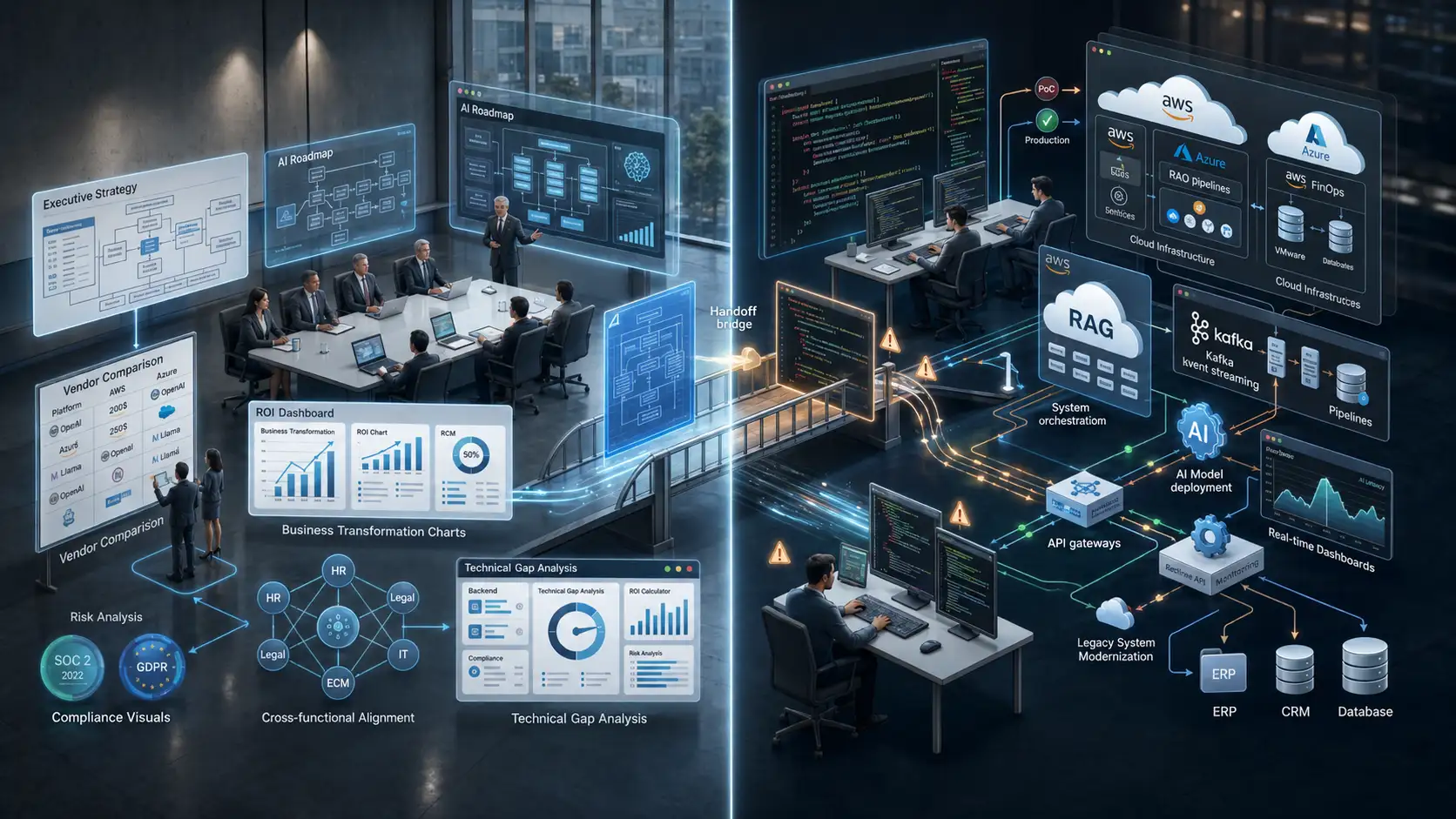

AI application development is no longer a “nice-to-have” capability reserved for tech giants. It has become a practical growth lever for B2B companies and agencies that need faster decision-making, streamlined operations, and smarter customer experiences. The difference today is that AI isn’t just a research concept, it’s deployable inside real enterprise software, connected to data pipelines, running on cloud platforms and governed by security and compliance standards.
This guide breaks down what AI application development means, how AI-powered applications work, where they deliver value, how to build them step by step, and how to estimate cost, timeline, and ROI. If you’re a B2B agency planning to deliver custom AI software for clients or a business evaluating enterprise AI solutions this is your end-to-end foundation.
What is AI Application Development?
AI application development is the practice of designing, building, and deploying software applications that can learn from data, recognize patterns, make predictions, automate decisions, or generate outputs that mimic human-like reasoning. Unlike traditional enterprise software that follows fixed rules, AI-powered applications adapt based on data and improve over time.
For agencies, AI app development is often the difference between delivering “digital transformation” as a buzzword and delivering measurable results like reduced operational costs, increased automation, faster analytics, and better customer targeting.
Definition of AI Application Development
AI application development refers to creating software that uses Artificial Intelligence methods such as Machine Learning (ML) and Deep Learning (DL) to perform tasks traditionally requiring human intelligence like classification, forecasting, anomaly detection, personalization, language understanding, or computer vision.
Unlike off-the-shelf tools, custom AI application development allows organizations to build solutions tailored to proprietary data, internal workflows, and specific enterprise objectives.
In practice, it usually includes:
- Business logic (what the app does)
- Data pipelines (how data is collected, cleaned, and delivered to AI components)
- AI models (ML/DL algorithms trained to perform a specific task)
- Deployment infrastructure (cloud platforms, APIs, and monitoring systems)
- Governance and AI ethics (how decisions are managed, audited, and made trustworthy)
When organizations say they want “custom AI software,” they typically mean a system that:
- integrates into existing enterprise software and workflows,
- uses proprietary data, and
- produces outcomes aligned with business automation goals.
How AI Applications Work
An AI-powered application works like a loop data flows in, intelligence happens, actions happen, and outcomes feed back into improvements. While implementations vary, most AI application architectures follow a predictable structure:
- Data Ingestion
- Data is pulled from sources like CRMs, ERPs, customer interactions, IoT devices, logs, documents, or third-party APIs.
- A reliable data pipeline ensures consistency, access control, and freshness.
- Data is pulled from sources like CRMs, ERPs, customer interactions, IoT devices, logs, documents, or third-party APIs.
- Data Preparation
- Raw data is cleaned, standardized, labeled (if needed), and transformed into features AI models can learn from.
- This step often decides success or failure more than the model choice itself.
- Raw data is cleaned, standardized, labeled (if needed), and transformed into features AI models can learn from.
- Model Training or Adaptation
- A Machine Learning or Deep Learning model is trained using historical data.
- Tooling frequently includes Python, with frameworks like TensorFlow and PyTorch.
- A Machine Learning or Deep Learning model is trained using historical data.
- Inference (Decision/Prediction)
- The trained model runs on new data to produce outputs like predictions, classifications, or recommendations.
- This can happen in real-time (e.g., fraud detection) or batch mode (e.g., weekly demand forecasts).
- The trained model runs on new data to produce outputs like predictions, classifications, or recommendations.
- Integration into the Application
- AI outputs are delivered through APIs or embedded components within enterprise software.
- This is where AI becomes “usable,” not just “accurate.”
- AI outputs are delivered through APIs or embedded components within enterprise software.
- Monitoring, Feedback, and Continuous Improvement
- Performance is tracked for accuracy, drift, latency, bias, and failures.
- Models are retrained or refined as data and business needs evolve.
- Performance is tracked for accuracy, drift, latency, bias, and failures.
This lifecycle is what separates a one-off AI demo from a production-grade enterprise AI solution. Many enterprises partner with specialized teams offering AI Application Development services to ensure their solutions are scalable, secure, and aligned with long-term business automation goals.
Benefits of AI-Powered Applications
For B2B and agencies, AI application development is valuable when it drives measurable outcomes: saving time, improving decisions, reducing waste, or enabling new services. The strongest AI application use cases are typically tied to high-volume processes, complex decision-making, or environments where humans struggle to scale.
Increased Efficiency and Automation
AI-powered applications accelerate workflows by automating tasks that are repetitive, time-consuming, or error-prone. This includes both “front office” automation (customer-facing) and “back office” automation (operations).
Where AI-driven efficiency shows up most:
- Automated document processing (invoices, contracts, claims)
- Smart routing (tickets, leads, support issues)
- Predictive maintenance scheduling in industrial settings
- Workflow automation inside enterprise software platforms
- Real-time anomaly detection that eliminates manual monitoring
For agencies, this is the easiest benefit to position because it ties directly to business automation and cost reduction. Clients often don’t need “AI”, they need faster operations and fewer bottlenecks.
Improved Decision Making with AI Insights
The second major benefit is decision intelligence. AI reveals patterns humans can’t see quickly, consistently, or at scale. Instead of relying on gut instinct or static dashboards, organizations can use AI to predict outcomes, quantify risk, and recommend next-best actions.
Common decision upgrades:
- Forecasting revenue, demand, churn, or operational capacity
- Identifying high-value customer segments or behaviors
- Detecting fraud, compliance risks, or unusual activity
- Optimizing pricing, inventory, and supply chain decisions
This is especially powerful in B2B environments where one “better decision” can impact large contracts, long sales cycles, or expensive operational outcomes.
Cost Reduction and ROI Benefits
AI application development can reduce costs in multiple ways:
- Labor cost reduction through automation of repetitive work
- Lower error rates leading to fewer refunds, rework cycles, or compliance penalties
- Operational optimization that reduces waste (inventory, energy, machine downtime)
- Higher conversion and retention via personalization and smarter targeting
ROI is usually strongest when AI is deployed in areas with:
- high transaction volume,
- expensive mistakes,
- or measurable cost leakage.
A practical approach is to focus ROI conversations on 3 metrics:
- Time saved (hours reduced per week/month)
- Cost avoided (errors, downtime, waste, fraud)
- Revenue improved (conversion, retention, upsell)
When agencies position AI projects with measurable ROI, the buying decision becomes easier and budgets become more defensible.
AI Application Use Cases Across Industries
AI is not one-size-fits-all. The best AI application use cases vary by industry, data maturity, and business priorities. Below are examples that align well with enterprise adoption high-value, repeatable, and measurable.
Healthcare
Healthcare has high data density, high stakes, and complex operational workflows making AI incredibly valuable when applied responsibly and ethically.
High-impact AI-powered applications in healthcare:
- Medical imaging assistance (detecting anomalies in X-rays, MRIs, CT scans)
- Clinical decision support (risk scoring, early warning systems)
- Patient triage and scheduling optimization
- Claims and billing automation
- Personalized patient engagement via AI assistants
Because healthcare is heavily regulated, security, compliance, and AI ethics play a larger role than in many other industries. Successful healthcare AI solutions typically emphasize transparency, auditability, and rigorous data governance.
Finance
Finance is one of the earliest adopters of Machine Learning due to the need for risk management, fraud prevention, and personalization at scale.
Common enterprise AI solutions in finance:
- Fraud detection and anomaly monitoring in real-time transactions
- Credit scoring and underwriting optimization
- Anti-money laundering (AML) pattern detection
- Customer personalization and product recommendations
- Automated customer support for banking and insurance
Finance organizations often prioritize explainability and compliance. Even if a model is accurate, stakeholders may require clear reasoning behind decisions especially where regulatory requirements exist.
Retail & E-commerce
Retail and e-commerce AI is often ROI-driven because small improvements in conversion, pricing, and supply chain can produce massive results at scale.
Popular AI-powered applications:
- Product recommendation engines
- Demand forecasting and inventory optimization
- Dynamic pricing models
- Customer segmentation and churn prediction
- Visual search and product discovery
- Customer support automation using AI assistants
For agencies, retail is often a good entry point because the data is abundant, outcomes are measurable, and stakeholders are open to experimentation as long as improvements are tied to revenue.
Manufacturing
Manufacturing uses AI to reduce downtime, optimize throughput, and detect issues earlier than humans can. It’s often closely linked to IoT and operational data pipelines.
High-value manufacturing AI application use cases:
- Predictive maintenance (forecasting equipment failures)
- Quality inspection using computer vision
- Production optimization (reducing bottlenecks)
- Supply chain forecasting
- Energy and resource optimization
These solutions typically require strong integration with legacy systems and operational technology. That’s where agencies and AI consulting services can differentiate by making AI work inside existing enterprise environments rather than forcing a complete rebuild.
AI Application Development Process – Step by Step
A repeatable AI app development process is what turns “AI potential” into production value. While every project differs, the steps below are the most common pattern for building custom AI software that works reliably in enterprise settings.
Requirement Analysis
This stage defines what the AI application should do and why it matters. It also prevents the most common failure: building a model that performs well technically but solves the wrong business problem.
Key outputs of requirement analysis:
- The business objective (e.g., reduce churn by 10%, cut processing time by 40%)
- The AI task type (classification, forecasting, recommendation, NLP, vision)
- Success metrics (accuracy alone isn’t enough tie to business KPIs)
- Constraints (latency limits, security requirements, compliance, integrations)
- Data availability assessment (what data exists, where it lives, how clean it is)
Agencies should treat this as a paid discovery phase whenever possible. Strong requirement analysis reduces scope creep and makes cost/timeline more predictable.
Data Collection & Preparation
This is often the most time-consuming phase because AI depends on data quality. Even the most advanced Deep Learning approach will fail if the data pipeline is unstable or the data is incomplete.
Core activities include:
- Identifying sources (databases, enterprise software, third-party data, logs, documents)
- Building ingestion and validation pipelines
- Cleaning and transforming data
- Labeling (for supervised learning)
- Managing privacy, access control, and compliance
A strong data foundation often includes:
- Versioned datasets
- Data quality checks
- A reproducible preprocessing workflow
- Secure storage aligned to enterprise needs
For many B2B clients, this phase is where AI consulting services deliver major value: helping organizations operationalize their data pipelines.
Model Development & Testing
Model development is where ML/DL expertise matters but it’s only one piece of the system. The right model depends on business requirements, data type, and operational constraints.
Common tools and frameworks:
- Python for development and experimentation
- TensorFlow and PyTorch for Deep Learning workflows
- Traditional ML libraries (often used alongside DL depending on complexity)
Testing should include more than accuracy:
- Performance across segments (bias/fairness checks)
- Robustness to data drift and missing values
- Latency and throughput tests for production readiness
- Security considerations (model extraction risks, adversarial input concerns)
A practical development approach is to start with a baseline model, measure results, then iterate. This creates momentum and avoids spending months building a “perfect model” before validating business value.
Deployment & Integration
Deployment is where many AI projects struggle because production systems are different from notebooks. The model must run reliably, securely, and at scale often inside complex enterprise software ecosystems.
Deployment decisions include:
- Hosting on cloud platforms or on-prem (depending on compliance)
- Serving predictions through APIs or embedded services
- Monitoring for performance, drift, and failures
- Integrating outputs into workflows (dashboards, automation triggers, alerts)
A production-ready AI application needs:
- Observability (logs, metrics, alerts)
- Model versioning and rollback strategies
- Access control and auditability
- Clear integration points for enterprise workflows
For agencies building enterprise AI solutions, deployment and integration quality is often the differentiator between “pilot project” and “long-term contract.”
Maintenance & Continuous Improvement
AI applications are living systems. Real-world data changes. Customer behavior shifts. Market conditions evolve. If you don’t monitor and improve, model performance will degrade.
Maintenance typically includes:
- Continuous monitoring for drift and anomalies
- Regular retraining schedules or event-driven retraining
- Updating pipelines when data sources change
- Governance and compliance audits
- Refining the user experience based on feedback
This phase is also where recurring revenue opportunities exist for agencies: managed AI services, model monitoring, ongoing optimization, and continuous delivery.
AI vs Traditional Software Applications
AI doesn’t replace traditional software; it complements it. The key is knowing when AI adds value and when rules-based logic is still the best option.
Key Differences Between AI and Traditional Software
Traditional software:
- Follows explicit rules written by developers
- Produces predictable outputs for predictable inputs
- Works best for structured workflows with stable requirements
- Is easier to test deterministically
AI-powered applications:
- Learn patterns from data rather than relying only on rules
- Make probabilistic predictions (not always “right/wrong” in a simple way)
- Improve (or degrade) over time depending on data and monitoring
- Require data pipelines, model governance, and continuous iteration
In enterprise settings, the best solutions often combine both:
- Traditional logic handles core workflow control and business rules
- AI handles uncertainty, prediction, automation, and pattern recognition
Understanding the differences between AI vs traditional software applications helps decision-makers avoid overengineering solutions where rules-based systems are still sufficient.
When to Choose AI Over Traditional Solutions
AI is usually the right choice when:
- Rules become too complex to maintain
- The problem involves pattern recognition (vision, language, anomalies)
- You need forecasting or predictive decision-making
- The volume of work is too high for manual processing
- The environment changes frequently and static logic fails
Traditional software is better when:
- The process is stable and rules are clear
- You need deterministic behavior with zero tolerance for variance
- Data is limited or unreliable
- Compliance requires strict rule-based transparency (in some cases)
For agencies, a strong selling point is helping clients choose wisely. Not every “AI idea” needs AI. Being honest about that builds trust and better long-term relationships.
Challenges in AI Application Development
AI application development comes with unique challenges that don’t exist in typical software projects. Many organizations underestimate the challenges in AI application development, particularly around data readiness, system integration, and long-term model governance.
Data Quality & Availability Issues
Data is the fuel for AI. Poor-quality data leads to poor outcomes, even with advanced models.
Common data challenges:
- Missing values, inconsistent formats, duplicates
- Data stored in silos across tools and departments
- Low volume of labeled data for supervised learning
- Biased or unrepresentative data
- Privacy restrictions that limit usage
Mitigation strategies:
- Start with a data audit during discovery
- Build robust data pipelines with validation
- Use human-in-the-loop workflows for labeling and quality checks
- Design for data governance and secure access from day one
Agencies that can guide clients through data maturity improvements often become strategic partners rather than short-term vendors.
Integration with Existing Systems
Enterprise environments rarely allow “greenfield” builds. Most AI projects must integrate with existing enterprise software CRMs, ERPs, data warehouses, legacy databases, and operational tools.
Integration challenges include:
- Inconsistent APIs and data formats
- Security and access control constraints
- Latency requirements for real-time AI decisions
- Legacy systems that weren’t built for AI
The solution is strong architecture:
- Clear API boundaries
- Event-driven or batch pipelines where appropriate
- Scalable cloud platforms (or hybrid architectures if needed)
- Reliable monitoring and observability
This is also where a company like Mindrind can naturally position value helping organizations deploy AI inside real enterprise workflows, not just as a disconnected proof-of-concept.
Security & Compliance Concerns
AI introduces new security and compliance considerations:
- Sensitive data exposure in training datasets
- Access control for models and outputs
- Risks of model inversion or extraction attacks
- Regulatory concerns (industry-specific)
- Bias and fairness concerns tied to AI ethics
Best practices include:
- Encrypting data at rest and in transit
- Role-based access control and audit logs
- Governance frameworks for model approvals
- Regular security testing and compliance reviews
- Transparent reporting around AI performance and limitations
For B2B clients, addressing these concerns early shortens procurement cycles and builds executive confidence.
How to Choose the Right AI Application Development Partner
For agencies and B2B decision-makers, choosing AI application development company is often the most important decision in the project. AI is not only about building a model, it’s about building a production system that delivers outcomes.
Evaluating AI Development Companies
When evaluating AI development partners, look beyond portfolio screenshots. Focus on evidence of real production delivery:
What strong AI development companies demonstrate:
- Clear AI app development process (discovery → data → model → deployment → monitoring)
- Experience integrating with enterprise software ecosystems
- Knowledge of cloud platforms and scalable deployment
- Ability to design and maintain data pipelines
- Understanding of AI ethics, compliance, and security
- Case studies with measurable ROI metrics
A good partner should be comfortable discussing outcomes, tradeoffs, and long-term maintenance not just model accuracy.
Questions to Ask Before Hiring
Ask questions that reveal execution maturity:
Data & feasibility
- What data do we need, and how will you assess readiness?
- How do you handle missing or low-quality data?
- What’s your approach to data pipelines and governance?
Model development
- How do you choose between ML vs Deep Learning?
- Will you use TensorFlow or PyTorch and why?
- How do you test models beyond accuracy?
Deployment
- How will the AI integrate with our existing systems?
- How do you handle monitoring, drift detection, and retraining?
- What security controls are included?
Delivery
- What does the project roadmap look like?
- What dependencies do you need from our team?
- What do you need for long-term success after launch?
A trustworthy partner answers these clearly, without hiding behind vague promises.
Cost Considerations
Cost should reflect scope, complexity, and long-term needs not just “model building.” Many AI projects become expensive because discovery is skipped and assumptions fail later.
Key cost drivers include:
- Data engineering effort (often the largest hidden cost)
- Complexity of integrations with enterprise systems
- Real-time vs batch processing requirements
- Compliance and security requirements
- Maintenance and continuous improvement plans
For agencies reselling AI services, having a partner that provides transparent pricing and clear scope boundaries helps protect margins and client satisfaction.
Cost & Timeline of AI Application Development
Costs and timelines vary widely, but you can estimate them reliably by understanding scope components and risk factors. The biggest mistake is assuming AI app development is like traditional software where features are the main variable. In AI, data readiness and model uncertainty often drive the schedule.
Factors Affecting Cost
Here are the most common factors that affect the cost of AI application development:
- Use case complexity
- Simple classification with clean data is cheaper than multi-modal deep learning solutions.
- Data readiness
- If data pipelines exist and data is clean, costs drop.
- If data is scattered, inconsistent, or unlabeled, costs rise.
- Model requirements
- Some use cases need explainability and governance.
- Others need real-time inference with tight latency constraints.
- Integration depth
- Standalone AI tools are cheaper than embedded enterprise AI solutions integrated with ERP/CRM workflows.
- Security and compliance
- Heavily regulated industries add audit, governance, and security layers.
- Maintenance expectations
- Ongoing monitoring, retraining, and optimization adds recurring costs but protects long-term ROI.
As a rule, production-grade custom AI software is rarely just a “one-time build.” Accurately estimating AI application development cost requires evaluating data complexity, integration depth, security requirements, and ongoing maintenance needs rather than focusing only on initial build expenses.
Typical Timeline for AI App Development
A realistic AI app development process often looks like this:
- Requirement analysis: 2–4 weeks
- Data collection & preparation: 4–10 weeks (can be longer if data is messy)
- Model development & testing: 4–8 weeks
- Deployment & integration: 3–8 weeks
- Maintenance & improvement: ongoing (monthly/quarterly cycles)
So, an initial production launch often falls in the range of 10–24 weeks, depending on complexity and data maturity. Agencies should frame this as “time to first value” plus iteration cycles, rather than treating launch as the finish line.
ROI Estimation and Budget Planning
ROI planning should be tied to measurable outcomes from the beginning. A simple ROI estimation framework:
- Calculate current cost
- Manual hours spent
- Cost per error
- Lost revenue due to slow decision-making or poor targeting
- Estimate improvement
- Automation percentage
- Error reduction rate
- Conversion/retention uplift
- Translate into dollars
- Hours saved × cost/hour
- Error reductions × average cost per incident
- Revenue lift × average customer value
- Compare against total cost
Include:
- Development + deployment
- Cloud infrastructure
- Maintenance and monitoring
- Ongoing AI consulting services if required
For agencies, ROI framing is also a powerful sales asset. When you can clearly map a budget to measurable impact, you not only reduce procurement friction but also significantly speed up approvals.
Final Thoughts
AI application development is not about chasing trends it’s about building intelligent, data-driven systems that improve how businesses operate. The strongest AI-powered applications combine robust data pipelines, well-tested models, secure deployment, and a clear plan for continuous improvement.
For B2B agencies, this pillar topic is also a strong growth opportunity. As more companies increasingly demand enterprise AI solutions, agencies that can deliver or strategically partner with experts who do are far more likely to secure higher-value contracts and long-term retainers.
If your goal, therefore, is to turn AI into a scalable client offering whether through full delivery or a strategic partnership then focus on building repeatable processes, prioritizing ROI driven use cases, and implementing production ready engineering from day one. That’s how AI stops being a concept and becomes a competitive advantage.
Frequently Asked Questions
AI application development is most valuable for businesses that handle large volumes of data, repetitive workflows, or complex decision-making. Enterprises in healthcare, finance, retail, manufacturing, and SaaS often benefit the most because AI-powered applications can automate operations, improve forecasting accuracy, and enhance customer experiences at scale.
The timeline depends on data readiness, use case complexity, and integration requirements. In most enterprise scenarios, an initial production-ready AI application can take anywhere from 10 to 24 weeks, including discovery, data preparation, model development, deployment, and testing. Ongoing optimization typically continues after launch.
No. While Machine Learning and Deep Learning are core components, AI application development also includes data pipelines, system architecture, cloud deployment, security controls, monitoring, and integration with existing enterprise software. The model is only one part of a larger production system.
ROI is usually calculated by measuring time savings, cost reductions, error reduction, or revenue improvements enabled by AI automation or predictive insights. Successful projects define ROI metrics early, such as reduced processing hours, lower operational costs, or improved conversion and retention rates.
Yes. Most enterprise AI solutions are designed to integrate with CRMs, ERPs, data warehouses, and other legacy systems using APIs and data pipelines. Proper integration ensures AI insights are embedded directly into business workflows rather than operating as standalone tools.
The most common risks include poor data quality, unclear business objectives, weak system integration, and lack of ongoing monitoring. Addressing governance, security, and AI ethics early in the process significantly reduces long-term operational and compliance risks.